
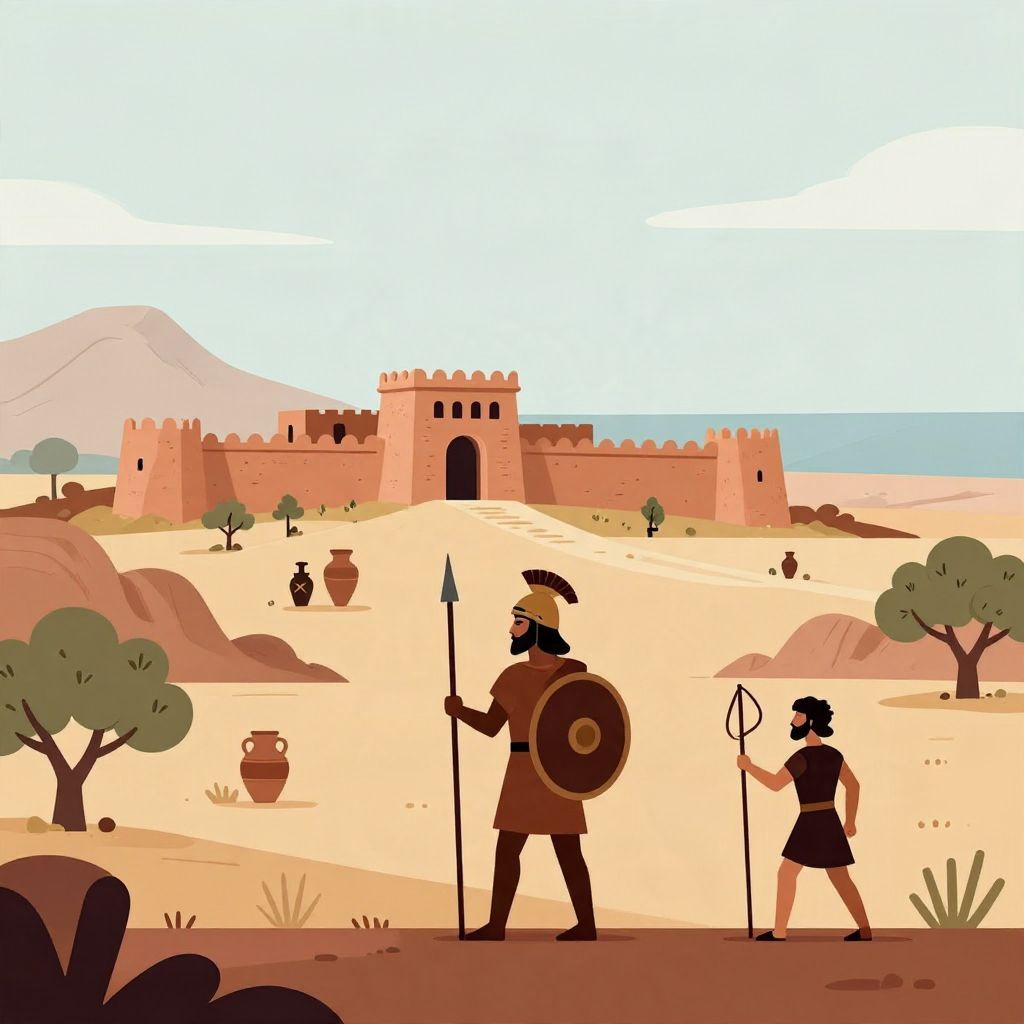
Where was Goliath from? The short answer is that the Bible places Goliath in Gath, one of the major Philistine cities in the southern Levant. In the story of David and Goliath, he is presented as a Philistine champion who fought on behalf of the Philistines against Israel in the early Iron Age.
That answer sounds simple, but the historical background is more nuanced. Goliath belongs to a narrative shaped by ancient Israelite memory, Philistine identity, and later biblical interpretation. Understanding where he was “from” means looking at both the text and the world of the eastern Mediterranean around the 11th to 10th centuries BCE.
Where Was Goliath From?
Goliath was from Gath, according to the biblical account in 1 Samuel. Gath was one of the five major Philistine city-states, located in the southern Levant, likely in the area of today’s Israel or near the border region with the West Bank. In the story, Goliath is a Philistine warrior representing that coastal people.
What the Bible Says About Goliath’s Origin
The clearest textual answer comes from the Hebrew Bible. Goliath is identified as “the Philistine of Gath,” which places him in a specific city rather than in a vague ethnic category alone. The narrative presents him as a military champion, not a king or ruler, and as a symbol of Philistine strength in conflict with Israel.
Gath in the biblical tradition
Gath appears several times in the Bible as a Philistine city. It is associated with powerful warriors and with the broader Philistine presence in the south of Canaan. The phrase “of Gath” is important because it ties Goliath to a known Philistine center rather than treating him as a generic enemy.
Why this matters historically
For historians, this detail helps locate the story in the geography of the Iron Age Levant. It also suggests that the author or final editor of the story knew Gath as a real place in the regional landscape, even if the narrative itself is shaped by theology, national memory, and literary tradition.
Where Was Gath?
Gath was one of the principal Philistine cities in the southern Levant, alongside Gaza, Ashkelon, Ashdod, Ekron, and possibly another center depending on how the list is counted. Its exact archaeological identification has been debated, but many scholars associate it with Tell es-Safi in modern Israel.
The geography of the Philistine cities
The Philistines settled mainly along the coastal plain after the collapse of Late Bronze Age political systems, around the 12th century BCE. Their cities formed a network of urban centers with strong connections to the Mediterranean world. Gath sat inland compared with some of the coastal cities, giving it strategic value in regional conflict.
Why Gath was important
Gath was not just a minor village. It was a significant Philistine stronghold and, at times, a major power in the region. That makes it a plausible setting for a legendary warrior figure in later Israelite tradition. A champion from Gath would have represented one of Israel’s most formidable neighbors.
Who Were the Philistines?
The Philistines were a people who settled in the southern coastal region of Canaan during the early Iron Age. They are often linked by scholars to the broader “Sea Peoples” phenomenon, though that connection is still debated in detail. By the time of the David and Goliath story, they were established as a distinct regional power.
Philistine identity in history
Philistine culture was not identical to that of the Israelites or the inland Canaanite groups. Archaeology shows influences from the Aegean and eastern Mediterranean, especially in pottery and some material culture, though the Philistines also adopted many local Levantine practices over time. Their identity was therefore mixed and evolving.
How the Bible portrays them
In biblical literature, the Philistines often serve as Israel’s major rivals during the period of the judges and early monarchy. They are depicted as militarily strong, technologically formidable, and politically organized. Goliath is one of the most famous literary expressions of that rivalry.
Was Goliath a Real Historical Person?
This is where the historical question becomes more complicated. Goliath is best known as a biblical figure, and there is no direct historical record proving that the specific warrior of 1 Samuel existed exactly as described. Many historians treat him as a legendary or semi-legendary character rooted in real Iron Age conflicts.
What can be said with confidence
- Goliath is presented in the Bible as a Philistine from Gath.
- Gath was a real Philistine city in the southern Levant.
- Philistine-Israelite conflict was a genuine feature of the Iron Age.
- The story likely reflects a historical memory shaped into a dramatic narrative.
What remains uncertain
We cannot verify Goliath’s personal biography in the way we might verify a later historical figure. The biblical account may preserve older traditions, but it also uses literary themes such as the underdog defeating the giant. That means historians distinguish between the historical setting and the story’s theological message.
Archaeology and the Question of Goliath’s Home
Archaeology has helped clarify the world in which the Goliath story emerged, even if it cannot confirm the individual himself. Excavations at sites associated with Philistine culture, especially Gath/Tell es-Safi, show a large and influential urban center in the right period. This supports the setting of the biblical tradition.
Tell es-Safi and Gath
Many archaeologists identify Tell es-Safi as ancient Gath because of its size, location, and finds from the Iron Age. The site shows evidence of a substantial settlement that fits the profile of a major Philistine city. That does not prove Goliath lived there, but it strengthens the historical plausibility of the tradition.
Material culture and regional power
Philistine cities were part of a competitive landscape of small kingdoms and city-states. Warfare, alliances, and border disputes were common. A story about a champion from Gath fits naturally into that environment, where individual warriors could symbolize the strength of an entire city or people.
The Broader Historical Background of Goliath’s Story
The David and Goliath episode is set during a time of political transition in the southern Levant. The old Bronze Age order had collapsed, new peoples and polities had emerged, and local kingdoms were forming. Israel and the Philistine cities were among the most important powers in this changing landscape.
Why the story became so famous
The Goliath narrative is memorable because it dramatizes a larger historical struggle: the contest between a rising Israelite monarchy and a powerful Philistine neighbor. Over time, the story became a symbol of faith, courage, and reversal of expectations. Its lasting power comes from both its historical setting and its literary force.
Goliath as a cultural symbol
In later tradition, Goliath came to represent more than a Philistine warrior. He became a symbol of overwhelming force, and David became the model of the unexpectedly victorious underdog. That symbolic life of the story is separate from the historical question of where he was from, but it explains why the tale endured.
So, Where Was Goliath From in Historical Terms?
Historically speaking, Goliath was from Gath, a major Philistine city in the southern Levant. The biblical text is explicit on this point, and archaeology supports the existence of a substantial Philistine urban center in that region. What remains uncertain is whether Goliath was a single historical warrior, a composite figure, or a legendary champion built from older memories.
In other words, the best evidence says Goliath belonged to the Philistine world of Iron Age Canaan, specifically Gath, but his exact personal history cannot be confirmed beyond the biblical tradition. That distinction is important: the place is historically grounded, while the individual remains partly in the realm of tradition and legend.
For readers interested in the wider setting, it can also help to learn more about where Canaan was and the broader ancient Near Eastern world that shaped the Goliath story.