
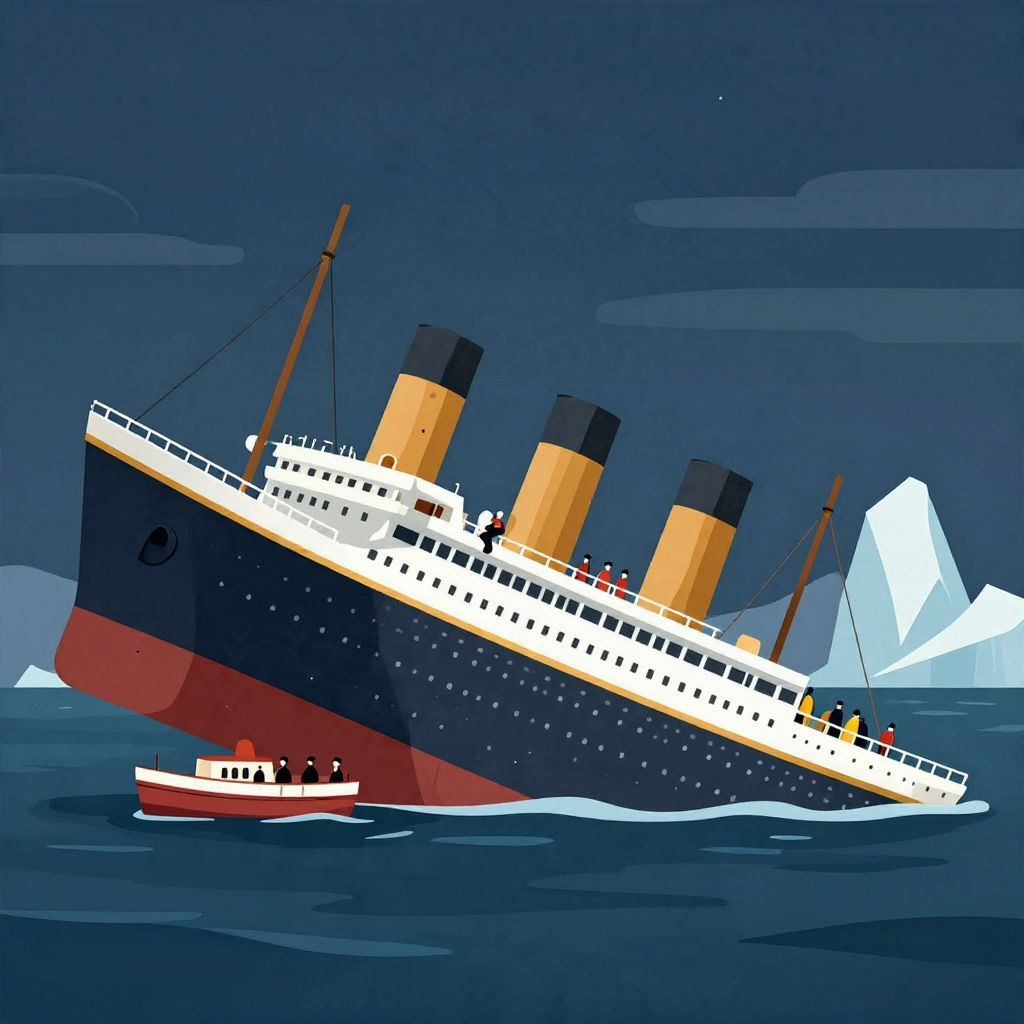
People still ask how long it took the Titanic to sink because the ship’s final hours became one of the most famous maritime disasters in history. The answer is both simple and tragic: after striking an iceberg late on the night of April 14, 1912, the Titanic sank about two hours and forty minutes later, in the early hours of April 15.
That short span helps explain why the disaster was so deadly. The ship was enormous, but the damage was fatal, the night was cold and dark, and there were not enough lifeboats for everyone aboard.
How Long Did It Take the Titanic to Sink?
The Titanic took about 2 hours and 40 minutes to sink after it collided with an iceberg at 11:40 p.m. on April 14, 1912. It disappeared beneath the North Atlantic at about 2:20 a.m. on April 15. That timeline is widely accepted by historians and survivors’ testimony, though exact minute-by-minute details can vary slightly in different accounts.
What Happened in Those 2 Hours and 40 Minutes?
The sinking was not immediate. After the collision, the ship remained afloat long enough for passengers and crew to try to understand the damage, launch lifeboats, and send distress calls. The problem was that the iceberg had opened several compartments to the sea, and the Titanic’s design could not survive that level of flooding.
The collision and the first minutes
The iceberg strike was relatively glancing rather than a head-on crash, which is one reason the ship did not break apart instantly. But the impact tore open the hull below the waterline. Water began entering multiple compartments, and the ship’s engineers and officers quickly realized the situation was serious.
Evacuation under pressure
As the hours passed, crew members began loading lifeboats. This process was slow at first because many passengers did not immediately grasp the danger. The Titanic was a luxury liner, and some people initially believed it could stay afloat until help arrived. In reality, the ship was already doomed.
The lifeboat launch was also complicated by confusion, cold weather, and the fact that there were far fewer lifeboat places than people on board. Even when boats were lowered, many left only partially filled at first, reflecting uncertainty about how much danger the ship was truly in.
The final plunge
As flooding worsened, the ship’s bow sank deeper and the stern rose higher. The Titanic eventually broke apart under immense structural stress, then slipped beneath the surface. The final moments were chaotic and catastrophic, with the ship’s lights reportedly going out shortly before it vanished.
Why Did the Titanic Sink So Quickly?
The Titanic did not sink in minutes, but it did sink faster than many people expected for such a large vessel. The main reason was that the iceberg damage was extensive enough to flood several compartments at once. The ship was designed to survive certain kinds of flooding, but not the scale of damage caused that night.
Flooding beyond the ship’s limits
The Titanic was built with watertight compartments, a modern feature for the time. However, the ship’s bulkheads did not extend high enough to contain the water once several forward compartments filled. As the bow settled lower, water spilled over the tops of the compartments and spread farther through the ship.
Design weaknesses and the limits of technology
Historians often explain the disaster as a combination of design, speed, and circumstance rather than a single failure. The ship was traveling quickly through an ice field at night, the lookout had limited visibility, and the available lifeboats were not enough for everyone. Even if the collision had been less severe, the Titanic’s safety systems were not prepared for a disaster of this scale.
A Simple Timeline of the Titanic’s Final Hours
The best way to understand how long it took the Titanic to sink is to follow the sequence of events from impact to disappearance.
- 11:40 p.m., April 14, 1912: The Titanic strikes an iceberg in the North Atlantic.
- Shortly after midnight: Crew and officers assess the damage and begin preparing lifeboats.
- After 12:00 a.m.: Distress signals are sent, and lifeboats start leaving the ship.
- 1:00 a.m. to 2:00 a.m.: Flooding worsens, the ship’s bow sinks lower, and the stern rises higher.
- About 2:20 a.m.: The Titanic disappears beneath the sea.
This timeline is approximate, but it captures the broad sequence agreed on by most historical accounts.
Did the Titanic Break in Half Before It Sank?
Yes. The Titanic appears to have broken apart before it went under completely. For many years, this detail was debated, but later evidence strongly supported the conclusion that the ship fractured during the final stage of sinking. The exact moment and mechanics are still studied, but the breakup is now accepted as part of the disaster.
The breakup mattered because it shows how immense the strain became on the ship’s structure as the stern lifted and the bow descended. It also helps explain why the sinking ended so violently after more than two hours of desperate effort.
How Many People Survived the Sinking?
About 700 people survived, while more than 1,500 died. The exact figures vary slightly depending on the source and how crew and passenger totals are counted, but the scale of loss is not in doubt. The tragedy was made worse by the cold water, the limited number of lifeboats, and the time it took for rescue ships to arrive.
Why survival depended on timing
Those who reached lifeboats early had the best chance of surviving. Once the ship had gone under, people left in the freezing Atlantic faced extreme danger from hypothermia. The short window between collision and sinking meant there was little room for error.
Why the Exact Time Matters in History
Knowing how long it took the Titanic to sink is more than a trivia fact. It helps historians understand the disaster as a sequence of decisions, technical limits, and human reactions. The 2 hour and 40 minute interval shows that the ship was not lost instantly; instead, there was a critical period in which better preparation, faster recognition, or more lifeboat capacity might have saved more lives.
The disaster also changed maritime safety. In the aftermath, governments and shipping authorities strengthened lifeboat requirements, improved radio watch procedures, and pushed for new international safety standards. The Titanic’s sinking became a turning point in how passenger ships were regulated.
The Historical Legacy of the Titanic’s Sinking
The Titanic remains famous not only because it sank, but because it sank in a way that exposed the limits of early 20th-century confidence in technology. The ship was celebrated as nearly unsinkable, yet the disaster revealed how quickly modern engineering could fail when design assumptions met real-world danger.
Its final 2 hours and 40 minutes have been studied ever since by historians, marine experts, and investigators. That time span captures the human drama of the event: shock, confusion, courage, and loss unfolding against the frozen Atlantic night.
So, the direct answer is clear: the Titanic took about 2 hours and 40 minutes to sink after hitting the iceberg. If you want to explore the disaster further, you may also be interested in how the Titanic broke in half and what time the Titanic hit the iceberg.