
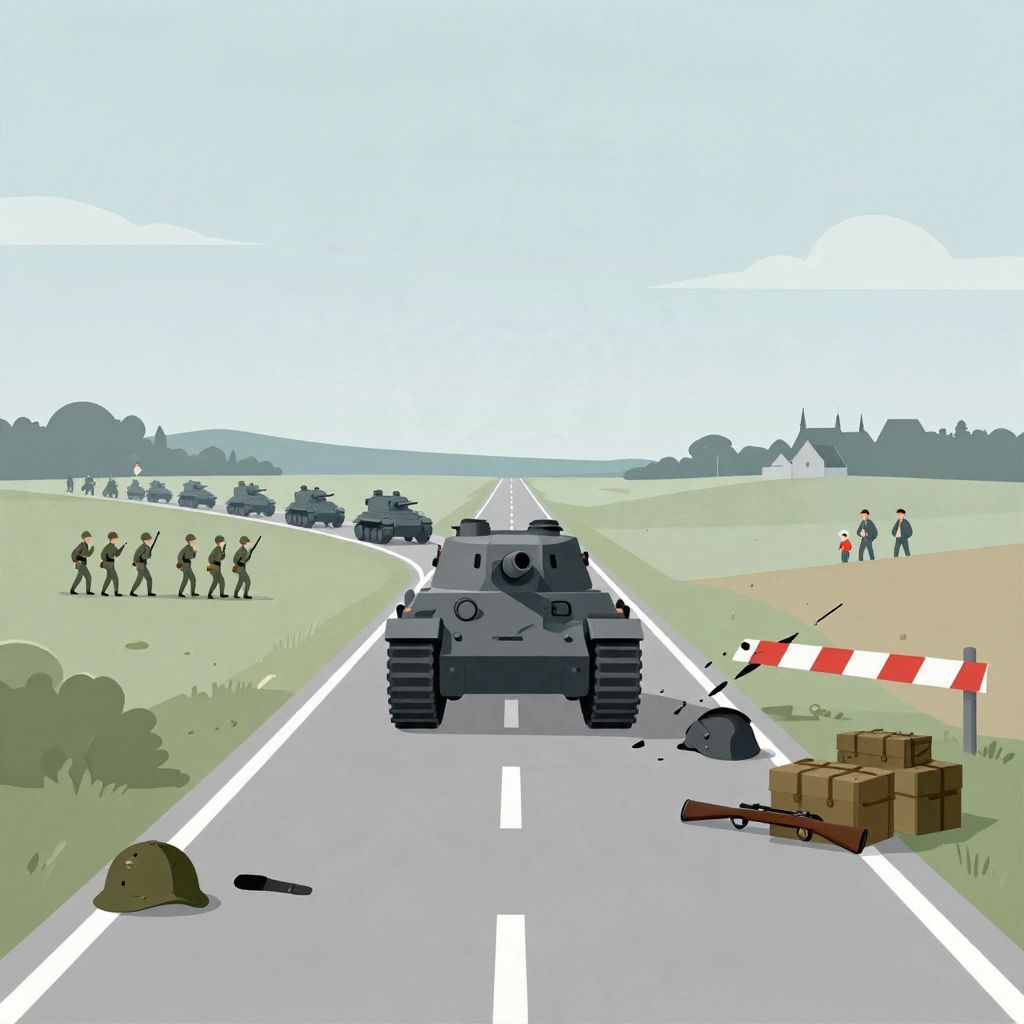
France’s defeat in 1940 was not simply a matter of “falling easily” to Nazi Germany. It was the result of a fast-moving German campaign, serious French strategic mistakes, and the collapse of Allied plans in the face of a war that had changed faster than many leaders expected.
France still had a large army, a powerful empire, and strong defenses on paper. But in May and June 1940, German forces used speed, surprise, air power, and armored warfare to break through the Ardennes, encircle Allied armies, and force an armistice in just six weeks.
Why Did France Fall So Easily to the Nazis?
France did not collapse because it was weak in every respect. It fell because German strategy outpaced French planning, the Allied command was slow to respond, and the decisive German breakthrough at Sedan shattered the front. Political divisions, poor coordination, and the shock of modern mechanized war turned a difficult defense into a rapid defeat.
The Strategic Background: France Before 1940
To understand the defeat, it helps to look at the interwar years. France emerged from World War I victorious but deeply scarred. The country had suffered enormous losses between 1914 and 1918, and many French leaders believed the next war would be won by defense, not offense. That outlook shaped military planning for two decades.
Fear of another slaughter
French society remembered the trenches of World War I. The army and political leadership expected a long, attritional war and wanted to avoid another catastrophic frontal battle. This encouraged a cautious military culture and a preference for fixed defenses, mobilization plans, and careful coordination rather than bold maneuver.
The Maginot Line and defensive thinking
The Maginot Line, a chain of fortifications built along part of France’s eastern frontier, became a symbol of this defensive approach. It was not useless: it could delay an enemy and protect key sectors. But it also encouraged the belief that major attacks would come where the line was strongest. The problem was that Germany did not attack there in the decisive way French planners expected.
How the German Attack Worked
The German victory in 1940 depended on a campaign of speed and concentration. Rather than repeating the trench warfare of 1914–1918, Germany used combined arms tactics: tanks, motorized infantry, artillery, and air power working together to punch through weak points, exploit confusion, and move faster than the enemy could reorganize.
The Ardennes surprise
French and Allied planners believed the Ardennes region was too difficult for a major armored assault. It was wooded, hilly, and thought to be unsuitable for large tank formations. German forces under Army Group A crossed through this area anyway, then pushed toward the Meuse River. This was one of the most important strategic surprises of the campaign.
The breakthrough at Sedan
The crossing at Sedan in mid-May 1940 was decisive. German air attacks and artillery helped break French positions, and once the river line was breached, German armored units moved rapidly into the rear areas. The French command struggled to understand the scale of the attack and to mount an effective counterstroke before the Germans expanded the breach.
Speed and communications
German armored units were not just fast on the road; they also benefited from better battlefield coordination. Radios allowed commanders to adjust quickly, while French units often relied on slower communication systems and more rigid command procedures. In a fast-moving crisis, that difference mattered enormously.
French Military Weaknesses in 1940
France was not unarmed or undefended, but several military weaknesses made it vulnerable. Some were structural, while others were the result of doctrine and decision-making. The French army had tanks, artillery, and many capable soldiers, but it was not organized to respond effectively to the kind of war Germany launched.
Outdated doctrine and divided use of armor
French tanks were often technically strong, and some models were well armored. The problem was how they were used. Many were dispersed among infantry units instead of concentrated into powerful armored formations. German forces, by contrast, used tanks as the spearhead of a mobile offensive. France had machines; Germany had a system.
Command delays and rigid planning
The French high command was often slow to react. Once the German breakthrough occurred, French leaders faced uncertainty about where the main attack was and how far it would extend. Their plans were built for a more orderly battlefield than the one they encountered. In a crisis, delays in communication and decision-making proved costly.
Air power and battlefield shock
The German air force, the Luftwaffe, did not win the war alone, but it played a major role in creating panic, disrupting movement, and supporting the advance. Air attacks on roads, bridges, and troop concentrations added to the sense that the front was disintegrating. For soldiers and civilians alike, the psychological effect was severe.
The Allied Problem: France Did Not Fight Alone
France’s defeat was also an Allied defeat. Britain had sent the British Expeditionary Force, and Belgian and Dutch forces were involved in the early fighting. But the Allied plan depended on moving into Belgium to meet the German attack there. When the main German blow came through the Ardennes, the Allied deployment was already committed in the wrong direction.
The Dyle Plan and the trap
The Allied strategy assumed that Germany would attack through central Belgium, as in previous wars. French and British forces advanced northward to meet that expected assault. This left them stretched out and vulnerable when the Germans struck farther south. In effect, the Allies moved into a position that Germany had anticipated and exploited.
Coordination problems among allies
Coalition warfare is always difficult, and in 1940 it was especially so. French, British, Belgian, and Dutch forces had different priorities, command systems, and political pressures. Once the German offensive accelerated, coordination became harder, not easier. The result was confusion at the very moment unity was most needed.
Political and Psychological Factors Inside France
Military defeat alone does not explain why France asked for an armistice so quickly. Political crisis, fear of civil collapse, and the trauma of mass retreat all shaped the response. By June 1940, the French government faced a desperate choice: continue fighting from North Africa or seek terms on the mainland.
Division among French leaders
French political life in the 1930s had been unstable, with sharp conflicts between left and right, labor unrest, and anxiety over communism and fascism. These divisions did not cause the military defeat, but they weakened confidence in national unity. When the crisis came, leaders disagreed about whether France could or should keep fighting.
The shock of collapse
As German forces advanced, millions of civilians fled south in what became one of the largest refugee movements in French history. Roads clogged, communications broke down, and the visible signs of defeat spread rapidly. This mass exodus intensified the sense that the state was losing control. A military setback became a national panic.
The decision for an armistice
Marshal Philippe Pétain, a revered First World War figure, became the central voice for seeking an armistice. Supporters argued that continued resistance on French soil would bring more destruction. Opponents believed France should fight on from its empire or alongside Britain. The armistice of 22 June 1940 ended the campaign, but at the cost of occupation and the creation of the Vichy regime.
Was France “Easily” Defeated?
The phrase “fell easily” can be misleading. France was defeated quickly, but not because it lacked courage or military strength altogether. The campaign was short because Germany achieved operational surprise and rapidly exploited weaknesses in Allied planning. French resistance was real, but it was overwhelmed by the speed and coordination of the German offensive.
What historians emphasize
Historians generally point to several overlapping causes rather than one single explanation:
- Strategic surprise through the Ardennes and Sedan.
- German operational speed and concentrated armored warfare.
- French defensive doctrine shaped by World War I.
- Command and communication failures during the breakthrough.
- Allied misdeployment and poor coordination.
- Political shock and civilian panic as the front collapsed.
What France did well—and what that means
France was not a hollow shell. Many French units fought hard, and some local defenses delayed German advances. But bravery could not compensate for a strategic system that had been outmaneuvered. The defeat was therefore less a story of national weakness than of military and political systems failing under the pressure of a new kind of war.
The Aftermath: Occupation, Vichy, and Resistance
The fall of France transformed Europe. Northern and western France came under German occupation, while the Vichy regime governed the unoccupied zone in the south until 1942. The defeat also reshaped the wider war: Britain continued alone for a time, the Free French movement emerged under Charles de Gaulle, and France’s empire became a contested source of manpower and legitimacy.
Long-term consequences
France’s 1940 defeat had consequences far beyond the battlefield. It damaged confidence in prewar institutions, exposed the limits of static defense, and became a lasting lesson in the dangers of underestimating rapid mobile warfare. It also left a deep moral and political scar that shaped French memory long after liberation in 1944.
Conclusion
France did not fall because it was inherently weak; it fell because Germany found and exploited the weaknesses of an outdated defensive strategy, poor Allied coordination, and a command system unprepared for a lightning-fast campaign. The speed of the defeat was shocking, but the causes were military, political, and psychological rather than mysterious. For related World War II context, see why Hitler invaded the Soviet Union and how many Americans died on D-Day.