
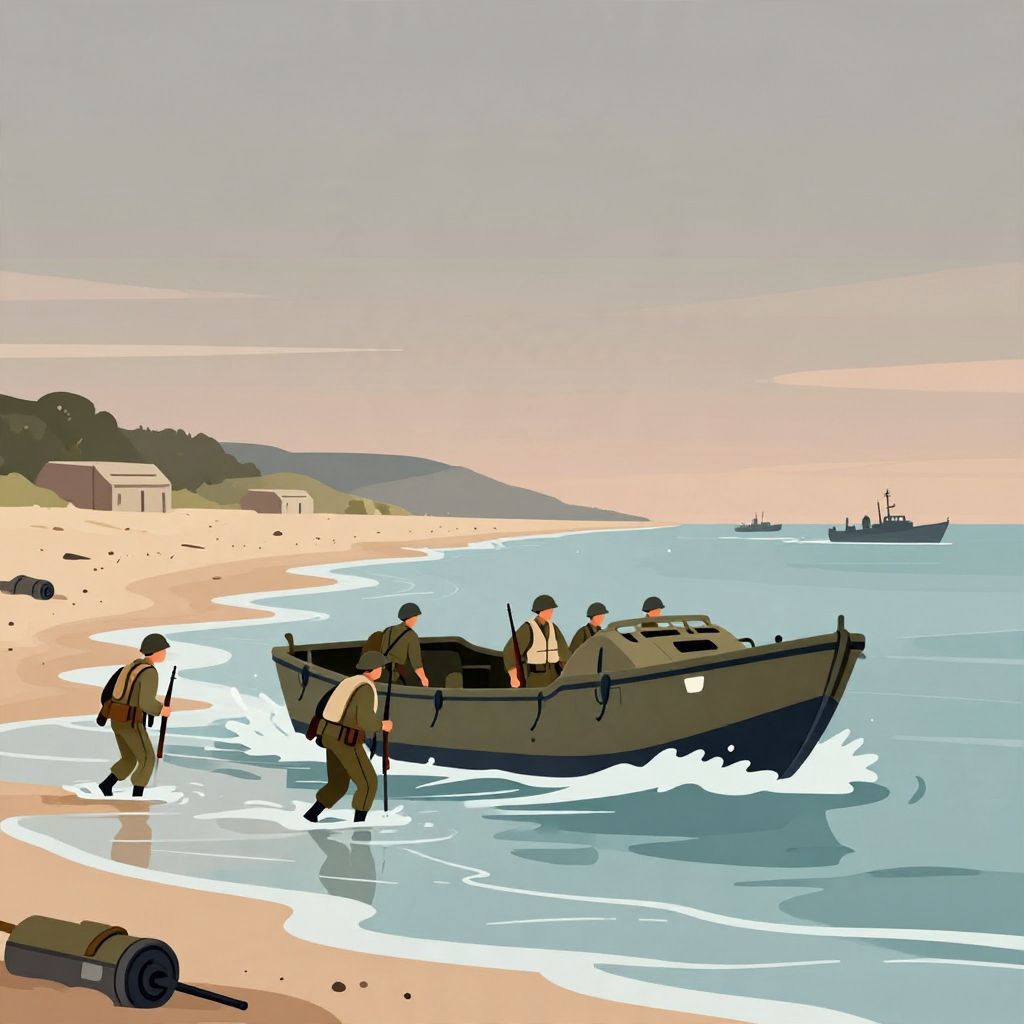
How many Americans died on D-Day? The most widely accepted answer is that about 2,500 American service members were killed during the Allied landings and fighting on 6 June 1944. That number is usually given as an estimate rather than an exact total, because records were compiled amid battle, confusion, and later revisions.
D-Day was the opening day of the Allied invasion of Normandy, the largest amphibious assault in history. American losses were especially heavy at Omaha Beach, where strong German defenses, rough seas, and difficult terrain made the landings far deadlier than planners had hoped.
How many Americans died on D-Day?
About 2,500 Americans were killed on D-Day, 6 June 1944. Historians commonly cite a range of roughly 2,500 to 2,500-plus because exact totals varied as reports were corrected, but the standard figure remains around 2,500 dead from the U.S. Army, Navy, and other American forces involved in the invasion.
Why the number is an estimate, not a perfectly fixed total
Battlefield records on D-Day were incomplete from the start. Units landed under fire, some men were reported missing before their fate was known, and casualty lists were revised after the fighting. In addition, historians sometimes separate killed in action from those who later died of wounds, which can slightly change how totals are presented.
What the number usually includes
- American troops killed during the landings on the beaches and in the air
- Personnel who died in the immediate fighting on 6 June 1944
- In some counts, a small number of deaths from wounds received that day but recorded later
What the number usually does not include
- British, Canadian, and other Allied casualties
- German military deaths
- American deaths in the wider Normandy campaign after D-Day
Where American losses were heaviest
The deadliest American landing area was Omaha Beach. The beach was defended by experienced German troops, and the American assault units faced a deadly combination of machine-gun fire, artillery, obstacles, and a difficult approach over open sand. Many landing craft arrived off course or in rougher conditions than expected, adding to the chaos.
Omaha Beach
Omaha accounted for a large share of American D-Day deaths. Exact figures vary by source and method of counting, but the beach is consistently recognized as the most costly American sector on 6 June 1944. The terrain, strong defenses, and disorganized landings made it far more dangerous than planners had anticipated.
Utah Beach
American losses at Utah Beach were much lower than at Omaha. Some landing waves came ashore off target, but that accident actually placed many troops in a less heavily defended area. The result was a much smaller death toll than the Americans suffered farther east.
The airborne landings
American airborne divisions also suffered casualties on D-Day. Paratroopers from the 82nd and 101st Airborne Divisions were dropped behind enemy lines before dawn to seize roads, bridges, and exits from the beaches. Some were killed in the air, some drowned in flooded ground, and many were scattered far from their intended drop zones.
What D-Day was and why it mattered
D-Day refers to 6 June 1944, the first day of Operation Overlord, the Allied invasion of German-occupied France. The goal was to establish a secure foothold in Normandy, then build up enough men and equipment to break out of the beachhead and push into Western Europe.
The invasion was crucial because it opened a major Western front against Nazi Germany. By forcing Germany to fight on multiple fronts, the Allies increased pressure on German forces already engaged against the Soviet Union in the east and against Allied bombing campaigns from the air.
How the American death toll compares with other D-Day casualties
American deaths were only part of the total cost of the invasion. On D-Day, the Allies suffered thousands of casualties overall, including killed, wounded, and missing. British and Canadian forces also paid a heavy price, especially at beaches such as Gold, Juno, and Sword, and in the airborne operations.
Broad comparison
- Americans: about 2,500 killed on D-Day
- Allied total: several thousand killed, wounded, or missing on 6 June 1944
- German losses: also significant, though harder to count precisely because of incomplete wartime records
These figures remind us that D-Day was not a single dramatic moment but a massive military operation with many separate battles unfolding at once.
Why Omaha Beach became the symbol of American sacrifice
Omaha Beach has become the most famous American sector of D-Day because its fighting was so intense and so visible in later accounts. Veterans’ memories, official histories, and films have all helped shape the beach’s reputation as the place where the invasion came closest to failure.
That reputation is not exaggerated, but it can sometimes overshadow the broader operation. D-Day succeeded because American, British, Canadian, and other Allied forces all held together under extreme pressure. The dead at Omaha were part of a much larger effort that depended on coordination across sea, air, and land.
Historical records and how historians count the dead
When historians discuss D-Day casualties, they rely on wartime reports, unit histories, after-action summaries, and later archival work. Even so, exact totals can differ slightly depending on whether the count includes only those killed on 6 June or everyone who died from D-Day-related wounds shortly afterward.
Common reasons figures differ
- Different definitions of “D-Day deaths”
- Delayed reporting of missing personnel
- Later corrections to wartime records
- Separate accounting by army, navy, air force, and airborne units
For that reason, a careful answer avoids pretending there is a single perfect number. The historically responsible answer is that about 2,500 Americans died on D-Day, with small variations depending on the source and definition used.
The human cost behind the number
The figure of 2,500 can sound abstract, but it represents a catastrophic day for thousands of families. Many of the dead were very young, and many others were wounded, captured, or missing. The invasion also left a deep psychological mark on survivors, especially those who landed under direct fire at Omaha and in the airborne drop zones.
The scale of the losses is part of what made D-Day so memorable in American memory. It was not simply a victory; it was a victory won at a severe human cost. That cost helped shape how the invasion has been remembered in the United States and across the Allied world.
D-Day in the larger course of World War II
The American dead on D-Day were part of the broader Allied campaign to liberate France and defeat Germany. The Normandy landings did not end the war, but they made the eventual Allied advance into Germany possible. After the beachhead was secured, more troops, tanks, artillery, and supplies poured into France, turning the invasion into a sustained offensive.
In that sense, the casualties of 6 June 1944 were the price of opening a decisive front in Europe. The dead at Normandy helped make possible the liberation of occupied territory and the final collapse of Nazi Germany in 1945.
Bottom line
About 2,500 Americans died on D-Day, the Allied invasion of Normandy on 6 June 1944. The exact number can vary slightly by source and counting method, but that figure is the standard historical estimate. It remains one of the most sobering reminders of the cost of the largest amphibious assault in history.