
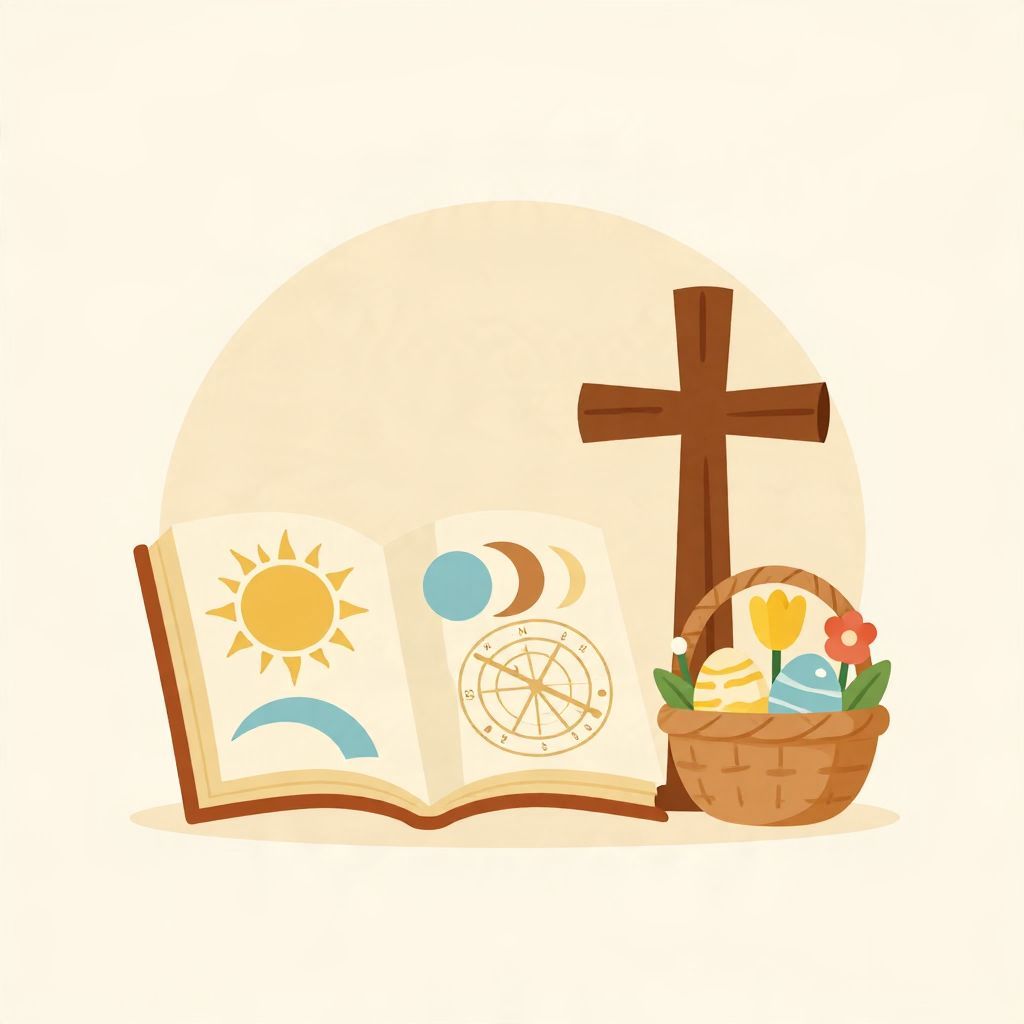
Why is Easter different every year? The short answer is that Easter is a movable feast: its date is tied to the lunar cycle and the timing of the spring equinox rather than to a fixed day on the calendar. That rule was shaped by early Christian tradition and later refined through centuries of debate about calendars, astronomy, and church authority.
The result is a holiday that can fall in March or April in Western Christianity, and on different dates again in Eastern Christianity. Behind that simple fact lies a long history stretching from the ancient Jewish calendar to the Roman Empire, medieval church councils, and the reforms that created the modern Gregorian calendar.
Why is Easter different every year?
Easter changes date because it is calculated as the first Sunday after the first full moon on or after the spring equinox. Since the moon’s phases do not line up neatly with the solar calendar, Easter shifts from year to year. In Western churches, it can fall between March 22 and April 25.
The historical roots of Easter’s changing date
From Passover to the earliest Christian observance
Easter began in the context of Passover, the Jewish festival that commemorates the Exodus from Egypt. The New Testament places Jesus’s crucifixion and resurrection during the Passover season, so the earliest Christians naturally linked the celebration of Jesus’s resurrection to that time of year. At first, however, there was no single agreed-upon date.
Some early Christian communities emphasized the day of the week, celebrating on Sunday because Jesus was believed to have risen on the first day of the week. Others kept the commemoration on the date of Passover itself, even if it fell on a different weekday. This disagreement became one of the earliest major calendar controversies in Christian history.
The Quartodeciman controversy
By the second century, Christians were arguing over whether Easter should always be connected to the Jewish date of Passover or always observed on Sunday. Those who kept the feast on 14 Nisan, the date of Passover in the Jewish lunar calendar, were later called Quartodecimans from the Latin word for fourteen. Others insisted on Sunday observance to emphasize the resurrection.
This was not just a technical dispute. It reflected deeper questions about Christian identity, continuity with Judaism, and the authority of regional churches. The controversy shows that Easter’s date was not fixed from the beginning; it emerged through debate and compromise.
How the church decided Easter should be calculated
The Council of Nicaea and a common rule
In the early fourth century, the Christian church sought greater unity. The Council of Nicaea in 325 CE did not leave behind a single surviving formula in the way many people imagine, but it did establish the principle that Easter should be celebrated on a common Sunday and not directly tied to the Jewish calendar date of Passover. Over time, this led to the rule used in Western Christianity: Easter is the first Sunday after the first full moon on or after the spring equinox.
This solution had practical advantages. It allowed Christians to keep Easter connected to spring, to the symbolism of renewal, and to the resurrection narrative, while also making it a Sunday feast. But it also made the holiday dependent on astronomical cycles, which are irregular when translated into calendar dates.
Why the moon matters
The moon’s cycle lasts about 29.5 days, so lunar months do not match the 30- or 31-day structure of the solar calendar. Because Easter depends on the first full moon after the equinox, its date can move by several weeks. If that full moon arrives early, Easter comes early; if it arrives later, Easter is delayed.
This is why Easter can be as early as March 22 or as late as April 25 in the Western tradition. The holiday is not random, but it is also not fixed to the civil calendar in the way Christmas is.
Why the spring equinox is part of the rule
A seasonal marker, not an exact astronomical moment
The spring equinox is the point in the year when day and night are roughly equal in length. In the Easter calculation, the church traditionally uses March 21 as the ecclesiastical equinox, even though the actual astronomical equinox may occur on March 20 or occasionally March 19, depending on the year and time zone. This is an important distinction: Easter is based on a church calendar rule, not a live astronomical observation.
That ecclesiastical convention was designed to keep the feast stable and predictable. Medieval Christians were not trying to calculate Easter from modern astronomy; they were using a calendrical system that could be applied across the Christian world.
Solar and lunar calendars working together
Easter sits at the intersection of two different ways of measuring time:
- The solar year, which follows the Earth’s orbit around the sun and governs the seasons.
- The lunar month, which follows the phases of the moon and shaped ancient Jewish and many other traditional calendars.
Because these systems do not align neatly, a feast tied to both will naturally move. That is the core reason Easter is different every year.
Why Eastern and Western Easter dates can differ
Different calendars, different calculations
Another reason Easter seems especially variable is that Eastern Orthodox churches and Western churches often celebrate it on different Sundays. The difference comes from calendar history. The Western church uses the Gregorian calendar, introduced by Pope Gregory XIII in 1582 to correct drift in the older Julian calendar. Many Eastern Orthodox churches continue to calculate Easter using the Julian calendar tradition, even when they use the Gregorian calendar for civil life.
Because the Julian calendar is now out of step with the solar year by about 13 days, the date of Easter can diverge between East and West. In some years the dates coincide; in others, Orthodox Easter falls much later.
Why the reform did not create one universal date
The Gregorian reform fixed a real problem: the old Julian calendar had slowly drifted away from the seasons. But the reform did not settle all Christian disagreements. Different churches maintained different traditions for calculating the Paschal full moon and the ecclesiastical equinox. As a result, the world still does not observe Easter on one universal date.
This is a reminder that calendars are not merely technical tools. They are also expressions of religious authority, identity, and tradition.
How medieval and modern calendar reforms changed Easter
The Julian calendar and its drift
The Julian calendar, introduced under Julius Caesar in 45 BCE, was a major improvement over older Roman timekeeping. But it assumed a year slightly longer than the actual solar year. Over centuries, that small error accumulated. By the late medieval period, the calendar had drifted enough that the date of the equinox no longer matched the church’s assumptions.
This mattered directly for Easter because the feast depended on the spring equinox. If the calendar drifted too far, the calculation would gradually move away from the season it was meant to reflect.
The Gregorian correction
The Gregorian reform shortened the calendar year slightly and adjusted the leap-year system. It also reset the date used for the ecclesiastical equinox. Western churches adopted the reform relatively quickly in Catholic countries, while Protestant regions adopted it more gradually. Some Eastern churches resisted it for religious and political reasons, which is one reason Easter traditions remain divided today.
The reform improved accuracy, but it did not make Easter fixed. Instead, it preserved the movable feast while making the calendar on which it was based more reliable.
What Easter’s changing date meant in everyday life
A movable feast shaped the Christian year
Because Easter moves, many other Christian observances move with it. Lent, Ash Wednesday, Palm Sunday, Ascension Day, and Pentecost are all calculated in relation to Easter. In premodern Europe, this had a major effect on farming rhythms, fasting practices, market schedules, and church attendance. The religious year was not a set of static dates but a living cycle.
For ordinary people, Easter’s variability was familiar rather than strange. Communities learned to plan around it. The holiday’s movement through late winter and spring also reinforced its symbolism of rebirth, light, and renewal.
Why the date still matters today
Even in modern societies with standardized civil calendars, Easter affects school holidays, travel, retail schedules, and public observance. Its date can shape everything from vacation planning to the timing of spring events. Yet its historical logic remains the same: Easter is tied to a religious calendar that combines biblical memory, lunar cycles, and seasonal symbolism.
Common misunderstandings about Easter’s date
It is not simply “the first Sunday after the first full moon” in a modern astronomical sense
That popular explanation is useful, but it is simplified. The church uses an ecclesiastical full moon and an ecclesiastical equinox, not necessarily the exact astronomical ones. This distinction helps explain why Easter sometimes differs from what a modern astronomy app might suggest.
It is not based on a single ancient date
Some people assume Easter was always fixed by Jesus’s resurrection date in the modern calendar. Historically, that is not the case. The earliest Christians inherited a Passover-season framework and then developed a separate Christian rule for the feast. Easter is therefore the product of historical development, not a direct timestamp from the first century.
It is not “late” or “early” by accident
Every Easter date follows a rule, even if the rule feels complicated. The holiday’s movement is the result of a deliberate attempt to connect Christian worship to the rhythms of spring and the lunar cycle while keeping the celebration on a Sunday.
The historical significance of Easter’s moving date
Easter’s changing date reveals how ancient and medieval societies understood time. Before modern standardization, calendars were not merely administrative tools; they were deeply tied to religion, astronomy, and communal life. The Easter calculation preserved a link to the natural world while also creating a shared Christian observance across regions and languages.
It also shows how history often leaves us with layered traditions. Jewish festival time, Roman calendar reforms, early Christian disputes, medieval church authority, and modern calendar corrections all contributed to the date people now see each spring. Easter is different every year because it carries that long history within it.
For a broader historical context, you may also be interested in when Jesus’s birthday was understood in history and other questions about how religious dates developed over time. The reason Easter moves is ultimately a story about calendars, faith, and the long effort to reconcile human time with the cycles of the heavens.