
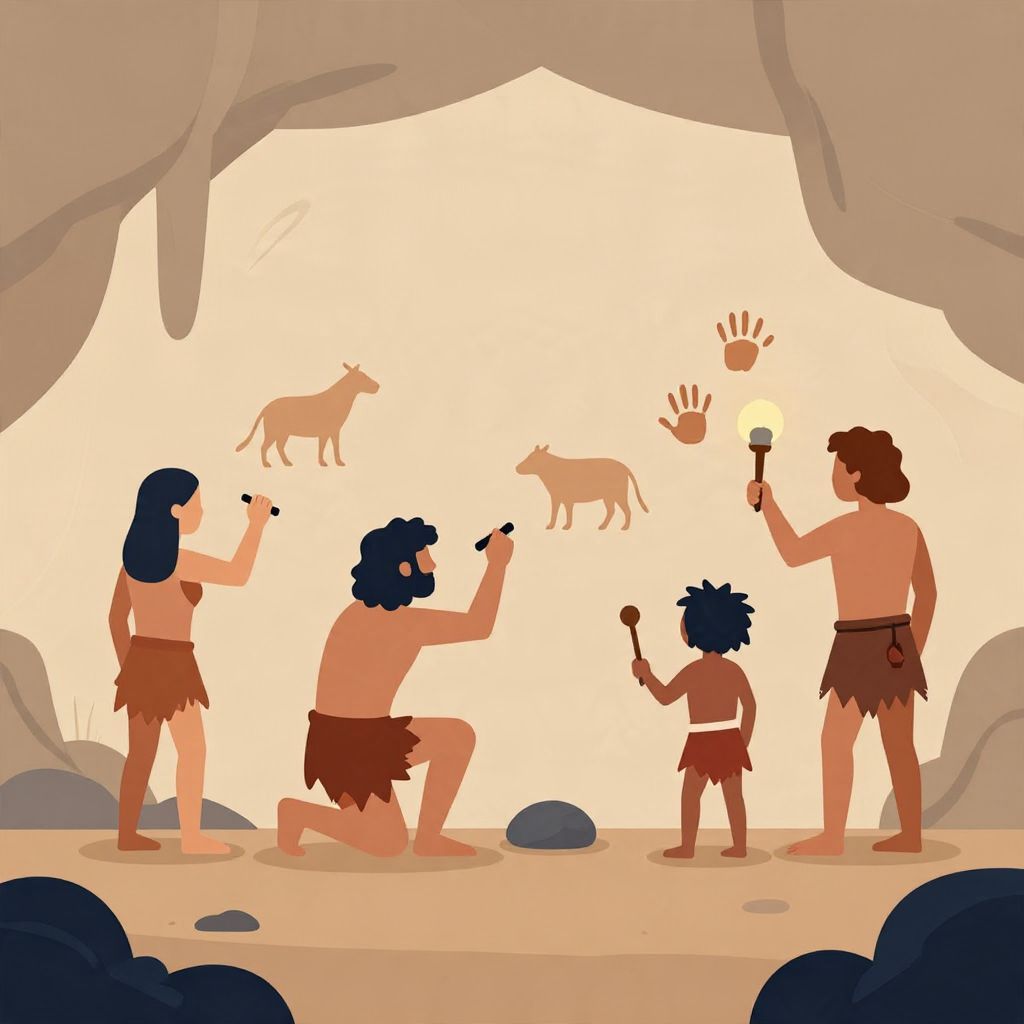
Why was drawing so important early on in history? Because before writing systems spread widely, drawing was one of humanity’s most flexible tools for recording, teaching, remembering, and communicating. It could show animals, people, tools, rituals, and symbols in ways that words alone could not.
Across prehistoric communities and early civilizations, drawing helped people make sense of the world and pass knowledge to others. It was not just decoration. It was a practical technology of memory, identity, religion, and power.
Why Was Drawing So Important Early On In History?
Drawing mattered early in history because it let people communicate across language barriers, preserve knowledge visually, and give meaning to objects, stories, and sacred spaces. Long before widespread literacy, images could teach hunting skills, mark territory, record beliefs, and support social order in ways that were immediate and memorable.
Drawing Before Writing: A Human Need for Visual Communication
Drawing is older than writing. Archaeological evidence shows that humans were making images tens of thousands of years ago, long before formal scripts appeared in Mesopotamia, Egypt, or elsewhere. In that early world, images were not a luxury. They were one of the main ways people organized experience.
Simple marks, carved signs, painted figures, and symbolic patterns could carry meaning even when spoken language differed from group to group. A drawing of an animal, a handprint, or a repeated geometric sign could communicate something shared: danger, abundance, belonging, or spiritual presence.
Why images worked so well
- They were easier to recognize than abstract speech for people who did not share a common language.
- They could be remembered more easily than long verbal explanations.
- They could be reproduced on walls, stones, pottery, bone, wood, and skin.
- They linked practical knowledge with emotion, ritual, and identity.
Prehistoric Cave Art and the Earliest Evidence
Some of the most famous early drawings are cave paintings and engravings from the Upper Paleolithic period, especially in Europe, though important early art also appears in Africa, Asia, and Australia. Sites such as Chauvet Cave in France, often dated to around 30,000 years ago or earlier, show that early humans created sophisticated images with remarkable skill.
These works were not random doodles. They often depict animals such as horses, bison, and deer with careful observation. Scholars have offered several interpretations: hunting magic, storytelling, clan identity, shamanic ritual, or a combination of these. There is no single universally accepted explanation, and that uncertainty matters. What is clear is that the images were meaningful enough to be made in difficult, dark, and sometimes dangerous places.
What prehistoric drawings may have done
- Preserved knowledge about animals, movement, and landscapes.
- Supported ritual by linking human communities to spiritual forces.
- Strengthened memory by turning experience into visible form.
- Created shared identity within small groups or clans.
Drawing as a Tool of Survival and Teaching
In early societies, survival depended on passing knowledge from one generation to the next. Drawing helped teach children and apprentices what to look for, how to hunt, how to make tools, and how to understand seasonal patterns. A visual image could compress a great deal of information into a single glance.
This was especially useful in non-literate cultures. If a community relied on oral tradition alone, memory had to do all the work. Drawing added a durable visual layer. It could reinforce a story, explain a ritual, or preserve a practical lesson long after the original speaker had died.
Examples of practical uses
- Showing the shape of animals and their movement.
- Marking routes, water sources, or hunting grounds.
- Explaining how to assemble tools or containers.
- Recording important events, alliances, or warnings.
Drawing and the Rise of Early Civilizations
As cities and states emerged in places such as Mesopotamia, Egypt, the Indus Valley, and later China and Mesoamerica, drawing became even more important. It now served not only local memory and ritual, but also administration, religion, and political authority.
Early civilizations needed ways to organize labor, store grain, collect taxes, and legitimize rulers. Writing eventually handled many of these tasks, but images remained central. Reliefs, wall paintings, seals, and illustrated objects helped rulers project power and define the world in visual terms.
In Egypt and Mesopotamia
In ancient Egypt, tomb paintings and carved scenes showed daily life, religious beliefs, and royal authority. These images were part of a larger system of ensuring order in life and the afterlife. In Mesopotamia, cylinder seals and carved imagery served administrative and symbolic purposes, identifying owners and affirming status.
In both regions, drawing and image-making were closely tied to belief. A picture could do more than represent reality; it could participate in it. That idea was especially important in religious cultures where images were thought to help sustain divine order, honor the dead, or protect the living.
Why Drawing Was Important in Religion and Ritual
Early drawing was often sacred. Many ancient societies believed images had power, whether as offerings, protective symbols, or visual links to gods and ancestors. A drawn figure could stand in for a living being, a divine presence, or a spiritual force.
Because of this, drawing was not merely about appearance. It was about relationship. Images helped people approach what was invisible, distant, or difficult to describe. They gave shape to belief.
Religious functions of drawing
- Decorating tombs, temples, and shrines.
- Depicting gods, spirits, and sacred stories.
- Protecting spaces with symbolic signs and figures.
- Supporting ceremonies through visual memory and repetition.
Drawing, Power, and Authority
As states grew larger, drawing became a political tool. Rulers used images to show victories, lineage, wealth, and divine favor. A carved scene of a king defeating enemies was not just art; it was propaganda in the broad historical sense, a visual message about who had the right to rule.
This mattered because most people in early states could not read complex texts. Images reached a wider audience than writing alone. They could be placed on monuments, palace walls, temples, coins, and official objects. In that way, drawing helped rulers shape public memory and political legitimacy.
How rulers used images
- To present themselves as strong, chosen, or divinely approved.
- To commemorate military victories and territorial control.
- To unify diverse populations under shared symbols.
- To make authority visible in public spaces.
Drawing as Memory: Before Books, Before Printing
Before paper was common and before printing transformed the spread of knowledge, drawing was a major way to preserve information. Maps, diagrams, genealogies, calendars, and illustrated manuscripts all depended on visual thinking. Even when writing existed, drawing often made writing more useful.
A diagram could explain a building plan. A map could show distance and direction. A painted scene could preserve a story more vividly than text alone. In this sense, drawing was an early form of information design.
Why visual memory mattered
Human beings remember images powerfully. Early societies understood this intuitively, even if they did not describe it in modern psychological terms. A striking image could survive when spoken words faded. That made drawing ideal for oral cultures, ceremonial traditions, and practical instruction.
The Social Value of Skill and Specialization
As societies became more complex, skilled artists and scribes gained status. Drawing required observation, training, and control of materials. In many early cultures, the ability to make accurate or symbolically powerful images was respected because it served the community.
Artists were not always “free creators” in the modern sense. They often worked within religious, courtly, or civic systems. Their drawings had rules, conventions, and purposes. Yet that made the skill no less important. In fact, standardization helped images communicate clearly across generations.
Drawing and the Development of Thought
Drawing also mattered because it helped people think. A line on a surface can simplify a complex object, reveal structure, and test an idea. This is why drawings became important not only in art, but later in mathematics, engineering, astronomy, and medicine.
Even in early history, visual representation supported abstract thought. A symbol could stand for an idea. A pattern could express order. A figure could be stylized enough to mean more than one specific person. Drawing therefore helped bridge the gap between concrete experience and conceptual understanding.
How Drawing Changed Over Time
Drawing did not remain the same across history. Its uses expanded as materials, technologies, and institutions changed. But its early importance set the stage for later developments in manuscript illustration, scientific diagramming, cartography, and fine art.
In broad terms, the historical sequence looks like this:
- Prehistoric era: images used for ritual, memory, and communication.
- Early states and civilizations: drawings support religion, administration, and royal power.
- Classical and medieval worlds: images appear in manuscripts, temples, and public monuments.
- Later periods: drawing becomes central to science, education, and artistic theory.
So What Is the Historical Answer?
Drawing was important early in history because it was one of humanity’s first reliable ways to make meaning visible. It helped people survive, teach, worship, remember, and govern. Before mass literacy, drawing was not secondary to language; in many settings, it was language’s partner.
That is why early drawings matter so much to historians. They are not just beautiful remnants of the past. They are evidence of how humans learned to communicate, organize society, and imagine the world. If you want to explore how visual expression shaped later cultures, you may also enjoy reading about the role of sculpture in history and how Leonardo da Vinci created mood in the Mona Lisa.