
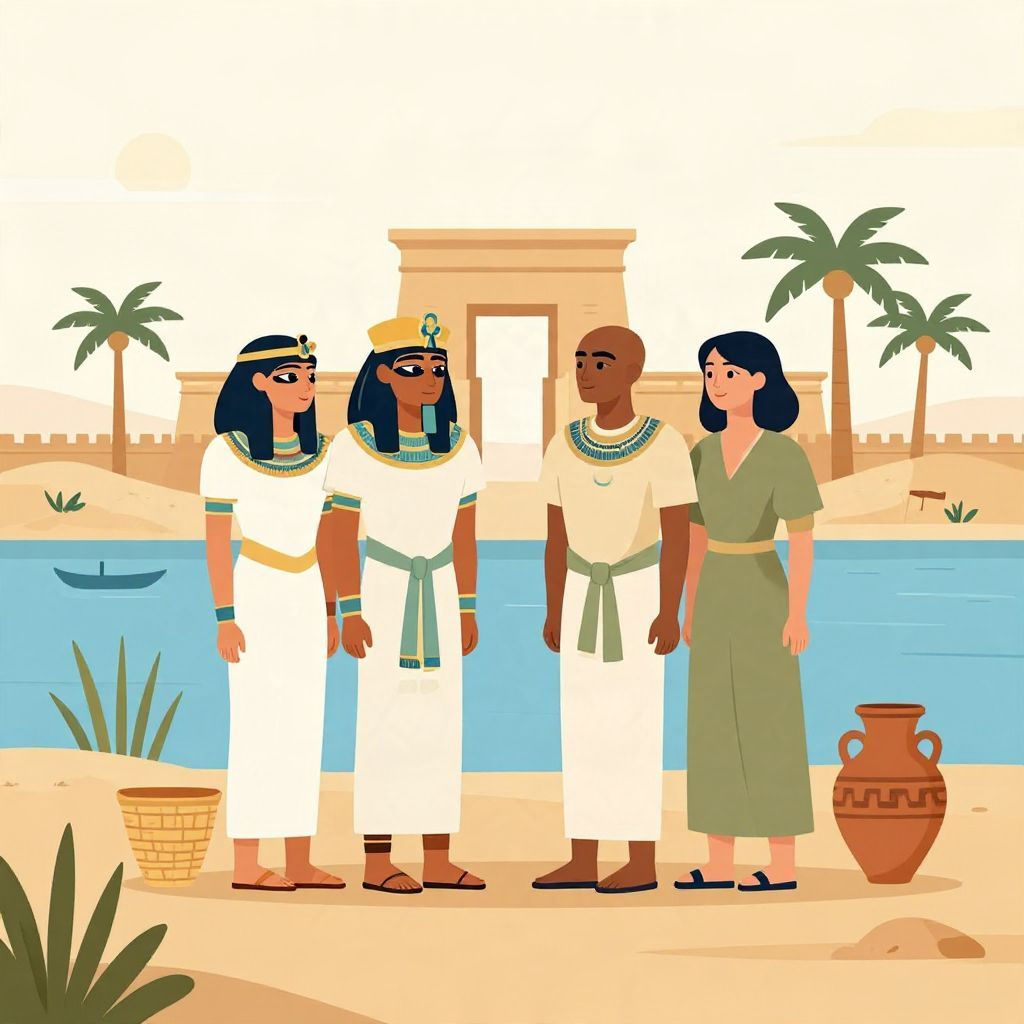
What do Egyptians look like? The short historical answer is that there is no single “Egyptian look.” Ancient and modern Egyptians have always been a diverse population shaped by the Nile Valley, North Africa, the eastern Mediterranean, and the wider Near East. Their appearance has varied across time, region, ancestry, and social background.
That means the best way to answer the question is historically: by looking at ancient Egyptian art, archaeology, written records, and modern population history. These sources show continuity in Egypt, but also centuries of migration and mixing that make any one fixed description misleading.
What Do Egyptians Look Like?
Egyptians do not have one universal appearance. Historically and today, most Egyptians are best understood as a North African and Middle Eastern population with a wide range of skin tones, hair textures, and facial features. Ancient art often shows medium-brown skin, dark hair, and varied features, but it was symbolic rather than a photographic record.
Ancient Egyptians: What the Evidence Shows
Art was stylized, not a realistic portrait system
When people ask what ancient Egyptians looked like, they often turn to wall paintings, tomb reliefs, and statues. These are useful, but they were not created to document ethnicity in a modern scientific sense. Egyptian artists used conventions: men were often painted darker than women, elites were idealized, and gods could be shown in symbolic colors. That makes art informative, but not literal.
Archaeology and mummies give a fuller picture
Mummies, skeletal remains, and burial goods suggest that ancient Egyptians were physically diverse, like any long-lasting population. Studies of remains indicate a mix of traits common in northeastern Africa and the eastern Mediterranean. Over thousands of years, Egypt’s location made it a crossroads for trade, war, diplomacy, and migration, so appearance would have varied from one region and period to another.
Skin tone in ancient Egypt
Ancient Egyptian art usually depicted Egyptians with brown to reddish-brown skin tones, though this was partly artistic convention. People from Nubia were often shown darker, while peoples from western Asia were often shown with lighter skin in Egyptian art. These visual codes reflected Egyptian ideas about identity and difference more than strict biological categories.
Why Ancient Egyptian Appearance Varied
Egypt was a crossroads of Africa and the Mediterranean
Geography shaped Egyptian history. The Nile Valley connected sub-Saharan Africa to the south and the Levant and Mediterranean to the north. Goods, people, and ideas moved through Egypt for millennia. As a result, ancient Egyptians were not isolated. Their appearance reflected long-term local continuity as well as contact with neighboring regions.
Dynasties, conquest, and migration changed the population
Egypt was ruled at different times by native dynasties, Nubian kings, Assyrians, Persians, Greeks, Romans, Arabs, and later Ottoman and European powers. These political changes did not erase the local population, but they did add layers of ancestry and cultural influence. Over centuries, intermarriage and migration contributed to the diversity seen among Egyptians today.
Class and region mattered too
Appearance also differed within Egypt itself. People in Upper Egypt, Lower Egypt, the oases, the Delta, and frontier regions could have distinct local histories. Urban elites, rural farmers, soldiers, priests, and foreign residents may also have differed in diet, health, and ancestry. In other words, “Egyptian” has always described a people with internal variety.
What Ancient Egyptian Art Can and Cannot Tell Us
It shows identity, not exact biology
Egyptian images are valuable because they show how Egyptians saw themselves and others. They can reveal hairstyles, clothing, makeup, jewelry, and social roles. But they cannot be read as exact racial portraits. Ancient artists followed rules that emphasized status, gender, age, and symbolic meaning more than individual realism.
Common visual features in Egyptian representations
In many depictions, Egyptians are shown with dark hair, almond-shaped eyes, and medium to brown skin. Men were often shown with broad shoulders and lean bodies, while women were often shown with slimmer frames and lighter skin in formal art. These patterns reflect artistic convention, not a universal biological template.
Hair and grooming were important
Hair in ancient Egypt could be worn short, braided, shaved, or covered with wigs. Wigs were especially common among elites and in ceremonial settings. Head shaving and body grooming were also widespread for hygiene and comfort in the hot climate. So if you imagine an ancient Egyptian, hair style may have been as important as facial features.
Modern Egyptians: A Diverse Population
Today’s Egyptians are not all the same in appearance
Modern Egyptians also vary widely. Some have lighter skin, others darker skin; some have straight hair, others wavy or curly hair; facial features vary across families and regions. This diversity reflects Egypt’s long history as a meeting place of African, Levantine, Mediterranean, and Arab influences.
Arab identity and Egyptian identity are not identical
Most Egyptians today speak Arabic and identify culturally as Arab, but that does not mean they are biologically identical to populations from the Arabian Peninsula. Egyptian identity developed through language, religion, state history, and local continuity in the Nile Valley. Many Egyptians are descendants of ancient populations with later admixture from surrounding regions.
Religious and ethnic minorities add to the picture
Egypt is home to Muslim and Christian Egyptians, especially Copts, as well as smaller communities such as Nubians, Bedouins, and others. These groups may preserve distinct local traditions and, in some cases, distinct physical traits. That variety is part of Egypt’s historical fabric, not an exception to it.
Common Misconceptions About Egyptian Appearance
“All Egyptians look like the pharaohs in movies”
Film and television often flatten ancient Egypt into a single look: dramatic eyeliner, golden skin, and highly stylized clothing. While some of that is inspired by real ancient practices, it is still a modern visual shorthand. Ancient Egyptians were real people with ordinary variation in age, health, and appearance.
“Ancient Egyptians were one race”
That idea is too simplistic for history. Modern racial categories do not map neatly onto the ancient world. Egyptians identified themselves through language, homeland, religion, office, and community. Their appearance may have overlapped with neighboring peoples, but ancient identity was not organized the way modern race concepts are.
“Egyptians looked exactly the same for 3,000 years”
Egyptian civilization lasted for millennia, from the early dynastic period around 3100 BCE through pharaonic, Greco-Roman, Islamic, and modern eras. No population remains unchanged for that long. Climate, migration, conquest, marriage patterns, and social change all affect appearance over time.
How Ancient Egyptians Saw Themselves and Others
Identity was often cultural and political
Ancient Egyptian texts and images usually focused less on “race” and more on belonging. Egyptians distinguished themselves from Nubians, Libyans, and peoples of western Asia, but those distinctions were often tied to politics, geography, and custom. A person could be foreign by origin and still become part of Egyptian society.
Foreigners were present in everyday life
Egyptian cities, temples, and military outposts included foreigners as traders, mercenaries, captives, diplomats, and settlers. Over time, some became fully integrated. This helps explain why Egyptian appearance was never uniform. The Nile Valley was connected to the wider ancient world, not sealed off from it.
What This Means for the Historical Question
The most accurate answer is diversity
If you are asking what Egyptians look like in a historical sense, the most accurate answer is that they have always been a diverse people. Ancient Egyptians likely often had brown skin, dark hair, and features common to northeastern Africa and the eastern Mediterranean, but there was never one fixed Egyptian appearance. Modern Egyptians remain diverse as well.
Why the question is harder than it seems
The question sounds simple, but it touches on deep issues: how historians use art, how populations change, and how identity works across time. Appearance is shaped by ancestry, environment, and culture, but it is also interpreted through the eyes of the society doing the describing. That is why careful history resists easy labels.
Conclusion
Egyptians, ancient and modern, do not fit a single visual stereotype. Historically, they have been a varied Nile Valley population shaped by continuity and contact, with appearances that range across skin tone, hair type, and facial features. If you want to explore related historical questions, you may also be interested in what Moses might have looked like or what Julius Caesar looked like.