
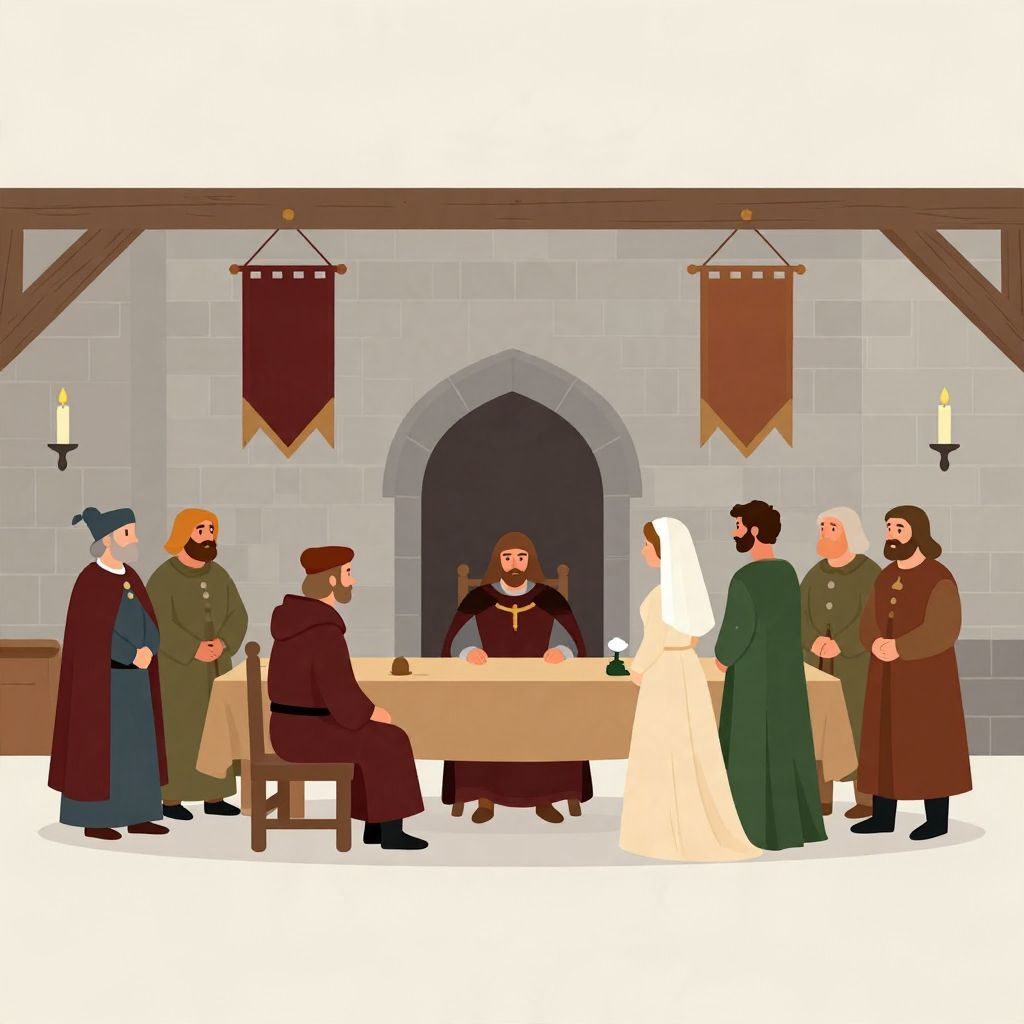
What is prima nocta? It is the name commonly given to the alleged right of a lord or ruler to spend the first night with a newly married woman in his domain. The idea is famous in popular culture, but historians generally treat it with caution because clear evidence for such a custom in medieval Europe is lacking.
In other words, prima nocta is better understood as a historical myth, a literary trope, or a later accusation about oppression than as a proven legal institution. Its story reveals as much about how people imagined feudal power as it does about marriage, lordship, and social control in the Middle Ages.
What is prima nocta?
Prima nocta is the supposed “first night” right, often described as a lord’s claim to a bride’s virginity on her wedding night. Despite its fame, there is no solid evidence that this was a formal, widespread legal practice in medieval Europe. Most historians consider it a legend, a misunderstanding, or a polemical story used to criticize feudal oppression.
Where did the idea of prima nocta come from?
The phrase itself is Latin, but the concept is not securely documented as a real medieval law. The modern image of prima nocta grew from later stories about tyrannical lords and from older traditions that linked rulers with sexual or ritual authority. Over time, these ideas were blended into a dramatic tale of feudal abuse.
Medieval and early modern roots
Some medieval texts mention payments or customs connected to marriage, especially fees owed to a lord when a tenant married. These were real in some places, but they were financial obligations, not sexual rights. Later writers sometimes confused or exaggerated these dues, turning them into a story about a lord taking a bride on her wedding night.
Why the myth spread
The legend fit well with criticism of feudal society. It offered a vivid symbol of aristocratic domination over ordinary people. In literature, political writing, and later popular histories, prima nocta became a shorthand for the cruelty of the medieval past, even when the historical record did not support it.
Was prima nocta actually practiced?
There is no reliable evidence that prima nocta existed as a recognized legal right in medieval Europe. Historians have searched for charters, law codes, court records, and administrative documents, but no convincing proof has emerged. Claims about the practice usually rest on later stories, hostile propaganda, or mistaken interpretations of marriage fines and lordly privileges.
What the evidence does show
- Some lords collected marriage fines or fees from tenants.
- Feudal authorities sometimes controlled whom tenants could marry, especially when land or inheritance was involved.
- Church law strongly regulated marriage and condemned sexual coercion.
- Local customs varied widely across regions and centuries.
These facts show that medieval people lived under unequal and often intrusive systems of power, but they do not prove a “first night” sexual right.
Why historians are skeptical
If prima nocta had been a real and common legal custom, it would likely appear more clearly in surviving legal records, complaints, sermons, or administrative documents. Instead, the evidence is thin and indirect. That absence does not prove that no abuse ever occurred, but it does mean the legend should not be treated as established fact.
How did feudal marriage rights actually work?
To understand the myth, it helps to look at real feudal practices. In much of medieval Europe, peasants and tenants did not have complete freedom over marriage if the marriage affected landholding, labor obligations, or inheritance. Lords could demand fees, approve matches, or benefit economically from a tenant’s marriage, especially when a widow or heiress was involved.
Marriage as an economic issue
Marriage was not only a personal or religious event. It could determine who worked a holding, who inherited land, and how obligations to a lord were transferred. Because of this, feudal authorities often had an interest in regulating marriage. That control was exploitative, but it was usually financial and social rather than sexual.
Church influence
The medieval Church increasingly asserted that marriage was a sacrament requiring consent. This mattered because it limited the ability of secular lords to treat marriage entirely as their property. Church teaching did not eliminate coercion, but it created an important legal and moral framework that made a formal prima nocta right unlikely.
Why is prima nocta associated with the Middle Ages?
Prima nocta is strongly tied to the Middle Ages because later generations used the period as a symbol of brutality, superstition, and arbitrary power. The medieval world was indeed marked by hierarchy and coercion, but later writers often exaggerated its harshness to contrast it with their own age. The result was a memorable but misleading stereotype.
The role of anti-feudal storytelling
From the early modern period onward, critics of aristocratic privilege used dramatic stories to show how unjust the old order had been. A lord taking a peasant bride on her wedding night was a powerful image. It condensed many grievances—taxes, labor dues, sexual vulnerability, and social inequality—into one shocking act.
Literature and film
Modern novels and films helped popularize the idea even further. Once it entered mass culture, prima nocta became familiar as a “medieval fact,” even though historians repeatedly questioned it. Popular storytelling often prefers a clear villain and a dramatic custom, which makes the legend persist.
Did any similar customs exist outside Europe?
Stories resembling prima nocta appear in different cultures and historical settings, but resemblance does not equal proof of a universal practice. Some societies had rituals involving sexual symbolism, bridewealth, or elite privilege, while others had myths about rulers’ authority over subjects. These should not be confused with a documented legal right to a bride’s first night.
Myth, ritual, and power
In many societies, rulers were imagined as having extraordinary powers over fertility, marriage, or the body. Such ideas could be symbolic, religious, or political. They may have influenced later stories about prima nocta, but they do not demonstrate that medieval European lords actually exercised such a right.
What do historians think today?
Most historians regard prima nocta as a myth rather than a verified institution. The consensus is not that medieval society was gentle or egalitarian, but that the specific claim of a lordly “first night” right lacks dependable evidence. Scholars instead focus on the real structures of feudal power: land control, marriage regulation, inheritance, and peasant dependence.
Important historical caution
It is possible for a legend to contain a grain of truth without being true in the form people repeat it. Medieval lords could be abusive, and women’s choices were often constrained. But historians distinguish between documented oppression and a specific custom that has never been convincingly proven.
Key facts about prima nocta
- Meaning: The alleged right of a lord to sleep with a bride on her wedding night.
- Status: Widely regarded by historians as a myth or unproven legend.
- Language: The phrase is Latin and means “first night.”
- Historical context: Often linked to feudal Europe, though not securely documented there.
- Real practice often confused with it: Marriage fines, lordly approval of marriages, and inheritance controls.
- Why it matters: It illustrates how later societies imagined medieval power and oppression.
Why the legend still matters
Even if prima nocta was not a real legal custom, the legend is historically important. It shows how people interpret the past through symbols of power, gender, and class. It also reminds us that not every widely repeated “historical fact” is well supported. Some stories endure because they are vivid, not because they are true.
So, what is prima nocta? It is best understood as a famous but unproven claim about medieval lordship, one that reflects real inequalities in feudal society without being a reliable description of actual law. For more context on the world that produced such myths, see what a feudal system was and what a duchy was.