
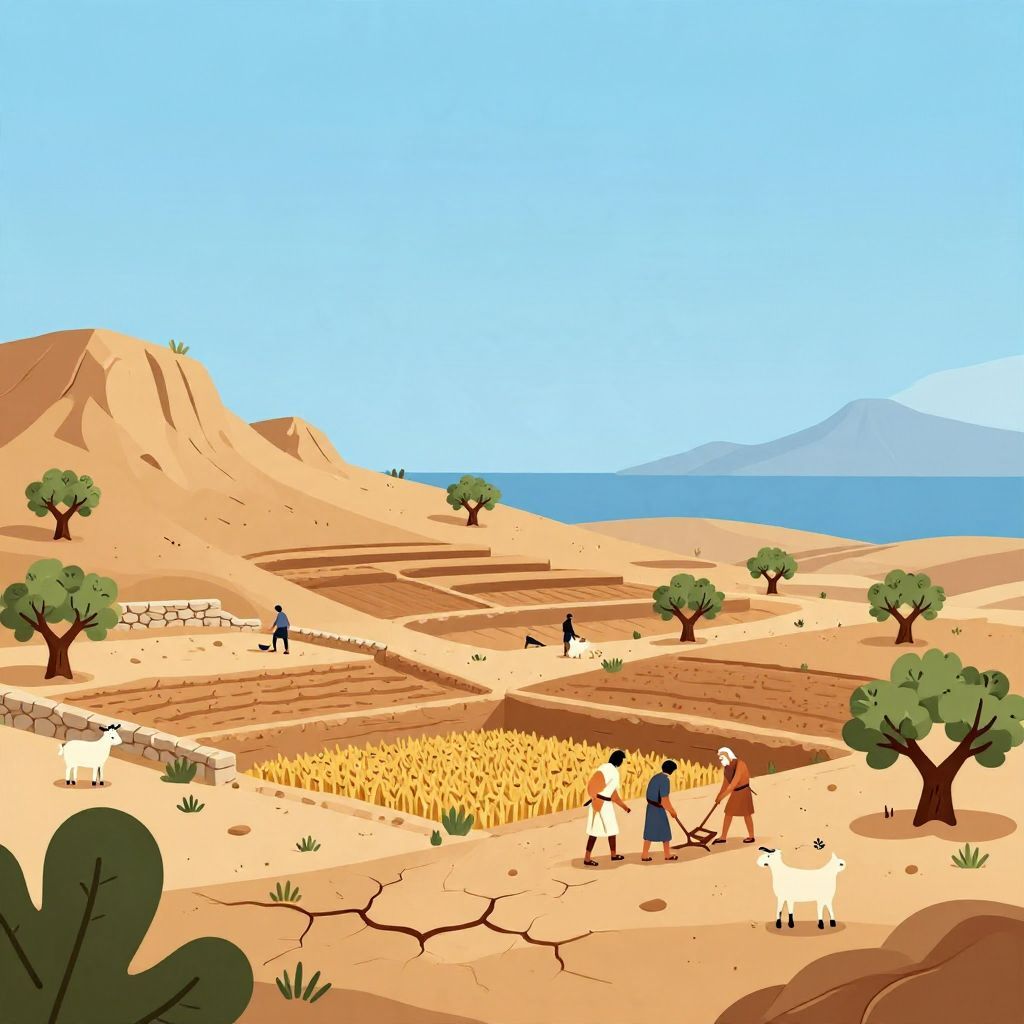
Why was farming difficult in Ancient Greece? The short answer is that Greek farmers worked in a harsh landscape with thin soils, limited flat land, irregular rainfall, and few large rivers. Agriculture was possible, but it was often risky, labor-intensive, and vulnerable to drought, erosion, war, and food shortages.
These geographic limits shaped ancient Greek society from the Archaic period through the Classical era and beyond. They helped push many communities toward olive growing, vine cultivation, trade, colonization, and a strong reliance on small family farms rather than large grain-rich estates.
Why Was Farming Difficult in Ancient Greece?
Farming was difficult in Ancient Greece because the land itself was uneven, rocky, and often poor for grain. Rainfall was seasonal and unreliable, arable land was scarce, and many settlements lacked irrigation systems large enough to offset drought. Greek farmers had to squeeze food from a difficult environment with limited tools and little margin for error.
The Geography of Greece Made Large-Scale Farming Hard
Mountains divided the land
Ancient Greece was not one broad fertile plain like Egypt’s Nile Valley or Mesopotamia’s river systems. Instead, it was a mountainous peninsula with many islands and narrow valleys. Mountains separated communities from one another and left only small pockets of cultivable land. This meant that many polis, or city-states, had to survive on local resources that were often insufficient.
The terrain also made transport difficult. Moving grain, livestock, tools, or manure overland was slow and expensive. In many places, it was easier to travel by sea than across the mountains, but sea travel did not solve the basic problem of limited farmland.
Soils were often thin and rocky
Much of Greece had shallow soil resting on limestone and other hard rock. Such soils could support olives, grapes, figs, and some cereals, but they were not ideal for heavy grain production. Even when land was cleared, erosion could quickly strip away the topsoil, leaving fields less productive over time.
This was especially important because ancient farming depended on repeated plowing and seasonal planting with little modern soil management. Without fertilizers on a large industrial scale, farmers had to rely on fallow cycles, animal manure, and careful land use to keep fields productive.
Rainfall was uneven and uncertain
Ancient Greece had a Mediterranean climate, with wet winters and hot, dry summers. That pattern could be useful for certain crops, but it also created a constant risk of drought. If winter rains failed or came too late, grain yields dropped sharply. Since most farming was rain-fed, a bad season could threaten survival.
Unlike river civilizations that could depend on predictable flooding and irrigation, Greek farmers had less control over water. Small springs, cisterns, and local channels helped in some places, but they could not fully overcome the climate’s unpredictability.
Ancient Greek Farmers Faced Many Environmental Risks
Erosion and overuse damaged the land
When hillsides were cleared for cultivation, rain could wash away the thin topsoil. Overgrazing by goats and sheep may also have worsened erosion in some areas, though historians caution against oversimplifying this as the only cause of land degradation. Still, the combination of deforestation, grazing, and steep slopes made farming more fragile.
As soils wore out, farmers sometimes had to abandon plots or shift to less demanding crops. This made long-term agricultural stability difficult, especially in regions with growing populations.
Wildlife, pests, and crop failure were constant threats
Ancient farmers had limited ways to protect crops from birds, insects, disease, and weather shocks. A single failed harvest could create hardship, especially in a household that depended on its own fields. Losses were not just economic; they could lead to hunger, debt, and dependence on wealthier neighbors or grain imports.
Because storage technology was limited, farmers also had to worry about spoilage, rodents, and theft. A successful harvest did not guarantee security through the year.
Greek Agriculture Was Labor-Intensive and Technologically Limited
Tools were simple
Greek farmers used basic tools such as wooden or iron plows, hoes, sickles, and digging sticks. These were effective for small plots, but they did not make farming easy. The plow, for example, often scratched the soil rather than turning it deeply, which limited productivity on hard or rocky ground.
Because labor-saving machinery did not exist, farming required many hours of human and animal effort. Families often worked together, and in some areas enslaved labor also supported agricultural production. Even so, the scale and efficiency of farming remained low by modern standards.
Irrigation was limited in many regions
Some ancient societies built large irrigation networks, but most Greek communities did not have the geography or political organization for such systems. The many small valleys and scattered settlements of Greece made large coordinated waterworks difficult. As a result, farmers depended heavily on rainfall and local water sources.
This made agriculture especially vulnerable in dry years. A field that produced well one season might fail the next if the rains were poor.
Why Grain Was So Hard to Produce Reliably
Wheat and barley needed better conditions than Greece often provided
Grain was the staple food of the ancient Mediterranean world, but it was not always easy to grow in Greece. Barley was hardier and more common than wheat, yet even barley needed enough moisture and decent soil to produce dependable yields. Wheat, which was often preferred for bread, was even more demanding.
Because grain yields were relatively low, many Greek communities could not feed themselves entirely from local production. That is one reason imports from areas such as the Black Sea region, Egypt, and Sicily became so important in later periods, especially for larger cities like Athens.
Food security depended on a narrow margin
Ancient Greek agriculture often operated close to subsistence. Families produced enough to survive in good years, but there was little buffer against disaster. A drought, a military campaign, or a disruption in trade could quickly create shortages. This vulnerability made farming not only difficult but politically significant.
Cities and states had to think about grain supply, storage, and access to markets. In times of crisis, these issues could become matters of public order and even war.
Farmers Had to Adapt to the Land They Had
Olives and grapes suited the environment better
Greek farmers did not simply fail at grain farming; they adapted to their environment. Olives and grapes were especially well suited to rocky hillsides and dry summers. Olive trees could survive poor soils, and vines could be trained on slopes where cereals struggled. These crops became central to Greek agriculture and trade.
Olive oil and wine were valuable not only as food and drink but also for lighting, ritual, medicine, and commerce. In a sense, the difficulty of grain farming helped shape the distinct agricultural identity of ancient Greece.
Mixed farming reduced risk
Many households combined crops with herding sheep, goats, and sometimes cattle. Livestock provided milk, wool, meat, manure, and a form of wealth that could be moved or traded. This mixed economy was a practical response to uncertain harvests. If one part of the economy failed, another might still support the household.
Still, herding did not eliminate the basic problem: the land could not easily support dense populations on grain alone.
Social and Political Consequences of Difficult Farming
Limited farmland influenced settlement and colonization
Because arable land was scarce, population pressure could become intense in some regions. One major response was Greek colonization, especially from the 8th to 6th centuries BCE, when Greeks founded settlements around the Mediterranean and Black Sea. These colonies were not just trading posts; many were attempts to secure land and resources unavailable at home.
This movement reveals how closely agriculture, population growth, and politics were connected. Farming difficulties at home helped push Greeks outward.
It shaped the rise of the polis
The struggle over land also influenced the development of the city-state. In many communities, landownership was tied to citizenship, military service, and political power. Small farmers formed an important social class, and disputes over land and debt could destabilize entire poleis. Agricultural hardship was therefore not only an economic issue but a cause of social tension.
In places like Athens, land scarcity and grain dependence contributed to reforms, political conflict, and greater concern with trade routes and overseas supply. In Sparta, geography and land use helped produce a very different social system centered on control of labor and territory.
How Historians Understand Ancient Greek Farming Today
Geography mattered, but so did human choices
Historians generally agree that geography was the main reason farming was difficult in Ancient Greece. But environment alone does not explain everything. Greek communities also made choices about what to plant, how to organize labor, where to settle, and how to respond to scarcity. Their agricultural world was shaped by both natural limits and human adaptation.
It is also important not to imagine all of Greece as equally poor or unproductive. Some regions, such as parts of Thessaly or certain coastal plains, were more fertile than others. The problem was not total inability to farm, but the uneven and often fragile nature of farming across much of the Greek world.
Ancient Greece was difficult, not impossible
Greek agriculture sustained cities, armies, temples, and trade networks for centuries. Farmers were resourceful and resilient. But they worked in a landscape that demanded constant effort and left little room for failure. That reality helps explain why Greek civilization developed as a network of small, competitive communities rather than a single unified agricultural empire.
In the end, farming was difficult in Ancient Greece because the land, climate, and available technology all placed strict limits on production. Those limits shaped Greek food, trade, settlement, and politics for centuries, making agriculture one of the most important forces in ancient Greek history. If you want to explore how these pressures affected daily life and state formation, related topics to read next include ancient Greek city-states and daily life in Ancient Greece.