
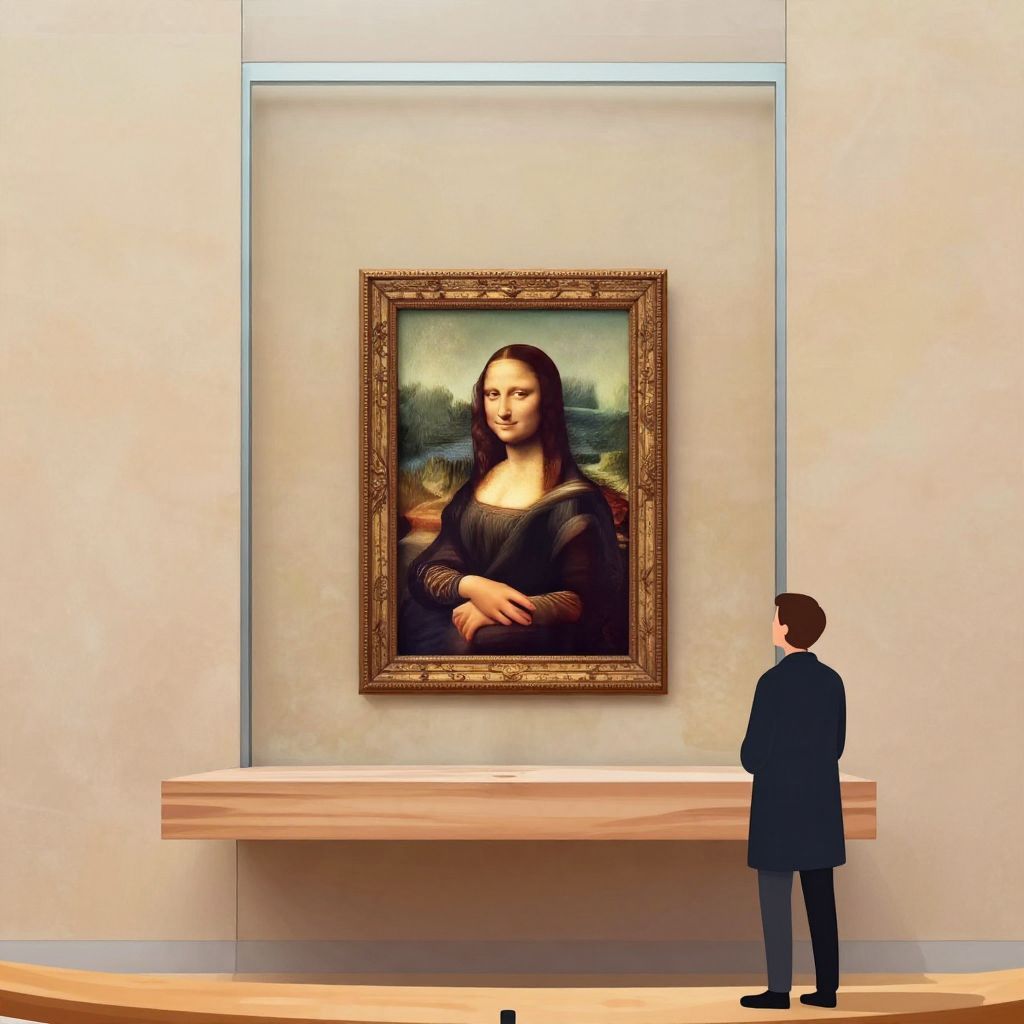
How big is the Mona Lisa? The short answer is that Leonardo da Vinci’s famous portrait is surprisingly small: it measures about 77 cm by 53 cm, or roughly 30 inches by 21 inches. Despite its modest size, the painting has become one of the most recognized works of art in the world.
Its fame can make it seem larger than life, but the original panel is intimate in scale. That small format mattered in the Renaissance, when portraiture often served private collectors, elite patrons, and carefully controlled settings rather than public exhibition halls.
How big is the Mona Lisa?
The Mona Lisa is approximately 77 cm tall and 53 cm wide (about 30 in × 21 in). It is painted on a poplar wood panel, not on canvas, and its size is one reason viewers are often surprised when they see it in person. The painting is much smaller than its reputation suggests.
Why the Mona Lisa seems larger than it is
Many people first encounter the Mona Lisa through reproductions, posters, books, museum websites, films, and endless digital images. Those versions can make the portrait feel monumental. In reality, the original work is an intimate half-length portrait, meant to be viewed at close range. Its scale encourages careful looking rather than dramatic distance.
A painting designed for private viewing
Renaissance portraits were often created for a patron’s home or personal collection. A smaller panel made sense in that world. It was portable, expensive, and suited to a domestic interior, where a viewer could stand close enough to study the sitter’s face, hands, and expression. The painting’s size helped create the sense of quiet psychological presence for which it is now famous.
What are the Mona Lisa’s exact dimensions?
Art historians and museums generally give the Mona Lisa’s dimensions as 77 × 53 cm. Slight variations may appear in different descriptions, but this is the standard measurement. The panel is relatively narrow, which contributes to the painting’s vertical emphasis and its focused composition.
How the size affects the composition
Because the portrait is not large, Leonardo had to organize the figure carefully within a tight frame. The sitter’s folded hands occupy the lower foreground, while the upper body turns gently toward the viewer. The landscape behind her stretches outward, creating a contrast between the compact figure and the open, atmospheric background. The small panel heightens the sense of controlled balance.
When was the Mona Lisa painted?
Scholars generally place the beginning of the Mona Lisa around 1503, though Leonardo may have continued working on it for years afterward. The exact chronology is not fully certain, which is common with Renaissance works. What is clear is that the painting belongs to Leonardo da Vinci’s mature period, when he was refining his approach to light, atmosphere, and human expression.
Who was the sitter?
The most widely accepted identification is Lisa Gherardini, the wife of Florentine merchant Francesco del Giocondo. That is why the work is also called La Gioconda in Italian and La Joconde in French. While the identification is broadly accepted, art history always leaves room for debate, and other theories have appeared over time. Still, Lisa Gherardini remains the standard historical explanation.
Why did Leonardo paint it on such a small panel?
Leonardo’s choice of a small poplar panel fits the practices of early 16th-century Italian portraiture. Panels were common supports before canvas became more widespread for certain kinds of painting. A smaller format also suited a private commission and allowed Leonardo to focus on subtle effects of modeling, shadow, and expression rather than large-scale display.
Materials and technique
The Mona Lisa is an oil painting on wood, and Leonardo used delicate layers of paint to create soft transitions between light and dark. This technique, often associated with sfumato, helped produce the portrait’s famously elusive expression. The small size does not diminish the technical ambition of the work; if anything, it makes the precision more impressive.
How does the Mona Lisa compare to other famous paintings?
Compared with many museum masterpieces, the Mona Lisa is modest in size. Some viewers expect a grand, wall-filling image because of its celebrity status, but it is closer in scale to a personal portrait than a monumental altarpiece. Its fame comes not from physical dimensions but from artistic quality, historical intrigue, and centuries of public fascination.
- Mona Lisa: about 77 × 53 cm
- Large Renaissance altarpieces: often several meters tall
- Decorative court portraits: sometimes larger, but still varied by purpose
This contrast helps explain why visitors to the Louvre often feel startled by the painting’s size. The work is displayed behind protective glass and viewed at a distance, which can make it seem even smaller in a crowded gallery.
How did the painting become so famous?
The Mona Lisa’s fame developed over time, not overnight. Leonardo’s reputation mattered, but the painting’s later history played a major role. It entered the French royal collection and eventually became a prized work in the Louvre. Its celebrity grew further in the 19th century, when writers and critics helped elevate Leonardo’s status and the portrait’s mysterious aura.
The 1911 theft and modern celebrity
A major turning point came in 1911, when the painting was stolen from the Louvre. The theft drew enormous international attention and turned the Mona Lisa into a global sensation. When it was recovered, its fame expanded even more. From then on, the painting was not just admired; it was instantly recognizable as a cultural icon.
What does the Mona Lisa’s small size mean for interpretation?
The painting’s dimensions are part of its meaning. A small portrait invites intimacy. It asks the viewer to come close, to notice the sitter’s gaze, the soft modeling of the face, and the restrained elegance of the pose. The scale reinforces the painting’s quiet psychological power, which is very different from the theatrical grandeur of large public art.
Intimacy and presence
Because the work is compact, the sitter feels near rather than distant. The viewer does not look up at a heroic figure or across a vast historical scene. Instead, the encounter is personal. That intimacy is one reason the portrait has been discussed so often by historians, artists, psychologists, and the public alike. Its smallness is not a limitation; it is part of the experience.
Where is the Mona Lisa now?
The Mona Lisa is housed in the Louvre Museum in Paris, where it is among the museum’s most visited works. It is displayed under protective conditions because of its age, fame, and vulnerability. The painting’s size, combined with the crowds that gather around it, means that many visitors see it from farther away than Leonardo may have intended.
Preservation and viewing conditions
Over the centuries, the panel has required careful conservation. Wood can warp, paint layers can age, and environmental changes can affect the surface. Modern display methods protect the work while allowing the public to see it. Even so, the experience is shaped by distance, glass, and traffic flow, which can make the painting feel smaller than reproductions suggest.
Why the Mona Lisa still matters
The Mona Lisa matters because it brings together technical mastery, historical context, and human curiosity. Its size is part of that story. At just 77 by 53 centimeters, it shows how a relatively small object can become one of the most influential images in world art. The painting’s power lies not in scale but in concentration, subtlety, and endurance across five centuries.
So, how big is the Mona Lisa? Not big at all in physical terms—but historically, artistically, and culturally, it is enormous. If you want to explore more of the painting’s story, see where King Francis kept the Mona Lisa and how da Vinci created the mood in the Mona Lisa.