
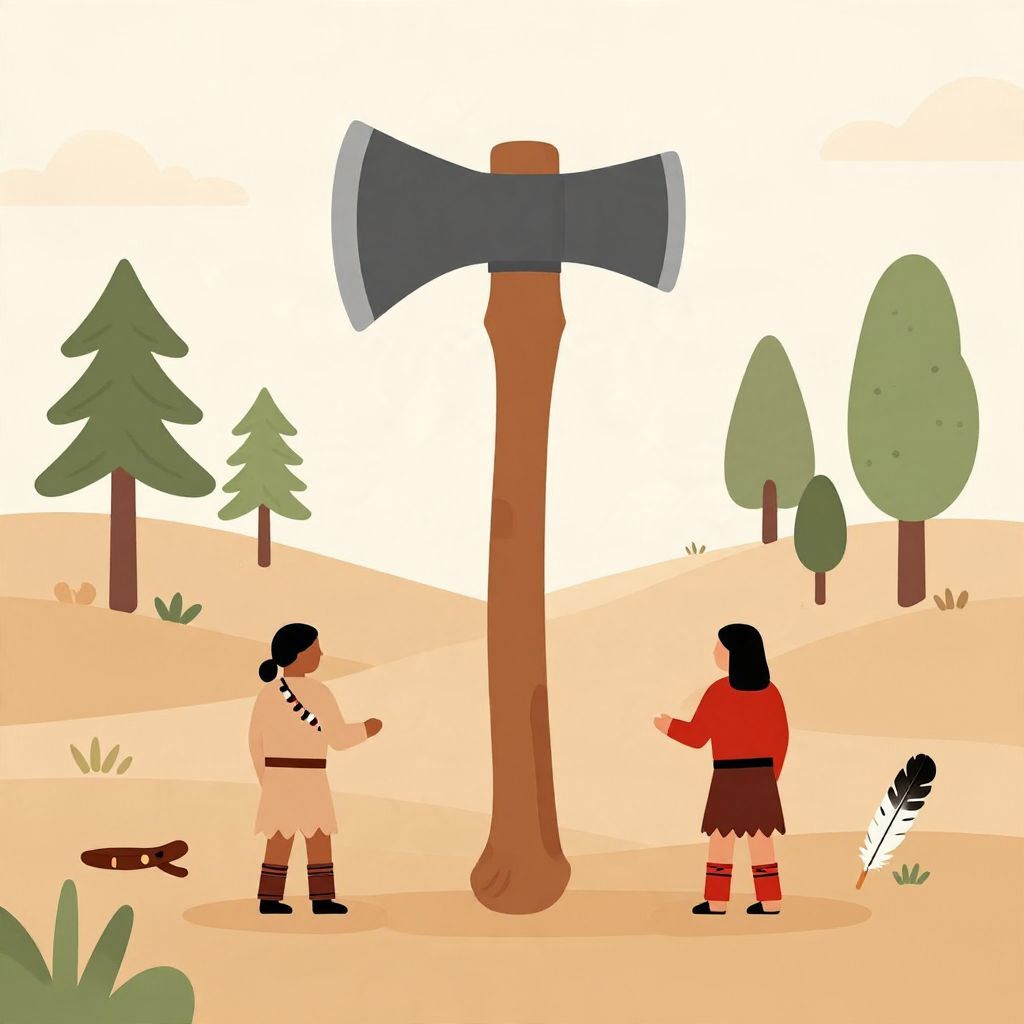
What is a tomahawk? In historical terms, it is a small axe or hatchet used by many Indigenous peoples of North America for cutting, hunting, and warfare. Over time, the tomahawk also became a symbol of diplomacy, trade, and conflict, especially during the colonial era.
Its history is more complex than the modern stereotype of a “war weapon.” The tomahawk changed in form and meaning as Native communities, European traders, soldiers, and settlers interacted across centuries.
What Is A Tomahawk?
A tomahawk is a lightweight hand axe, originally associated with Indigenous North American cultures. It was used for practical tasks such as chopping, but it also served as a close-combat weapon and ceremonial object. The word became especially familiar in English during the colonial period, when Europeans encountered and traded for these tools.
Origins and Early History
The tomahawk did not begin as a single fixed design. Indigenous peoples across North America used a range of stone-headed axes and hatchets long before sustained European contact. These tools were adapted to local materials, needs, and cultural practices, and they varied widely from region to region.
Before European contact
Archaeological evidence shows that Native communities used stone axes and adzes for woodworking, hunting preparation, and daily labor. Some of these tools had hafted handles and compact heads that resemble later tomahawks in function, though not always in exact shape. In other words, the tomahawk’s ancestry lies in older Indigenous tool traditions rather than in a single invention with a known date.
The origin of the name
The English word tomahawk comes from Indigenous languages of the eastern woodlands, commonly traced to Algonquian roots. European writers adopted the term after contact in the 16th and 17th centuries. Because spelling and pronunciation varied, early records show multiple forms of the word, reflecting how Europeans heard and recorded Indigenous speech.
How Did the Tomahawk Develop Over Time?
The tomahawk evolved as materials and trade networks changed. Stone heads were gradually joined, and in many places replaced, by metal heads obtained through trade with Europeans. This shift made the tool more durable and efficient, while also tying it more closely to colonial commerce and diplomacy.
Stone to metal
Before European trade goods became widespread, tomahawk-like tools were often made with stone heads hafted to wooden handles. After contact, metal—especially iron and steel—became highly valued. Indigenous smiths and traders adapted the new material into familiar forms, creating axes that were both practical and culturally meaningful.
Trade and exchange
European traders quickly recognized that tomahawks were useful trade items. They were compact, versatile, and easy to transport, making them common in exchange networks. A tomahawk could function as an everyday tool, a status object, or a diplomatic gift, depending on the context.
What Was a Tomahawk Used For?
The tomahawk had multiple uses, and its meaning depended on who carried it and where. It was not simply a weapon. In many communities, it was an all-purpose tool that could cut wood, process game, prepare camp materials, and serve in defense or warfare when needed.
Practical uses
- Chopping and splitting wood
- Preparing animal hides and game
- Clearing brush and making camp
- General household and travel use
Military and defensive uses
When used in combat, the tomahawk was valued for its light weight and speed. It was effective at close range and could be carried more easily than larger weapons. However, its battlefield role should not be exaggerated. In many historical settings, it was one weapon among many, alongside bows, spears, firearms, knives, and clubs.
Ceremonial and diplomatic uses
Tomahawks also carried symbolic meaning. Some were used in peace-making rituals, gift exchange, or as signs of alliance. The familiar phrase “bury the hatchet” reflects a later popular image of ending conflict, though the saying is more a cultural metaphor than a precise record of one universal Indigenous practice.
Tomahawks in Colonial North America
The colonial period gave the tomahawk new visibility. French, British, Dutch, and Spanish colonists encountered Indigenous peoples who already used axe-like tools, and they quickly incorporated tomahawks into trade, military life, and frontier culture. This was a period of exchange, adaptation, and conflict, not simple borrowing in one direction.
European influence on design
European metalworking influenced tomahawk forms. Some colonial-era tomahawks developed broader blades, pipe-bowl combinations, or decorative features. The so-called “pipe tomahawk” became especially notable in the 18th and early 19th centuries, combining a functional axe head with a smoking pipe stem. These objects were often used in diplomacy and ceremony as well as in daily life.
Military frontier use
Colonial soldiers and frontier travelers sometimes carried tomahawks because they were practical tools that could also be used in emergencies. Their portability made them useful in wooded terrain and on long journeys. Still, the image of the tomahawk as a universal frontier weapon is partly shaped by later popular culture, not just by historical reality.
The Pipe Tomahawk and Its Cultural Meaning
One of the best-known historical forms is the pipe tomahawk, a hybrid object associated especially with the 18th and early 19th centuries. It was both a weapon and a ceremonial pipe, and it became a powerful symbol in diplomacy between Native nations and colonial or U.S. officials.
Why it mattered
The pipe tomahawk was not merely decorative. Its double function made it especially meaningful in treaty settings, gift exchanges, and formal meetings. As with many objects in Indigenous and colonial history, its significance depended on relationship, context, and use. A single object could represent peace, alliance, prestige, or readiness for conflict.
Not just a stereotype
Popular images often reduce the tomahawk to a “war axe,” but that view misses its broader history. The pipe tomahawk in particular shows how material culture could bridge practical use and ceremonial expression. It also reminds us that Indigenous diplomacy was sophisticated, formal, and politically important.
Tomahawk Myths and Misconceptions
Modern depictions sometimes flatten the tomahawk into a simple symbol of violence. That image is incomplete. The historical tomahawk was diverse in form and purpose, and its meaning changed across time, region, and community.
Common misconceptions
- Myth: A tomahawk was only a weapon.
Reality: It was also a tool, trade item, and ceremonial object. - Myth: All tomahawks looked the same.
Reality: Designs varied widely by region and era. - Myth: The tomahawk was invented by Europeans.
Reality: Its roots are Indigenous, though European trade changed its materials and forms. - Myth: The tomahawk was mainly used in large battles.
Reality: It was often more important in everyday life, travel, and close-range encounters.
What Happened to the Tomahawk in Later History?
As firearms became more common and industrial tools spread, the tomahawk’s everyday role changed. It did not disappear, but it became less central as a general-purpose implement in many places. In the 19th and 20th centuries, it survived in ceremonial contexts, historical memory, reenactment, and later popular culture.
From lived object to symbol
By the modern era, the tomahawk increasingly functioned as a symbol of Indigenous identity, frontier history, or military imagery. This symbolic afterlife sometimes obscured its older practical uses. At the same time, many Native communities continued to preserve and reinterpret tomahawk traditions as part of cultural heritage.
Key Facts About the Tomahawk
- It is a small axe or hatchet with Indigenous North American origins.
- The term entered English through Indigenous languages, especially Algonquian-related forms.
- Early versions were often made with stone heads; later ones frequently used iron or steel.
- It served as a tool, weapon, trade item, and ceremonial object.
- The pipe tomahawk became especially important in diplomacy during the colonial era.
Why the Tomahawk Matters in History
The tomahawk matters because it reveals how technology, trade, and culture shaped everyday life in North America. It also shows that objects can carry multiple meanings at once. A tomahawk could be a tool for survival, a weapon of defense, a sign of alliance, or a symbol of identity.
Understanding the tomahawk means looking beyond stereotypes and recognizing Indigenous innovation, adaptation, and diplomacy. For more on historical objects and political structures, you may also find what is a duchy and what is a samovar useful for broader historical context.