
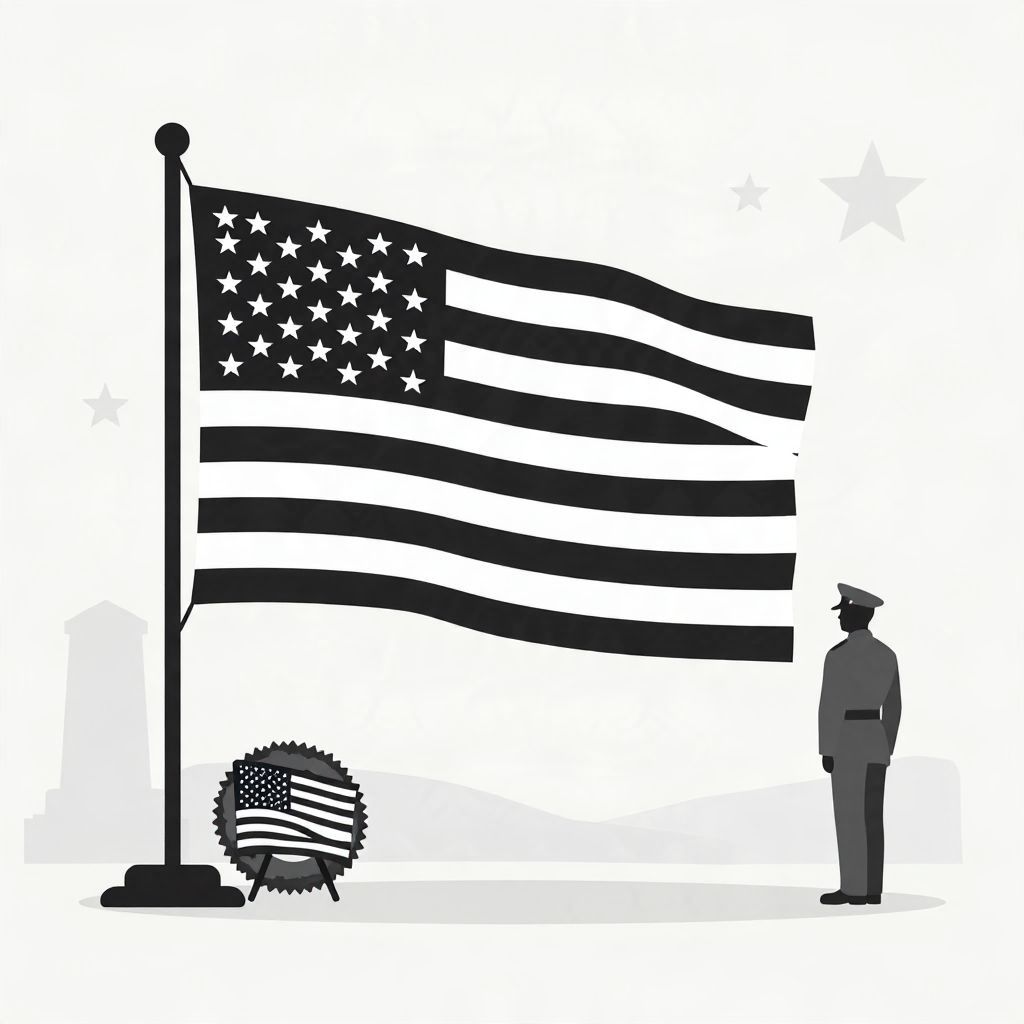
What does the black and white American flag mean? In most cases, it is not an official U.S. flag at all, but a modern variation of the American flag used to signal mourning, remembrance, protest, or support for specific causes. Its meaning depends on context, because different groups and individuals use it in different ways.
Historically, the black-and-white version is a symbolic adaptation of the Stars and Stripes rather than a separate national emblem. To understand it, you have to look at how the American flag has been reinterpreted in war, activism, memorial culture, and popular media.
What Does the Black and White American Flag Mean?
The black and white American flag usually represents mourning, respect for the dead, solidarity, or a somber political message. It is not the official U.S. flag, and its meaning changes by setting: some people use it to honor fallen service members or first responders, while others use it as a protest symbol or a sign of resistance.
Why the Black-and-White Flag Exists
The standard American flag is defined by law in its colors, proportions, and symbolism, but people have long adapted it for informal use. Black-and-white versions strip away the flag’s bright red, white, and blue palette and replace it with a stark, subdued look that suggests grief, seriousness, or defiance. The visual effect is immediate: the familiar national symbol becomes quieter and more severe.
A symbol of mourning and remembrance
One of the most common meanings is mourning. Black has long been associated in Western cultures with death, loss, and solemnity, so a black-and-white American flag can function as a memorial emblem. It may appear at funerals, on social media after tragedies, or in displays honoring military personnel, police officers, firefighters, or civilians killed in the line of duty.
A sign of protest or political dissatisfaction
In some settings, the black-and-white flag is used to express anger or disillusionment with the government, social conditions, or national policy. Because it removes the flag’s bright colors, it can suggest that something is “wrong” with the nation or that the country is being viewed through a more critical lens. This use is modern, informal, and highly dependent on the group displaying it.
A visual style borrowed from modern culture
The black-and-white look also became popular through graphic design, tattoos, apparel, and online imagery. In these contexts, the flag may be chosen less for a fixed political meaning and more for its dramatic appearance. That does not erase its symbolism, but it does mean the same image can carry different messages from one person to another.
Is It an Official American Flag?
No. The black and white American flag is not the official U.S. flag recognized by federal law. The official flag is the familiar red, white, and blue design established by statute and custom. Black-and-white versions are unofficial modifications, and their meaning comes from social use rather than from the U.S. government.
The difference between official and symbolic use
The United States has a legally defined flag, but Americans have always used flag imagery in broader ways: on clothing, posters, memorials, military insignia, and protest art. Once a symbol enters public culture, it can be reworked to express grief, patriotism, irony, rebellion, or unity. The black-and-white version belongs to that larger tradition of symbolic adaptation.
The Historical Roots of Flag Modification
Changing the colors of a national flag is not unique to the United States. Across modern history, flags have been altered to communicate urgency, mourning, or political stance. Black-and-white versions often appear when people want to keep the shape of the national symbol while changing its emotional tone.
Black as mourning in Western tradition
In Europe and North America, black has long been the color of formal mourning. That association carried into modern civic life, where black ribbons, draped flags, and memorial bunting became common ways to mark death and catastrophe. The black-and-white American flag draws on that older visual language.
Flags in wartime and remembrance culture
During and after wars, nations often use flags in altered forms to honor the dead. In the United States, flags are commonly flown at half-staff after national tragedies or deaths of major public figures. The black-and-white American flag is a more modern, informal extension of the same impulse: it keeps the national emblem visible while signaling loss.
Common Meanings in Modern Use
Because the symbol is unofficial, you should always read it in context. The same black-and-white flag can mean very different things depending on who is using it and where it appears.
- Mourning: honoring the dead or marking a tragic event.
- Memorial: remembering military personnel, police, firefighters, or civilians.
- Solidarity: showing support for a group affected by violence or loss.
- Protest: expressing criticism of government, policy, or social conditions.
- Stylistic patriotism: using a subdued version of the flag for fashion, art, or design.
Why context matters so much
Unlike an official flag flown under strict rules, a black-and-white version has no single universally accepted meaning. A memorial display at a cemetery, for example, is likely to communicate grief and respect. The same image on a protest banner may signal anger or resistance. Without context, the symbol can be ambiguous.
How the Symbol Became Popular
The black-and-white American flag became especially visible in the late 20th and early 21st centuries, when digital media, political branding, and merchandise made symbolic imagery easier to spread. It appears in online profiles, decals, patches, T-shirts, tattoos, and commemorative displays. Its popularity reflects both the power of the American flag and the desire to reinterpret it.
Social media and visual shorthand
Online culture helped standardize the image as a quick visual shorthand. In a fast-moving digital environment, a black-and-white flag can communicate seriousness or grief instantly, without a long explanation. That speed, however, also encourages misunderstanding, since viewers may project their own assumptions onto the symbol.
Law enforcement and military associations
Some black-and-white American flags are linked to specific professions or causes, especially in memorial settings. For example, variations may be used to honor fallen officers or service members. In those cases, the flag is less about national identity in the abstract and more about sacrifice, duty, and remembrance.
Common Misunderstandings About the Black and White Flag
Because the symbol is so visible, it is often misunderstood. People sometimes assume it has one fixed meaning or that it is an official replacement for the U.S. flag. Neither is true. Its meaning is flexible, and that flexibility is exactly why it has become so widely used.
It is not the same as the “thin blue line” flag
Some black-and-white American flags are associated with the “thin blue line” design, which usually includes a single blue stripe and is used to show support for police. But not every black-and-white flag is a thin blue line flag, and not every black-and-white version carries the same message. The details matter.
It is not a single political ideology
People across the political spectrum use black-and-white flag imagery. One person may see it as patriotic mourning; another may see it as protest; a third may simply like the design. Historical interpretation depends on who is using the symbol, when, and for what purpose.
How to Interpret It in Real Life
If you encounter a black-and-white American flag, the safest historical reading is to ask what setting it appears in. A memorial service, a veteran’s tribute, a political rally, and a social media profile all suggest different meanings. Symbols are not fixed objects; they are shaped by use.
- Look at the setting: memorial, protest, decoration, or online post.
- Notice added symbols: stripes, stars, text, emblems, or colors may change the meaning.
- Consider the audience: family, activists, veterans, police supporters, or general public.
- Avoid assuming one universal message: the symbol is intentionally flexible.
The Larger Historical Meaning of Altered Flags
The black-and-white American flag is part of a longer history of people reshaping national symbols to express emotion and politics. Flags are powerful because they condense identity into a simple image. When their colors are changed, the new version often says as much about grief, conflict, or cultural memory as it does about patriotism.
In that sense, the black-and-white flag is less a separate flag than a commentary on the original one. It keeps the national outline but changes the mood, turning celebration into solemnity or pride into critique. That is why it remains so visually striking and so open to interpretation.
In short, the black and white American flag usually means mourning, remembrance, or protest, but its exact message depends on context. It is an unofficial adaptation of the U.S. flag, not a replacement for it. If you want to explore related symbolism, you may also find our guides to what the black American flag means and what the black flag means useful.