
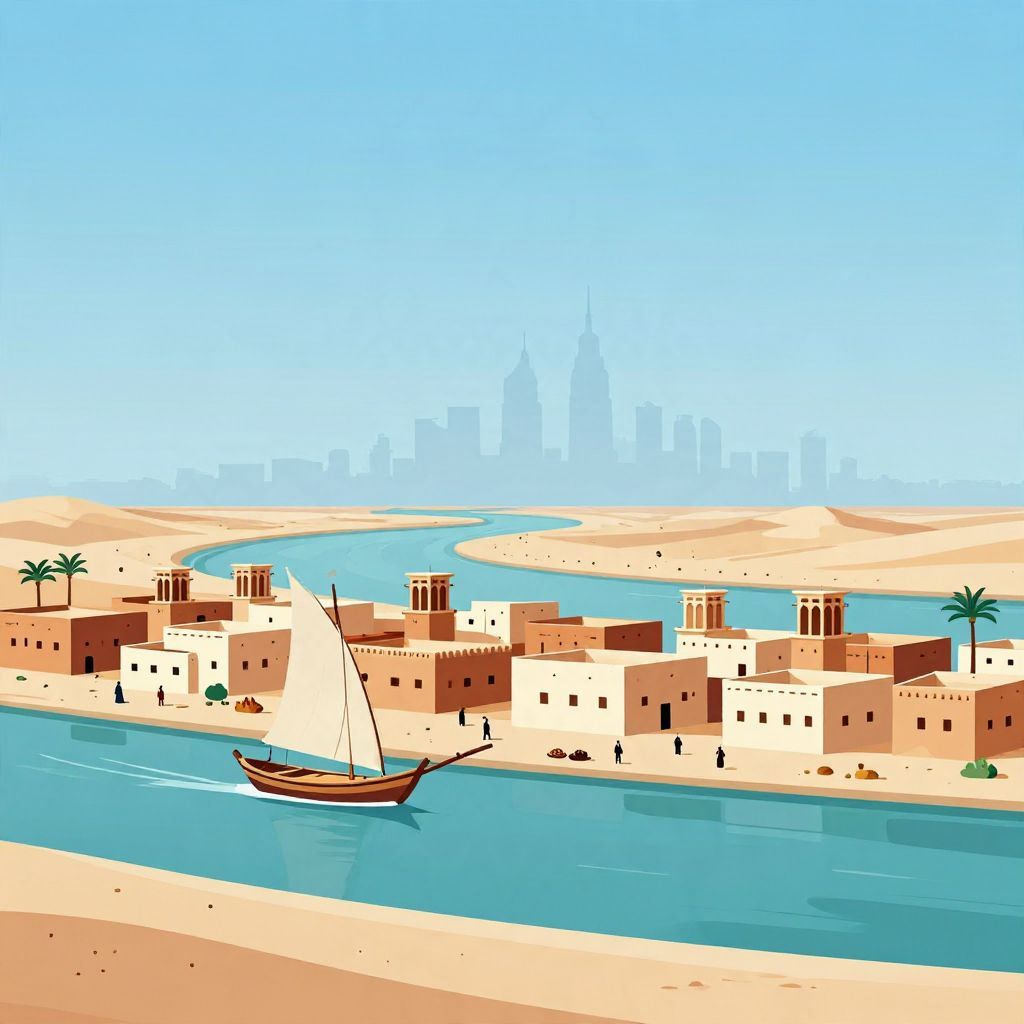
When was Dubai built? The short answer is that Dubai was not “built” all at once. It began as a small settlement in the early 19th century, with the earliest widely cited written reference dating to 1822. Over time, it grew from a creekside trading and pearling community into the modern city known today.
So the real history of Dubai is a story of gradual development, not a single founding moment. Its rise was shaped by migration, maritime trade, local leadership, and later the oil era and global investment.
When Was Dubai Built?
Dubai’s earliest documented settlement dates to about 1822, when it was described as a small town on the creek. But the city’s roots likely go back earlier, and its modern urban form emerged much later in the 20th century. In other words, Dubai was established in stages rather than “built” on one exact date.
The Early Origins of Dubai
A settlement on the creek
Dubai’s original location mattered. The natural creek provided shelter for boats and a practical base for fishing, pearling, and trade. This waterway helped turn the area into a useful stop along Gulf maritime routes, long before skyscrapers and highways existed.
Historical records from the early 1800s show Dubai as a modest settlement rather than a major city. The population was small, and daily life depended on the sea, local commerce, and seasonal economic activity. Like many Gulf communities, Dubai’s early growth came from geography as much as from politics.
Before the city: regional history
The broader region of what is now the United Arab Emirates had been inhabited for centuries by nomadic, coastal, and trading communities. Archaeological evidence from the UAE as a whole shows much older human activity, but that is not the same as saying Dubai itself was an ancient city. The present-day urban center of Dubai is comparatively recent.
This distinction is important. When people ask “when was Dubai built,” they usually mean the origin of the city, not the age of human settlement in the wider desert and coastal region. For that question, the best answer is the early 1800s, especially around 1822.
Who Founded Dubai?
The Al Maktoum family and the rise of the town
Dubai’s political history is closely tied to the Al Maktoum family, who became rulers of the area in 1833. That year is often treated as a major turning point because it marks the beginning of the ruling dynasty that still governs Dubai today.
It is more accurate to say that the Al Maktoum family helped shape and expand Dubai than to say they “built” it from nothing. The settlement already existed, but their leadership gave it greater stability and direction. Under their rule, Dubai developed into a more organized town and port.
Why 1833 matters
The year 1833 is significant because it marks a political transition, not the first human presence in the area. For historians, this is often the closest thing to a “founding date” for modern Dubai as a ruled settlement. Still, the city’s growth continued gradually over the next century and beyond.
How Dubai Grew in the 19th and Early 20th Centuries
Trade, pearling, and the creek economy
In the 1800s and early 1900s, Dubai’s economy depended heavily on trade and pearling. Pearl diving was especially important across the Gulf before the rise of cultured pearls and modern oil wealth. Merchants, sailors, and divers all played roles in the local economy.
Dubai also benefited from its position as a trading hub. Merchants moved goods through the creek, and the town became known for relatively open commerce. This helped attract people from nearby regions, adding to the population and encouraging further expansion.
Migration and openness
Dubai’s growth was not only about local resources. It also reflected migration. People moved there for work, trade, and opportunity. That openness became one of the city’s defining features and later helped Dubai become a cosmopolitan commercial center.
By the early 20th century, Dubai was still small compared with modern standards, but it had become an established port town with a distinct identity. Its future depended on balancing traditional livelihoods with new economic possibilities.
The Turning Point: Oil, Reform, and Modernization
Oil discovery and its limited early impact
Oil was discovered in Dubai in the 20th century, but unlike some neighboring states, Dubai’s early oil reserves were not vast. Oil revenue still mattered, but Dubai’s leaders also pursued trade, infrastructure, and diversification. That decision proved crucial.
Rather than relying solely on oil, Dubai invested in ports, transport, and business-friendly policies. This helped the city prepare for a future beyond petroleum. In historical terms, this was a major reason Dubai transformed so quickly in the late 20th century.
From town to global city
Dubai’s modern identity emerged through a series of planned developments: roads, ports, airports, commercial districts, and real estate projects. The city was no longer just a settlement on a creek; it became a regional and international hub.
This modern phase can make Dubai seem much older than it is, because the skyline and infrastructure are so dramatic. But the city’s rapid transformation is recent. Most of the Dubai people recognize today was built in the second half of the 20th century and the early 21st century.
A Simple Dubai Timeline
If you want the history in chronological form, this timeline gives the clearest answer:
- Before the 1800s: The wider region had long been inhabited, but Dubai was not yet a major urban center.
- Early 1800s: Dubai appears in historical records as a small settlement, with a commonly cited reference around 1822.
- 1833: The Al Maktoum family becomes the ruling dynasty of Dubai.
- Late 1800s to early 1900s: Dubai grows as a creekside trading and pearling town.
- Mid-20th century: Oil and modernization begin reshaping the city.
- Late 20th century onward: Dubai expands into a major global metropolis.
Why There Is No Single “Built” Date
Different meanings of “built”
The question “When was Dubai built?” can mean different things. It might ask when people first settled there, when the town was first recorded, when the ruling family took control, or when the modern city took shape. Each answer is valid in a different sense.
For historical accuracy, the safest answer is that Dubai was established as a small settlement in the early 19th century, with a documented reference around 1822, and it became politically defined under the Al Maktoum family from 1833 onward.
Myth versus history
Because Dubai is now famous worldwide, people sometimes imagine it as either ancient or suddenly invented. Neither is quite right. It has real historical roots, but it is not an ancient city in the way some older civilizations are. Its modern form is the result of deliberate planning and rapid 20th-century development.
The Lasting Significance of Dubai’s History
Dubai’s history shows how geography, trade, and leadership can shape a city over time. A sheltered creek, a trading economy, and a ruling dynasty created the foundations for growth. Later, strategic modernization turned a small Gulf settlement into one of the world’s best-known cities.
So, when was Dubai built? If you mean the origin of the settlement, the best answer is around 1822. If you mean the beginning of modern Dubai as a ruled town, 1833 is the key date. And if you mean the city people recognize today, that transformation happened mainly in the 20th and early 21st centuries. For more on Dubai’s modern skyline, see when the Burj Khalifa was built, or explore another major construction history with when the Pyramids of Giza were built.