
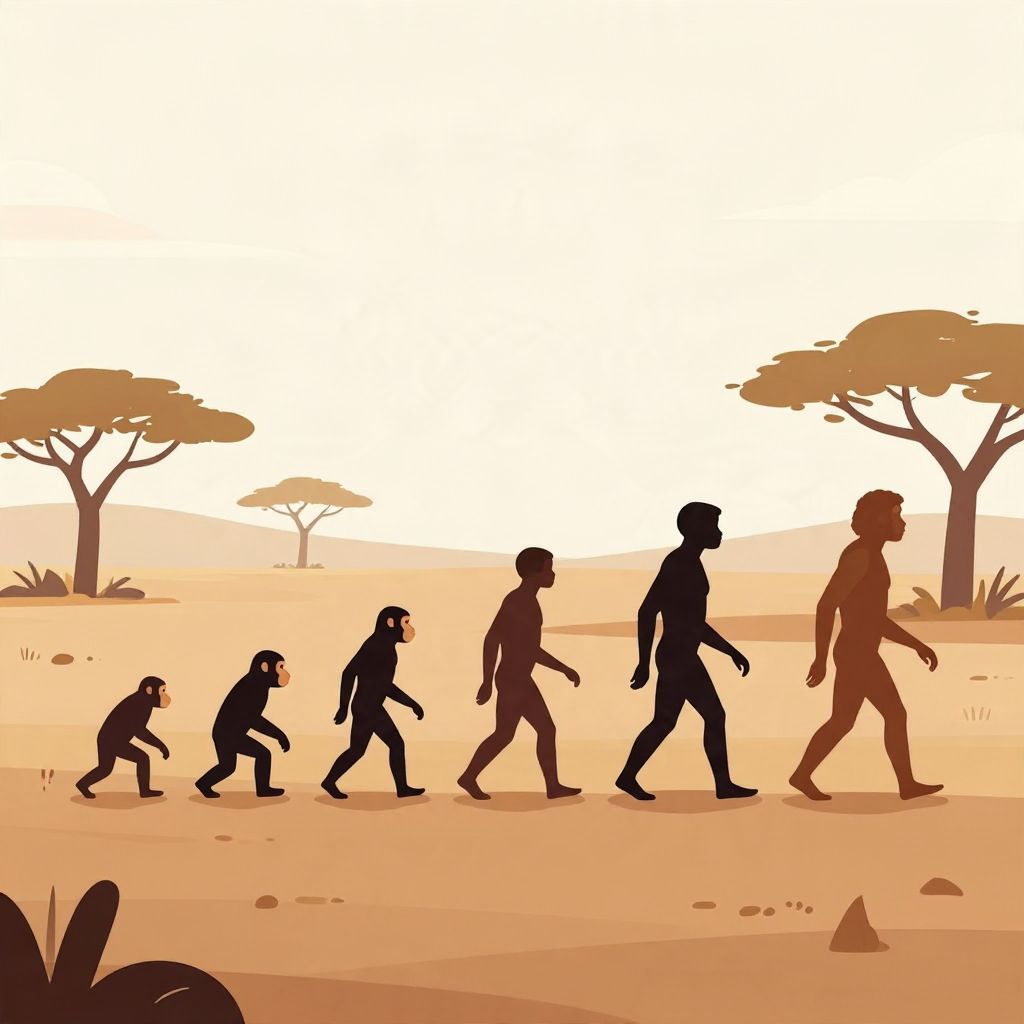
When was walking invented? The short answer is that it was not invented at all. Walking is a biological ability that evolved gradually in human ancestors over millions of years, long before Homo sapiens appeared.
If you are asking when humans first walked on two legs, the best evidence points to early hominins in Africa roughly 6 to 7 million years ago, with fully efficient human-style walking developing much later. The story is evolutionary, not technological.
When Was Walking Invented?
Walking was never invented in the way a tool, machine, or language system is invented. It emerged through evolution. The earliest known hominins likely began moving habitually on two legs in Africa around 6 to 7 million years ago, and bipedal walking became more refined over time in later species such as Australopithecus and Homo erectus.
Why “Invented” Is the Wrong Word
People often ask “when was walking invented” because they want a single origin date. But walking is a form of locomotion shared by many animals, and human walking is one branch of a much older evolutionary history. No one designed it. Natural selection favored traits that made upright movement useful in certain environments.
Walking as an evolved trait
In evolutionary terms, traits do not appear all at once. Small changes in bones, muscles, balance, and posture can accumulate over many generations. Early hominins did not suddenly become modern walkers overnight. Instead, they likely used a mix of climbing, knuckle-walking-like movement, and upright steps before becoming fully adapted to life on the ground.
The Earliest Evidence for Two-Legged Walking
The earliest evidence for habitual bipedalism comes from fossils of very early hominins found in Africa. The exact species and dates are debated, but several discoveries suggest that upright walking was already developing by the late Miocene epoch, around 6 to 7 million years ago.
Key early candidates
- Sahelanthropus tchadensis (about 7 million years ago) may show signs of upright posture, though the evidence is limited and disputed.
- Orrorin tugenensis (about 6 million years ago) has femur features that some researchers interpret as evidence of bipedal walking.
- Ardipithecus species, especially Ardipithecus ramidus (about 4.4 million years ago), show a mix of climbing and walking adaptations.
These fossils do not prove that early hominins walked exactly like modern humans. They do show that the evolutionary path toward walking on two legs was underway very early.
How Human Walking Evolved
Human walking is distinctive because it is efficient, upright, and stable over long distances. That version of walking did not appear instantly. It took millions of years of anatomical change in the pelvis, spine, legs, feet, and skull balance.
Important anatomical changes
- Pelvis: Became shorter and broader, helping support the body upright.
- Spine: Developed an S-shaped curve that helps balance the torso.
- Femur: Angled inward so the knees sit under the body’s center of gravity.
- Feet: Arches formed to absorb shock and provide spring in each step.
- Foramen magnum: The opening where the spine enters the skull moved underneath the head, a sign of upright posture.
These changes made walking more efficient, but they also created trade-offs. Human bodies became less specialized for climbing than those of earlier ancestors, and childbirth became more difficult because of changes in the pelvis.
Why Did Early Humans Start Walking Upright?
There is no single accepted reason why bipedalism evolved. Most historians of science and evolutionary anthropologists see it as the result of several pressures working together rather than one dramatic cause. The environment in Africa was changing, and upright walking may have offered advantages in survival and movement.
Main theories
- Energy efficiency: Walking on two legs can be efficient for long-distance travel.
- Freeing the hands: Upright posture left the hands available for carrying food, infants, or tools.
- Seeing over vegetation: Standing taller may have helped with spotting predators or resources.
- Heat management: An upright body exposes less surface area to direct sun at midday and catches more breeze.
- Carrying and foraging: Bipedalism may have helped in transporting food across open habitats.
These explanations are not mutually exclusive. Different hominin populations may have benefited from bipedalism for different reasons at different times.
From Early Hominins to Modern Humans
By the time the genus Homo appeared, walking had become a central part of human life. Species such as Homo erectus, beginning around 1.9 million years ago, were especially well adapted for long-distance walking and perhaps endurance travel. Their bodies were closer to modern human proportions than those of earlier hominins.
What changed in Homo erectus?
Homo erectus had longer legs, a more modern body shape, and a gait suited to covering ground efficiently. This mattered because humans were becoming more mobile, ranging across larger territories and adapting to varied environments. Walking was no longer just a way to move around; it became a foundation for migration and survival.
Walking and Human Migration
Walking shaped the human story far beyond anatomy. Once early humans could travel efficiently on land, they were able to move out of Africa and into Asia, Europe, and eventually the rest of the world. In that sense, walking was one of the key abilities behind human expansion across the globe.
Major migration milestones
- Early bipedal ancestors evolved in Africa millions of years ago.
- Homo erectus spread beyond Africa by about 1.8 million years ago.
- Later Homo species, including Homo sapiens, continued migrating into new regions.
Walking did not cause migration by itself, but it made migration possible on a much larger scale. The ability to travel long distances on foot became one of the most important human adaptations.
Did Humans Ever “Learn” to Walk?
Every individual human learns to walk during infancy, but that is different from the evolutionary origin of walking as a species trait. Babies are born with the biological capacity for bipedal movement because millions of years of evolution built that ability into the human body. Development in childhood repeats, in miniature, an ancient evolutionary history.
Individual development versus evolution
A child’s first steps are not the invention of walking. They are the personal expression of a species-level trait that already exists. Evolution created the capacity; development activates it.
What the Fossil Record Can and Cannot Tell Us
The fossil record gives strong evidence that upright walking is ancient, but it cannot show the exact first moment it appeared. Fossils are incomplete, and early bipedal behavior is hard to reconstruct from bones alone. Scientists therefore work with probabilities, not absolute certainty.
What is well supported
- Human ancestors were walking on two legs millions of years ago.
- Bipedalism appeared before large brains in human evolution.
- Walking evolved gradually, not suddenly.
What remains uncertain
- The exact species that first walked habitually on two legs.
- The precise date when bipedalism became common.
- Which environmental pressures mattered most.
The Broader Historical Meaning of Walking
Although walking is biological, it has enormous historical significance. Once humans became habitual walkers, they could hunt, gather, trade, migrate, and build communities across wide landscapes. Later civilizations depended on walking for daily life, transport, warfare, pilgrimage, and labor. For most of human history, walking was not optional; it was the basic rhythm of life.
Walking in later history
Even after animals, carts, roads, and vehicles appeared, walking remained central to how people experienced the world. Cities were built for pedestrians as much as for wheels. Religious processions, military marches, and long journeys on foot all reflect the deep historical importance of this ancient human ability.
So, When Was Walking Invented?
If by “walking” you mean human bipedal locomotion, the best answer is that it began evolving in our early ancestors around 6 to 7 million years ago in Africa and became more human-like over millions of years. If you mean the modern, efficient human gait, that developed much later, especially in species such as Homo erectus and Homo sapiens.
The simplest historical takeaway is this: walking was not invented by a person or at a single moment. It is one of humanity’s oldest evolutionary achievements, and it helped make human migration, survival, and civilization possible. For related background, see what step migration is and what cultural divergence means.