
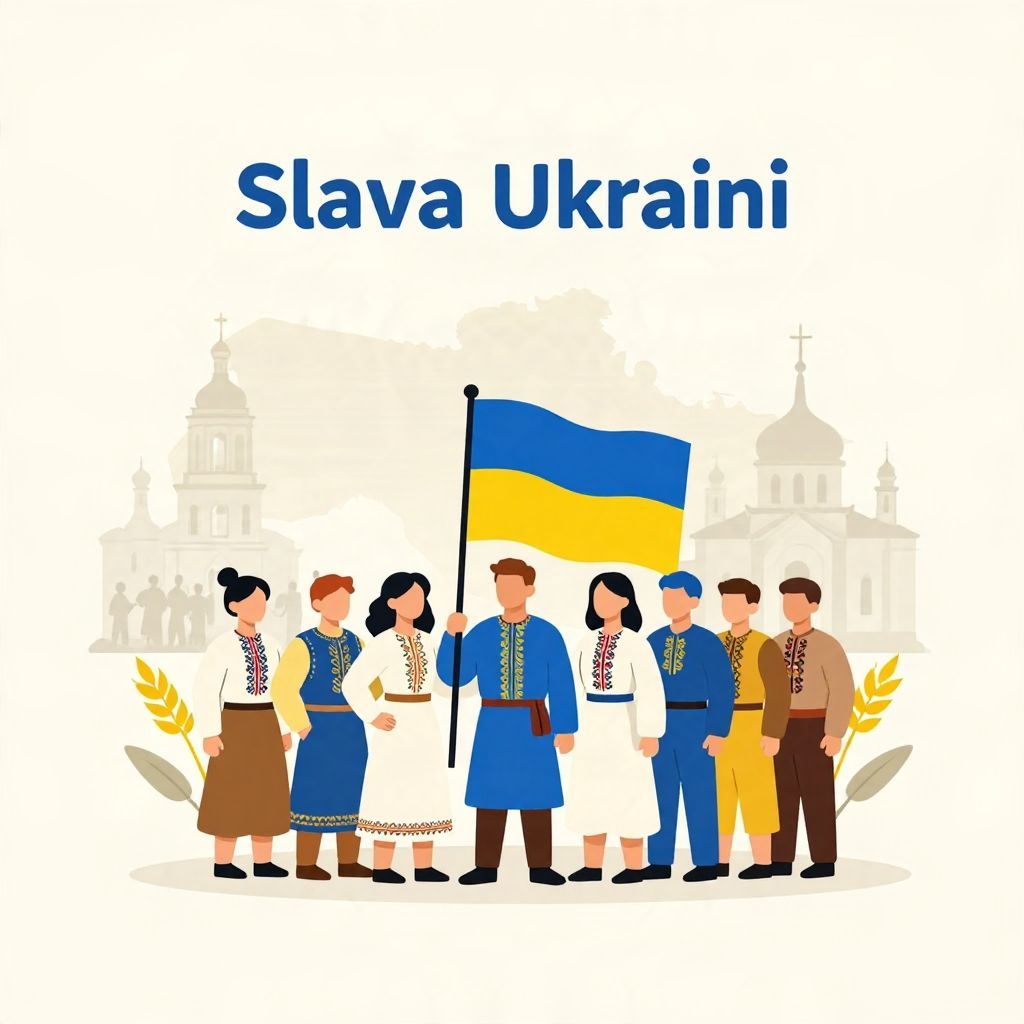
“Slava Ukraine” is a Ukrainian patriotic greeting that means “Glory to Ukraine.” Today it is widely recognized as a symbol of Ukrainian national identity and resistance, especially since Russia’s full-scale invasion in 2022. But the phrase is older than the current war, and its meaning has changed over time as Ukraine’s modern nationhood developed.
To understand it properly, you need both the language and the history behind it. The phrase has been used in politics, literature, military culture, and public protest, and its modern significance reflects a long struggle over independence, sovereignty, and memory.
What does Slava Ukraine mean?
“Slava Ukraine” means “Glory to Ukraine.” It is a patriotic Ukrainian slogan and greeting, usually answered with “Heroyam slava”—“Glory to the heroes.” The phrase expresses admiration for Ukraine as a nation and, in modern use, honors those who have fought or sacrificed for its freedom.
Where did the phrase come from?
The exact origin of “Slava Ukraine” is not pinned to one single inventor or date, but it became prominent in the early 20th century during the rise of modern Ukrainian nationalism. It was used by student groups, cultural activists, and political organizations that wanted to strengthen a distinct Ukrainian identity under empires that controlled Ukrainian lands.
At that time, much of today’s Ukraine was divided between the Russian Empire and the Austro-Hungarian Empire. Ukrainian language and culture existed, but political independence did not. In that context, a phrase like “Glory to Ukraine” was not just ceremonial; it was a statement of national belonging.
Early 20th-century political use
The slogan became especially associated with Ukrainian nationalist movements in the 1910s and 1920s. It was used in public gatherings, songs, and political messaging. The response “Glory to the heroes” developed as a companion phrase, though different groups used variations of the greeting.
Because the historical record is uneven, scholars are careful not to assign the phrase to one exact moment of “first use.” What is clear is that by the interwar period it had become recognizable within Ukrainian political culture.
Why did the phrase become important in Ukrainian history?
The phrase became important because it condensed a larger historical struggle into a few words: the desire for self-rule, the defense of language and culture, and the memory of people who fought for independence. In a region repeatedly ruled by larger empires and later by the Soviet Union, short slogans carried real political weight.
Ukraine’s 20th century was marked by upheaval: the collapse of empires after World War I, brief independence efforts, Soviet consolidation, the Holodomor famine of the 1930s, Nazi occupation during World War II, and decades of Soviet rule. In that setting, patriotic language could be both inspiring and dangerous.
Suppression under Soviet rule
Under the Soviet regime, many expressions of independent Ukrainian nationalism were discouraged or repressed. “Slava Ukraine” was often associated with anti-Soviet resistance and nationalist organizations, especially those active during and after World War II. Because of that association, the phrase could carry a negative connotation in Soviet discourse.
This history matters because it explains why the slogan was not always universally embraced in all parts of Ukraine. For some, it symbolized freedom; for others, especially in Soviet memory politics, it could be linked to contested wartime allegiances.
How is “Slava Ukraine” used today?
Today, “Slava Ukraine” is used as a national greeting, a rallying cry at public events, and a sign of solidarity with Ukraine. Since 2022, it has become globally familiar as Ukrainians and supporters around the world use it to express resilience in the face of war.
In modern usage, the phrase is often spoken or written in a call-and-response form:
- Slava Ukraine! — Glory to Ukraine!
- Heroyam slava! — Glory to the heroes!
The response emphasizes sacrifice and courage, especially the service of soldiers, volunteers, medics, and civilians who have defended the country. In public life, the phrase now functions as both a patriotic greeting and a marker of national solidarity.
From political slogan to national symbol
What changed over time was not the literal meaning, but the context. In the early 20th century, it belonged mainly to nationalist circles. In the 21st century, especially after the 2014 Revolution of Dignity and the 2022 invasion, it became far broader in use, crossing into mainstream civic identity.
That shift is historically significant. It shows how a slogan once tied to political activism can become a widely shared expression of national unity when a society faces external threat.
Is “Slava Ukraine” controversial?
Yes, it can be controversial, but the reasons are historical and political rather than linguistic. Supporters see it as a legitimate expression of Ukrainian patriotism and resistance. Critics, especially in Russian state narratives, have tried to portray it as extremist or exclusively tied to far-right nationalism.
That portrayal is incomplete. While some nationalist groups used the phrase in the 20th century, its modern use is much broader and includes ordinary citizens, elected leaders, athletes, artists, and international supporters. Like many historical slogans, its meaning has expanded beyond its earliest political settings.
Why context matters
Language can carry different meanings in different eras. A phrase that once signaled a particular political movement can later become a general national symbol. Historians usually look at who used the slogan, when they used it, and in what circumstances before drawing conclusions about its meaning.
In the case of “Slava Ukraine,” the historical context is essential. It is not just a chant; it is part of a long story about nation-building, repression, resistance, and remembrance.
What does the response “Heroyam slava” mean?
“Heroyam slava” means “Glory to the heroes.” It honors those regarded as heroes of Ukraine’s historical struggle, whether they are soldiers, independence fighters, activists, or ordinary people who have defended the country in difficult times.
The phrase is intentionally broad. In modern Ukraine, “the heroes” can refer to those who died for independence in earlier centuries, those who resisted Soviet control, and those defending the state today. Its flexibility is part of why the greeting remains powerful.
Historical layers of heroism
Different generations of Ukrainians have identified different heroes. For some, the heroes were the fighters of the Ukrainian People’s Republic after 1917. For others, they were dissidents who challenged Soviet rule. Today, many Ukrainians also use the phrase to honor those affected by the current war.
This layering of memory is common in national slogans. Over time, a simple phrase can become a container for many historical experiences.
How did the phrase gain global recognition?
“Slava Ukraine” became widely known outside Ukraine during major political moments in the 21st century, especially after 2014 and then dramatically after February 2022. As international media covered the war, the phrase appeared in speeches, demonstrations, social media, and public solidarity campaigns.
It also spread because it is short, memorable, and easy to translate. People around the world adopted it as a gesture of support for Ukrainian sovereignty. In that sense, the slogan moved from a national expression to an international symbol of resistance.
Why symbols matter in wartime
During wars, slogans can do more than communicate ideas. They help build morale, define community, and signal allegiance. “Slava Ukraine” has served all three functions. It reminds Ukrainians of continuity with earlier struggles and signals to outsiders that the nation sees itself as enduring rather than passive.
That symbolic power is one reason the phrase has become so visible in diplomacy, sports, and public protest. It is a small phrase with a large historical burden.
What should readers understand about its history?
The most important thing to understand is that “Slava Ukraine” is not just a wartime slogan and not just a political slogan. It is a historical expression that grew out of the modern Ukrainian national movement, survived periods of repression, and later became a mainstream symbol of statehood and resilience.
Its meaning has been shaped by changing political realities. In one era it marked nationalist aspiration; in another it was suppressed; today it is widely embraced as a sign of national pride and defiance. That evolution is what gives the phrase its historical depth.
Conclusion
So, what does “Slava Ukraine” mean? It means “Glory to Ukraine,” but historically it means much more: a declaration of identity, a remembrance of sacrifice, and a statement of endurance. Its power comes from the long history behind it, not just the words themselves. For related background on how identity and custom develop over time, see what cultural divergence means in history and how cultural practices can shape national traditions.