
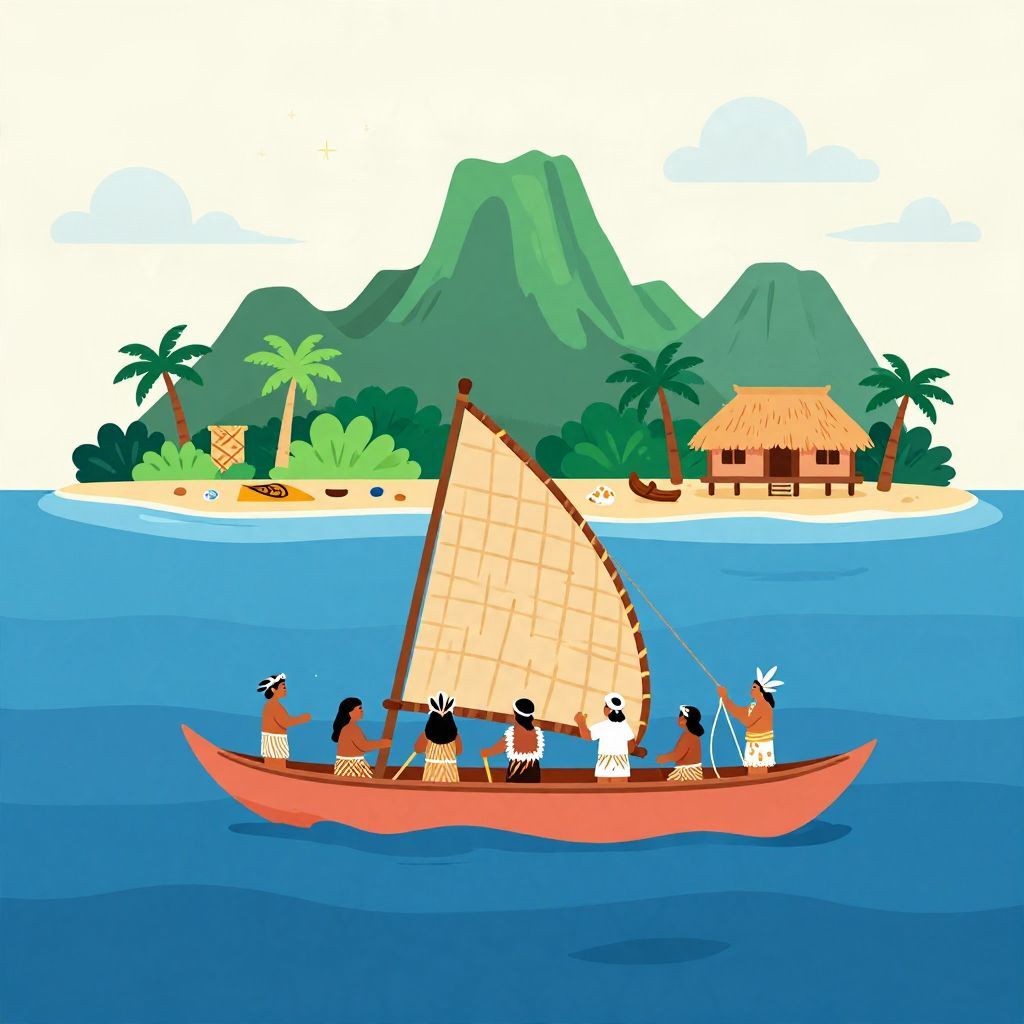
Where are Samoans from? The short answer is that Samoans are from Samoa, the Samoan Islands in central Polynesia, in the South Pacific Ocean. More broadly, Samoan identity grew from a long history of seafaring settlement, island life, and shared Polynesian culture across the islands now divided between the independent state of Samoa and American Samoa.
To answer the question fully, it helps to look at both geography and history: where the Samoan people settled, how their culture developed, and how colonial borders later split the islands into different political territories.
Where are Samoans from?
Samoans are from the Samoan Islands in Polynesia, especially the islands that make up modern Samoa and American Samoa. Their ancestors settled these islands thousands of years ago, and Samoan language, customs, and social organization developed there over many generations. Today, Samoans may live in Samoa, American Samoa, New Zealand, Australia, the United States, and elsewhere, but their historical homeland is the Samoan archipelago.
The Samoan homeland in the Pacific
The Samoan Islands lie in the central South Pacific, east of Fiji and west of the Cook Islands. They are part of Polynesia, the vast cultural and historical region formed by Austronesian-speaking peoples who spread across the Pacific over many centuries. Samoa’s two main modern political units are the independent nation of Samoa and the U.S. territory of American Samoa.
The islands that shaped Samoan identity
The Samoan archipelago includes larger volcanic islands such as Upolu and Savai‘i, along with smaller islands and coral atolls. These islands provided the setting for a distinct Polynesian society based on kinship, chiefly authority, agriculture, fishing, and voyaging. Because the islands are relatively close to one another, they also helped sustain a shared language and culture across the region.
How did the Samoan people come to these islands?
Scholars generally trace Samoan ancestry to the wider Austronesian expansion across Island Southeast Asia and the Pacific. By around 1000 BCE, and likely earlier in some areas, Lapita-associated seafarers had reached parts of the western Pacific. The ancestors of Polynesians, including Samoans, emerged from these long-distance movements and settled the Samoan Islands as part of the broader settlement of Oceania.
From Lapita voyagers to Polynesian societies
The Lapita cultural horizon is important because it marks some of the earliest known Pacific voyaging communities. Archaeology suggests these people were skilled navigators who carried plants, animals, and cultural practices across open water. Over time, their descendants in places like Samoa and Tonga developed the foundations of Polynesian language and society. Samoa became one of the key centers in this process.
Why Samoa mattered historically
Samoa is often described as a major homeland of Polynesian culture because it was part of the region where shared language, social customs, and political forms took shape. Many later Polynesian societies retained features linked to this early heritage, though each island group also developed its own traditions. In that sense, Samoa is both a specific homeland and part of a wider ancestral network.
A brief timeline of Samoan history
Understanding where Samoans are from means following a long chronology, from ancient settlement to modern statehood. The exact dates for early migration are approximate, but the broad sequence is well established.
- c. 1000 BCE or earlier: Austronesian-speaking voyagers spread into the western Pacific.
- c. 900–300 BCE: Lapita communities and their descendants settle and adapt in the Samoan Islands.
- First millennium CE: Distinct Samoan language, chiefly systems, and island traditions develop.
- 18th century: European explorers begin visiting and mapping the islands.
- 19th century: Missionaries, traders, and rival colonial powers increase their presence.
- 1899: Samoa is partitioned between Germany and the United States.
- 1962: Western Samoa becomes independent, later renamed Samoa in 1997.
What makes Samoan culture distinct?
Samoan culture is not just a matter of ancestry; it is a living social system built around family, land, service, and chiefly leadership. The fa‘a Samoa, or “Samoan way,” refers to the values and customs that shape everyday life, from respect for elders to communal responsibility. These traditions developed locally over centuries, even as Samoa remained connected to wider Polynesia.
Language and kinship
The Samoan language belongs to the Polynesian branch of the Austronesian language family. It is closely related to other Polynesian languages, yet it is distinct and deeply tied to Samoan identity. Kinship is organized through extended families, or aiga, which have long played a central role in landholding, social status, and mutual support.
Chiefs, villages, and social order
Traditional Samoan society is often described through its chiefly system, in which matai titles carry authority and responsibility. Villages have long been important political and social units. This structure helped maintain order across island communities and gave Samoan society resilience in the face of outside pressures, including colonial rule and Christian conversion.
How did outsiders change the story of Samoa?
European contact did not create Samoan identity, but it did reshape the islands’ political history. From the 1700s onward, explorers, traders, missionaries, and imperial powers became increasingly involved in Samoa. These encounters brought new religions, goods, diseases, and political rivalries, while Samoans actively negotiated, resisted, and adapted to outside influence.
Missionaries and conversion
Christian missionaries arrived in the 19th century and gradually gained influence. Christianity became deeply rooted in Samoan life, but it was woven into local society rather than simply replacing it. Today, many Samoans identify strongly as Christian, and religion remains an important part of public and family life.
Colonial partition
In 1899, imperial competition led to the division of the Samoan Islands. Germany took control of the western islands, while the United States acquired the eastern islands, now American Samoa. This split had lasting consequences. It created two political entities from one cultural homeland, but it did not divide the Samoan people themselves, who continued to share language, kinship ties, and cultural traditions across the border.
Are Samoans Polynesian?
Yes. Samoans are one of the major Polynesian peoples. Polynesia is a broad cultural and historical region that includes Hawaiians, Māori, Tahitians, Tongans, and many others. Samoans share deep ancestral links with these groups, but they are not simply “generic Polynesians.” They have their own homeland, language, and history within the larger Polynesian world.
Shared ancestry, distinct identity
It is useful to think of Samoan identity in two layers. First, there is the wider Polynesian ancestry that connects Samoans to other Pacific peoples. Second, there is the specifically Samoan cultural tradition that developed in the islands themselves. Both are true, and both matter. A person can be Polynesian in the broad sense and Samoan in the specific sense.
Where do Samoans live today?
Many Samoans still live in their ancestral islands, but migration has created large Samoan communities abroad. Economic opportunity, education, military service, and family networks have all contributed to movement across the Pacific and beyond. As a result, Samoan identity is both island-based and diasporic.
Modern Samoa and American Samoa
Independent Samoa is a sovereign nation, while American Samoa remains an unincorporated U.S. territory. Together, they represent the divided political homeland of the Samoan people. Despite different governments, the islands share language, family ties, and many cultural practices.
The Samoan diaspora
Significant Samoan communities exist in New Zealand, Australia, Hawaii, California, Utah, and other places. These communities have helped keep Samoan language and customs alive across generations. Migration has not erased Samoan origins; instead, it has extended Samoan history into new settings while preserving its connection to the islands.
What is the difference between Samoa and American Samoa?
This question often comes up because the names are similar. Samoa is an independent country in the western part of the Samoan archipelago. American Samoa is a U.S. territory in the eastern part. Both are part of the same cultural homeland, and people from both are Samoan. The political difference is modern; the cultural and historical connection is much older.
One people, two political systems
The division of the islands can make the geography seem complicated, but the basic historical point is simple: Samoans come from the Samoan Islands. The later colonial split changed borders, not ancestry. That is why Samoan identity is often discussed in terms of both nationality and ethnicity, depending on the context.
Why the question matters
Asking where Samoans are from is really asking about migration, settlement, identity, and colonial history all at once. The answer is not just a place on a map. It is a story of Pacific voyaging, island adaptation, social continuity, and political change. Samoa is a homeland with deep ancient roots and a modern global presence.
So, if you are looking for the simplest historically accurate answer: Samoans are from the Samoan Islands in Polynesia, especially the islands now known as Samoa and American Samoa. For more on how historians frame origins and geographic identity, you may also find Where Are Irish People From? and Where Is Alexander the Great From? useful comparisons.