
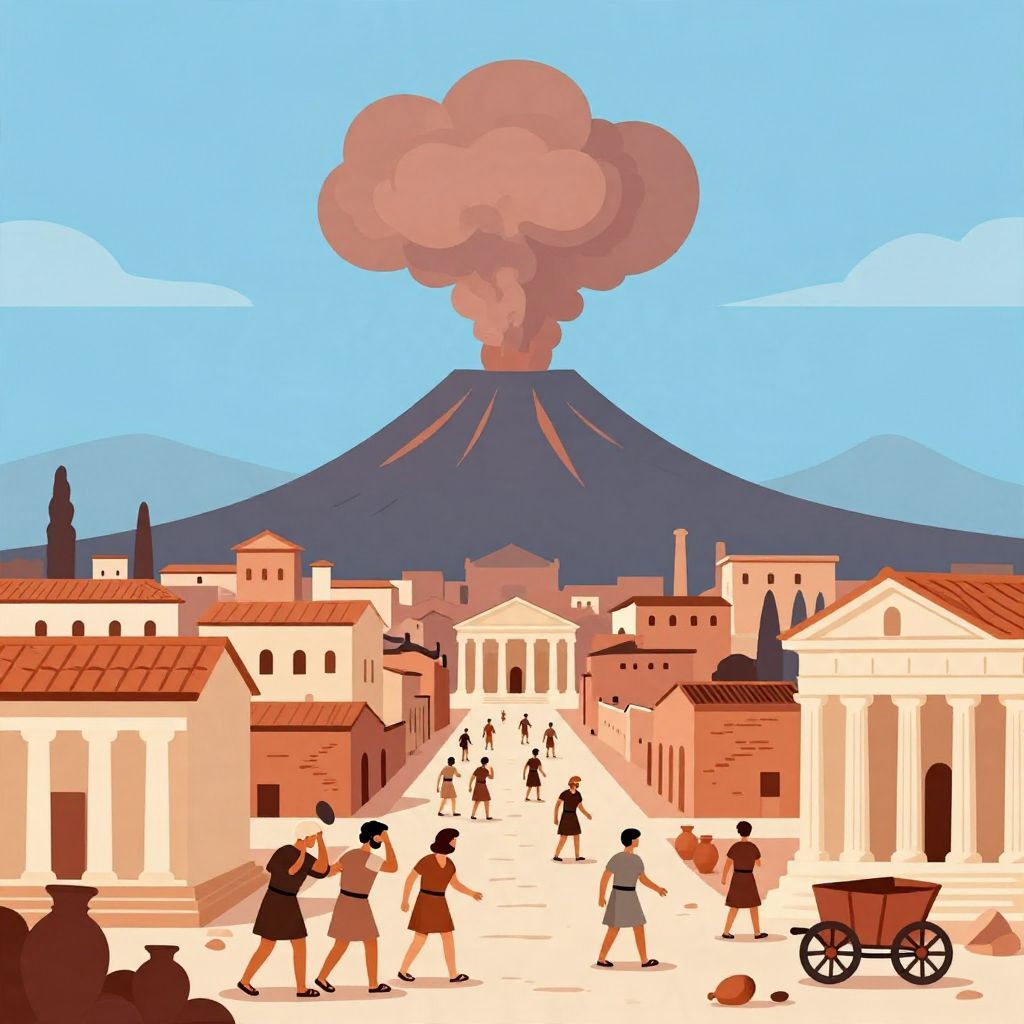
How many people died in Pompeii? The short answer is that historians cannot give a single exact number. The city was overwhelmed by the eruption of Mount Vesuvius in 79 CE, and the death toll is usually estimated at roughly 1,500 to 2,000 people, though some scholars think the number could have been lower or somewhat higher.
What we do know is that Pompeii was not emptied before disaster struck. Many residents escaped, while others were trapped by ash, pumice, toxic gases, collapsing roofs, and the wider destruction caused by the eruption. The surviving evidence is fragmentary, so any total must remain an estimate rather than a precise census.
How many people died in Pompeii?
Most historians and archaeologists estimate that about 1,500 to 2,000 people died in Pompeii during the eruption of Vesuvius in 79 CE. This figure is based on the number of bodies found, the size of the city, and what is known about how many residents and visitors were present. The exact total is uncertain because many remains were destroyed, buried, or never recovered.
Why historians cannot give an exact number
Pompeii was not preserved like a modern disaster scene with complete records. The eruption buried the city under layers of ash and pumice, and later excavation uncovered only part of the ancient urban area. Some victims left no identifiable remains, while others were reduced to traces in the volcanic deposits. Because of this, the death toll is reconstructed from archaeology rather than written casualty lists.
What makes the count uncertain?
- Incomplete excavation: not all of Pompeii has been fully explored.
- Loss of evidence: some bodies decomposed, were crushed, or were dispersed by the eruption.
- Population movement: not everyone in the city was a permanent resident.
- Survivors left no census: ancient records do not provide a reliable final headcount.
For these reasons, the number of dead is best understood as an informed estimate, not a fixed statistic.
What the archaeological evidence shows
Archaeologists have found hundreds of human remains in and around Pompeii, along with the famous plaster casts made by filling voids left in the ash by decomposed bodies. These casts helped reveal the positions of victims at the moment of death and showed that many people died where they had fallen or while sheltering indoors. The remains suggest a sudden, chaotic disaster rather than an orderly evacuation.
How the victims died
For a long time, people imagined that most Pompeians were buried instantly by a rain of ash. Modern research paints a more complex picture. Some died from falling pumice and collapsing structures during the early phase of the eruption. Others likely died later from extreme heat, poisonous gases, and the collapse of roofs under volcanic debris. The final deadly phase may have been especially lethal for those who had remained in the city.
In simple terms, Pompeii was not destroyed by one single mechanism. It was a sequence of hazards that became increasingly dangerous over several hours.
How many people lived in Pompeii before the eruption?
To estimate deaths, historians first try to estimate the city’s population. Pompeii’s population is usually placed at around 10,000 to 20,000 people, though exact figures are debated. The city was a busy Roman center with homes, shops, workshops, public buildings, and visitors. Not everyone was present on the day of the eruption, and some people may have been away in the countryside or traveling.
That means the death toll cannot simply be read as “the population of Pompeii.” Many residents survived by fleeing early, and some people who died in the wider eruption zone were not Pompeii residents at all.
Residents, slaves, and visitors
The ancient city included free citizens, enslaved people, merchants, laborers, children, and travelers. Archaeology suggests that some victims were families trying to escape together, while others were likely enslaved individuals or workers who had fewer means to flee quickly. Because the social structure of Pompeii was complex, the disaster affected different groups unevenly.
What ancient sources say about the eruption
The most famous ancient account comes from Pliny the Younger, who described the eruption in letters written years later. His testimony is invaluable for understanding the event, but it does not give a death toll for Pompeii. He wrote about the cloud, the ash, the darkness, and the panic, and he also described the death of his uncle, Pliny the Elder, during the broader eruption near the Bay of Naples.
Other ancient references confirm the catastrophe, but none provide a precise list of the dead in Pompeii. That is why modern estimates depend mainly on archaeology and analysis of the site.
How the death toll is estimated today
Modern scholars combine several kinds of evidence to estimate the number of deaths:
- Body counts from excavated areas — the number of individuals found in houses, streets, and shelters.
- Settlement size — how large Pompeii was and how densely it was inhabited.
- Escape patterns — signs that many people left before the worst phase of the eruption.
- Comparisons with nearby sites — especially Herculaneum and other affected settlements.
Because these methods do not produce identical results, estimates vary. Still, the commonly cited range of 1,500 to 2,000 deaths is widely used because it fits the available evidence reasonably well.
Pompeii versus Herculaneum: different death patterns
Pompeii is often discussed alongside Herculaneum, another city destroyed by Vesuvius in 79 CE. The two places were affected differently. Pompeii was buried mainly by ash and pumice fallout, while Herculaneum experienced intense pyroclastic surges and flows that killed many people more quickly and preserved organic material in a different way. Comparing the two helps historians understand why casualty estimates differ from site to site.
In Herculaneum, fewer bodies were initially found in the town itself, but many victims were later discovered near the waterfront shelters. In Pompeii, the number of recovered bodies is larger, but the preservation and excavation history are different. This makes direct comparison difficult.
Why the eruption was so deadly
The eruption of Vesuvius was catastrophic because it combined speed, volume, and multiple deadly effects. Ash and pumice began falling while many people were still in the city. As the eruption continued, roofs could collapse under the weight of debris. Later, superheated volcanic clouds and gases made survival nearly impossible for those who remained.
People who left early had a much better chance of survival. Those who stayed, delayed, or were unable to escape faced an increasingly lethal environment. The disaster was not only a natural event but also a human emergency shaped by timing, mobility, and access to escape routes.
Common misconceptions
- “Everyone in Pompeii died.” False. Many people survived by leaving in time.
- “The city was instantly buried.” Not exactly. The eruption unfolded in stages over many hours.
- “We know the exact casualty number.” We do not. All totals are estimates.
What the remains tell us about daily life in Pompeii
The human remains from Pompeii do more than reveal a death toll. They also offer a rare glimpse into everyday Roman life. Jewelry, tools, household objects, food vessels, and body positions show that people were caught in ordinary settings: homes, streets, shops, and courtyards. The disaster froze a moment in time, preserving evidence of social life, domestic routines, and the final attempts to survive.
This is one reason Pompeii remains so powerful in historical memory. It is not only a story about destruction; it is also a record of an ancient city interrupted in an instant.
The historical significance of Pompeii’s death toll
The exact number of deaths matters less than what the disaster reveals. Pompeii shows how vulnerable ancient cities were to sudden environmental catastrophe. It also demonstrates the limits of archaeological certainty: even one of the most famous sites in the world cannot provide an exact casualty count. The best historical answer is therefore approximate, carefully qualified, and grounded in physical evidence.
So, how many people died in Pompeii? The most responsible answer is probably around 1,500 to 2,000, with some uncertainty around that range. The eruption of 79 CE killed many, but not all, and the surviving evidence allows us to estimate rather than count with precision. If you want to explore related historical death tolls, you may also be interested in how many people died building the Great Wall of China and how many people died in the Columbine shooting.