
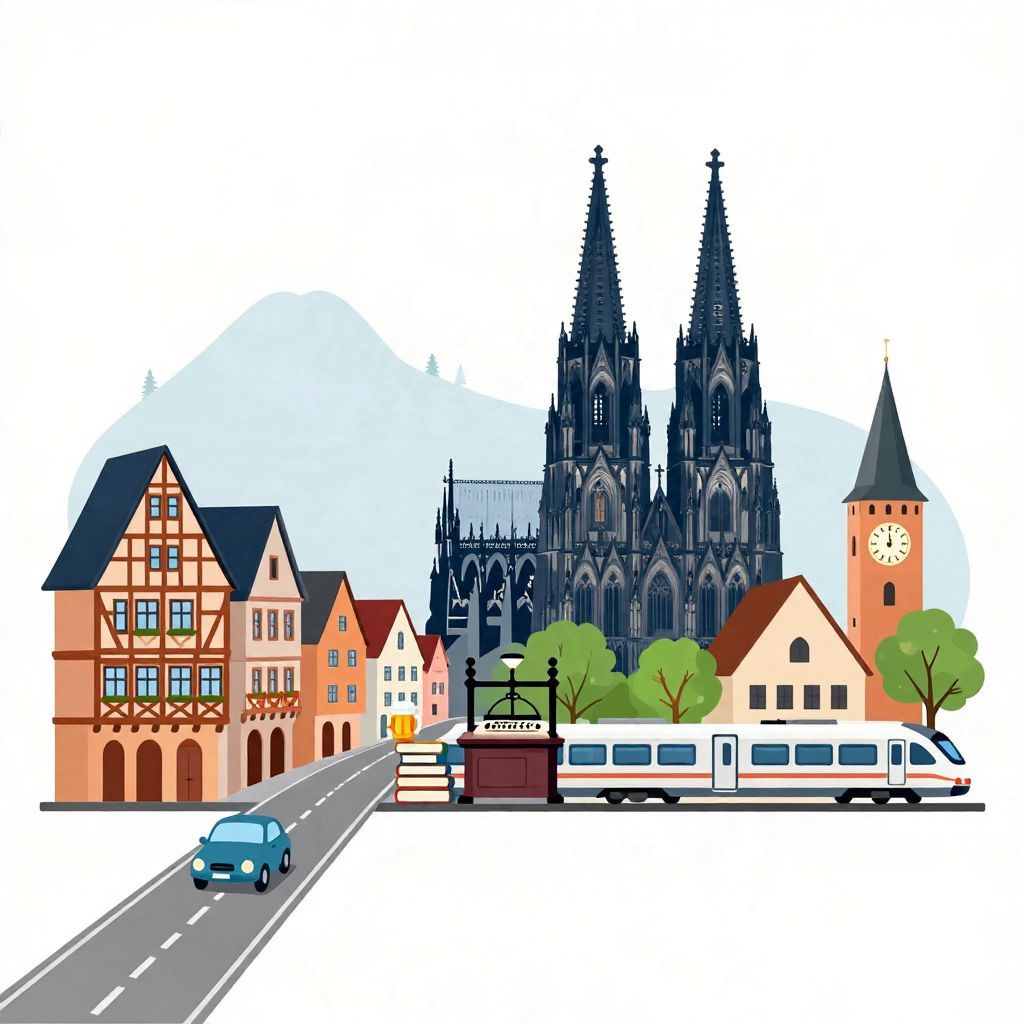
What is Germany known for? Historically, Germany is known for its central role in European politics, its long tradition of scholarship and philosophy, its major contributions to music, science, engineering, and printing, and its powerful impact on the history of war and reunification in modern Europe.
Because “Germany” did not exist as a single unified nation-state for most of history, the answer changes across time. The lands that became Germany were shaped by the Holy Roman Empire, the Reformation, industrialization, two world wars, division during the Cold War, and reunification in 1990.
What Is Germany Known For?
Germany is known for a combination of historical influence and modern achievement: medieval and early modern political power, Protestant Reformation history, classical music and philosophy, world-class engineering, scientific innovation, and the dramatic story of division and reunification in the 20th century. Its reputation comes from both cultural depth and major historical turning points.
Germany’s Historical Identity: A Land of Many States
To understand what Germany is known for, it helps to remember that for centuries there was no single “Germany” in the modern sense. Instead, the region was a patchwork of duchies, bishoprics, free cities, and kingdoms within the Holy Roman Empire, a political structure that lasted from the medieval period until 1806.
This fragmented past mattered. It encouraged regional diversity in language, law, religion, and culture, while also placing the German-speaking lands at the center of European trade, diplomacy, and conflict. The modern German nation emerged much later, especially in the 19th century.
The Holy Roman Empire and Medieval Power
The Holy Roman Empire, traditionally traced to 800 with Charlemagne and reconfigured in 962 under Otto I, was not “Germany” in the modern national sense. Still, much of its core territory lay in the German-speaking world, and its emperors shaped European politics for centuries. The empire’s loose structure made it powerful in prestige but often weak in central control.
German cities such as Cologne, Nuremberg, Augsburg, and Lübeck became important centers of commerce and urban culture. The Hanseatic League, a commercial network of northern European cities, helped make parts of the German coast and inland trade routes economically significant.
Germany and the Protestant Reformation
One of the most important reasons Germany is known in history is its role in the Protestant Reformation. In 1517, Martin Luther, a monk and theology professor in Wittenberg, challenged the sale of indulgences and broader church practices. His actions helped trigger a religious revolution that reshaped Europe.
The Reformation did not happen overnight, and Luther was not the only reformer. But the German lands became the main battlefield of confessional conflict between Catholics and Protestants. This led to long-term changes in religion, education, politics, and literacy across Europe.
Why the Reformation mattered
- It weakened the religious unity of Western Christianity.
- It encouraged Bible translation and wider reading.
- It increased the importance of local rulers in religious matters.
- It contributed to wars and political realignments across Europe.
Germany is therefore closely associated with the history of religious reform, not because it was the only place where reform ideas appeared, but because Luther’s challenge became a turning point with continent-wide consequences.
Germany Is Known for Philosophy, Literature, and Music
German-speaking lands produced many of Europe’s most influential thinkers, writers, and composers. This cultural legacy is one of the strongest answers to the question of what Germany is known for.
Philosophy and ideas
German philosophy became especially famous in the 18th and 19th centuries. Thinkers such as Immanuel Kant, Georg Wilhelm Friedrich Hegel, Karl Marx, and Friedrich Nietzsche shaped debates on ethics, history, politics, religion, and human freedom. Their work influenced not only academic philosophy but also modern political thought and social theory.
Germany became associated with serious intellectual culture, universities, and scholarship. The modern research university model, developed in part in German-speaking Europe, had a major influence on higher education worldwide.
Music and the arts
Germany is also known for classical music. Composers such as Johann Sebastian Bach, Ludwig van Beethoven, Johannes Brahms, and Richard Wagner helped define the European musical tradition. Their works remain central to concert culture today.
German literature also had a profound impact, especially through figures such as Johann Wolfgang von Goethe and Friedrich Schiller. The “German classical” tradition became associated with depth, discipline, and philosophical seriousness, although these are cultural generalizations rather than fixed historical truths.
Germany and Science, Printing, and Engineering
Another major reason Germany is known is its role in technological and scientific progress. The invention of movable-type printing in Europe is closely associated with Johannes Gutenberg of Mainz in the mid-15th century. Printing transformed communication, religion, education, and politics by making books cheaper and more widely available.
Later, German-speaking scientists and engineers made major contributions to chemistry, physics, medicine, and industrial design. In the 19th and early 20th centuries, German universities and laboratories were among the world’s leading centers of scientific research.
Examples of German contributions
- Printing: Gutenberg’s press accelerated the spread of knowledge.
- Chemistry: German laboratories helped professionalize modern chemical research.
- Physics: German scientists played major roles in the development of modern physics.
- Engineering: German industry became known for precision manufacturing and technical innovation.
It is important, however, not to turn this into a simplistic national stereotype. Scientific progress was international, and German achievements were part of wider European and global exchanges. Still, Germany’s reputation for technical expertise has deep historical roots.
Germany in the Age of Unification and Empire
The modern German nation-state emerged in the 19th century, not the Middle Ages. After the Napoleonic period, German-speaking states remained divided, but nationalism grew. Under Prussian leadership, Germany was unified in 1871 after the Franco-Prussian War, when the German Empire was proclaimed at Versailles.
This unification changed Europe’s balance of power. The new empire became an industrial and military giant, and its rise altered diplomacy, trade, and military planning across the continent. Germany is therefore known not only for culture and scholarship but also for its decisive role in modern European geopolitics.
Why unification mattered
German unification brought together many previously separate states under one national framework. It strengthened industry, railways, bureaucracy, and military power. At the same time, it intensified rivalries with other European powers and helped set the stage for the tensions that led to the First World War.
Germany and the World Wars
Perhaps no part of German history is more globally remembered than the two world wars. Germany’s role in both conflicts shaped its international reputation in the 20th century and continues to influence how people understand the country today.
World War I
Germany was a central power in World War I from 1914 to 1918. The war ended in defeat, the collapse of the German Empire, and the creation of the Weimar Republic. The Treaty of Versailles imposed territorial losses, military restrictions, and reparations, which deeply affected German politics and society.
The Nazi era and World War II
The most tragic and destructive chapter in German history began with the rise of Adolf Hitler and the Nazi regime in 1933. Nazi rule brought dictatorship, aggressive expansion, and the Holocaust, in which six million Jews were murdered along with millions of other victims, including Roma, disabled people, political opponents, and others targeted by the regime.
Germany’s defeat in World War II in 1945 left the country occupied, devastated, and morally confronted with the crimes of Nazism. This history is central to any honest answer to what Germany is known for. It is not the whole of German history, but it is one of its most consequential and painful parts.
Division, Cold War Germany, and Reunification
After 1945, Germany was divided into occupation zones and then into two states in 1949: the Federal Republic of Germany in the west and the German Democratic Republic in the east. Berlin was also divided, becoming a symbol of the Cold War.
West Germany developed into a democratic, market-oriented state and became a major economic power. East Germany became a socialist state aligned with the Soviet bloc. The Berlin Wall, built in 1961, became one of the most visible symbols of division in the modern world.
In 1989, the Wall fell amid popular protest and political change across Eastern Europe. Germany was formally reunified in 1990. Reunification remains one of the defining events of recent European history and is central to Germany’s modern identity.
What Germany Is Known for Today
In the present day, Germany is known internationally for its strong economy, high-quality manufacturing, environmental policy debates, cultural institutions, and role in the European Union. But these modern associations are inseparable from the country’s history.
Germany’s modern image combines several layers: the legacy of philosophers and composers, the memory of the Reformation, the burden of the Nazi era, the success of postwar democracy, and the achievement of reunification. Few countries carry such a complex historical reputation.
Common historical associations with Germany
- Martin Luther and the Protestant Reformation
- Gutenberg and the printing press
- Beethoven, Bach, Goethe, and German classical culture
- Scientific research and engineering
- Unification in 1871
- The First and Second World Wars
- The Berlin Wall and reunification in 1990
Why Germany’s Reputation Is So Broad
Germany is known for many things because its history spans both fragmentation and power, creativity and destruction, regional diversity and national unity. Its lands were a crossroads of Europe, and its political changes often had consequences far beyond its borders.
That is why the answer to “What is Germany known for?” cannot be reduced to one idea. It is known for major cultural achievements, deep intellectual traditions, technological innovation, and some of the most important political events in modern European history.
For readers interested in how cultural identity develops over time, a useful related topic is cultural divergence. Germany’s own history shows how regional differences, religion, politics, and memory can shape a nation’s long-term identity.