
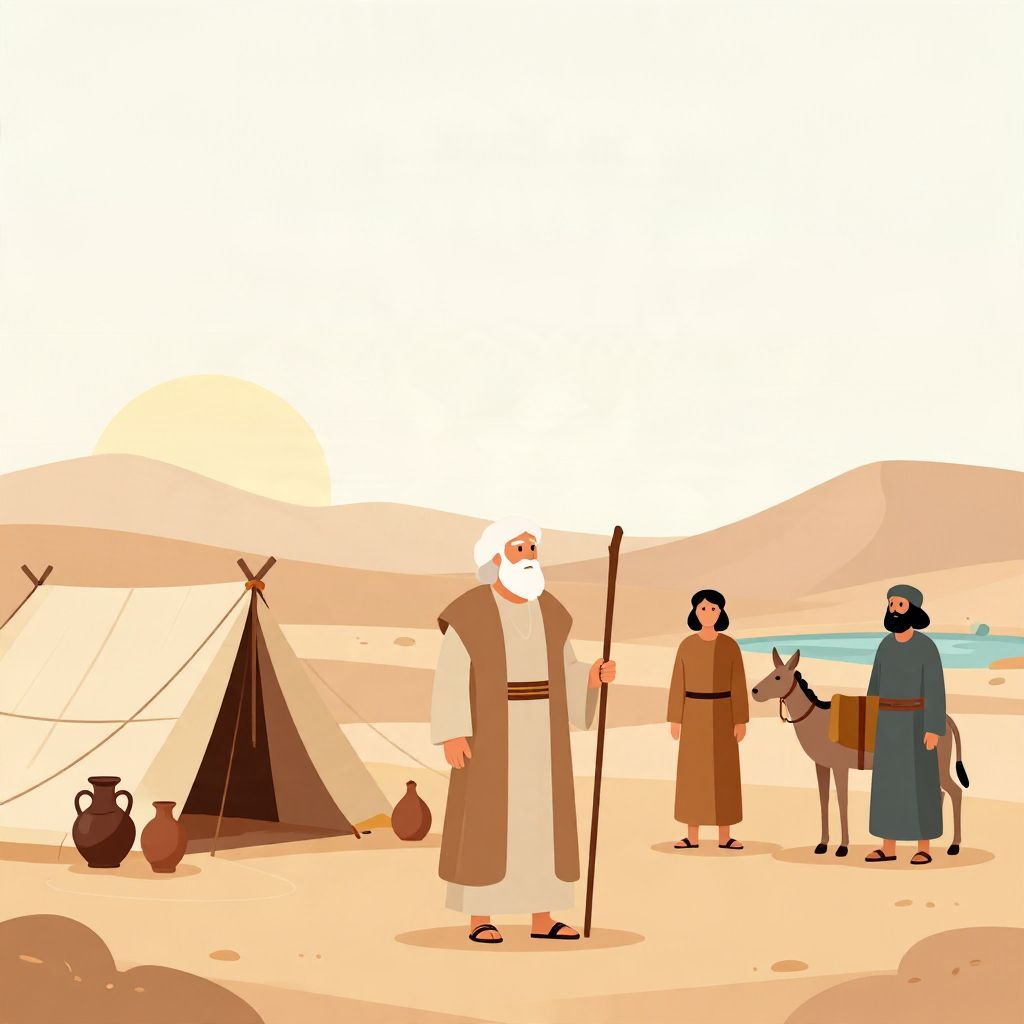
Abraham is one of the most important figures in the history of Judaism, Christianity, and Islam, but the question of how long he lived has a simple answer only within the biblical tradition. According to the Book of Genesis, Abraham lived to be 175 years old. That number comes from the ancient text itself, not from independent historical records.
Because Abraham belongs to the world of early biblical history, scholars treat his lifespan as part of religious tradition rather than verifiable biography. The figure of 175 has meaning within the biblical narrative, where long lifespans signal blessing, continuity, and divine favor.
How long did Abraham live?
According to Genesis 25:7, Abraham lived 175 years. The Bible says he died “in a good old age,” after a long life marked by migration, covenant, family conflict, and the founding of a lineage that would become central to Israelite identity. Historically, this is a scriptural claim, not a date that can be confirmed by archaeology.
What the biblical text says about Abraham’s age
The Book of Genesis gives Abraham’s age at several key moments, allowing readers to trace his life in a chronological framework. He is said to have been 75 when he left Haran, 100 when Isaac was born, and 175 when he died. These ages are part of the Bible’s internal chronology and are important for understanding the story as ancient authors told it.
Key ages in Abraham’s life
- 75 years old — Abraham leaves Haran after receiving God’s call.
- 86 years old — Ishmael is born to Hagar.
- 100 years old — Isaac is born to Sarah.
- 175 years old — Abraham dies and is buried by his sons Isaac and Ishmael.
These numbers do more than provide a timeline. In the biblical world, they help establish Abraham as a patriarch whose life stretches across generations and whose descendants will inherit a covenantal promise.
Was Abraham a historical person?
Historians cannot verify Abraham as a person in the same way they can verify later rulers or events with inscriptions, administrative records, or archaeology. Most scholars place Abraham in the realm of patriarchal tradition, meaning that the stories about him reflect ancient memory, identity formation, and theology, even if they may preserve echoes of older cultural settings.
That does not mean the story is meaningless. It means that Abraham’s lifespan belongs to the history of religious tradition, not to securely documented ancient biography. The Bible presents him as a real ancestor figure, but outside the text there is no direct evidence that can confirm his exact age or even establish his life with precision.
Why does the Bible give Abraham such a long life?
Long lifespans are common in the early chapters of Genesis. They appear in the stories of Adam, Noah, and other early figures, and they serve literary and theological purposes. Such ages elevate the patriarchs into a special era before the ordinary limits of later human life become the norm in the biblical narrative.
Possible meanings of the number 175
- Symbolic fullness — the age suggests a complete and honored life.
- Genealogical importance — Abraham stands at the center of a family line with lasting significance.
- Literary structure — the number fits the Bible’s broader pattern of notable ages for foundational figures.
Scholars disagree on whether the number 175 has a specific symbolic meaning beyond its narrative role. Some readers see it as a sign of divine blessing, while others understand it as part of the ancient literary style used to frame sacred history.
Abraham in historical context
Even though Abraham cannot be dated with certainty, the traditions about him reflect the broader world of the ancient Near East. His story includes migration, pastoral life, kinship ties, land ownership, and covenant language—features that fit the social world of early second-millennium or later Mesopotamian and Levantine traditions, though exact dating remains debated.
The biblical account places Abraham’s journey from Mesopotamia to Canaan at the center of a larger story about movement and promise. This reflects the importance of ancestry and land in the ancient world, where family identity and inheritance shaped both religion and social life.
Why Abraham matters historically
Abraham became a foundational figure for three major monotheistic traditions. In Judaism, he is the ancestor of the covenant people. In Christianity, he is a model of faith. In Islam, Ibrahim is a prophet and a key figure in the sacred lineage. His importance lies not only in the details of his life but in the way later communities remembered and interpreted him.
How Abraham’s death is described
Genesis says Abraham died “old and full of years,” and that his sons Isaac and Ishmael buried him in the cave of Machpelah, which Abraham had purchased earlier as a burial site. This burial scene is significant because it reunites the two sons of Abraham and ties the patriarch to a specific ancestral place in the land of Canaan.
The burial at Machpelah also matters because it becomes a family tomb associated with the patriarchs and matriarchs. In the biblical narrative, land, burial, and lineage are closely connected, making Abraham’s death part of the larger story of inheritance.
What historians can and cannot say
Historians can say that the Bible presents Abraham as living 175 years. They can also say that this figure belongs to a long tradition of ancient storytelling in which age, genealogy, and divine favor are closely linked. What historians cannot say is that Abraham’s lifespan has been independently confirmed by external evidence.
Established, likely, and uncertain
- Established: Genesis states that Abraham lived 175 years.
- Likely: The number functions as a literary and theological marker.
- Uncertain: Abraham’s exact historical dates and lifespan cannot be verified.
This distinction is important. A religious tradition can preserve a powerful and influential account without that account being measurable by modern historical methods. Abraham’s age is therefore best understood as a scriptural claim with enduring cultural significance.
Why readers still ask how long Abraham lived
People ask this question because Abraham stands at the beginning of a major historical and religious story. His age helps orient readers within Genesis and offers a concrete detail in a narrative that otherwise spans generations, migrations, and promises. It also reflects a broader curiosity about the relationship between sacred text and historical fact.
The answer, though brief, opens a larger window onto ancient memory. Abraham’s 175 years are not just a number; they are part of how the Bible frames the life of a patriarch whose descendants would shape the religious history of much of the world.
Conclusion
So, how long did Abraham live? In the biblical account, he lived 175 years. That figure comes from Genesis and should be understood as part of ancient religious tradition rather than independently verified history. Still, it remains one of the most enduring details in the story of Abraham, whose life continues to shape Jewish, Christian, and Islamic memory. For related biblical history, see how old Joshua was when Moses died and when Proverbs was written.