
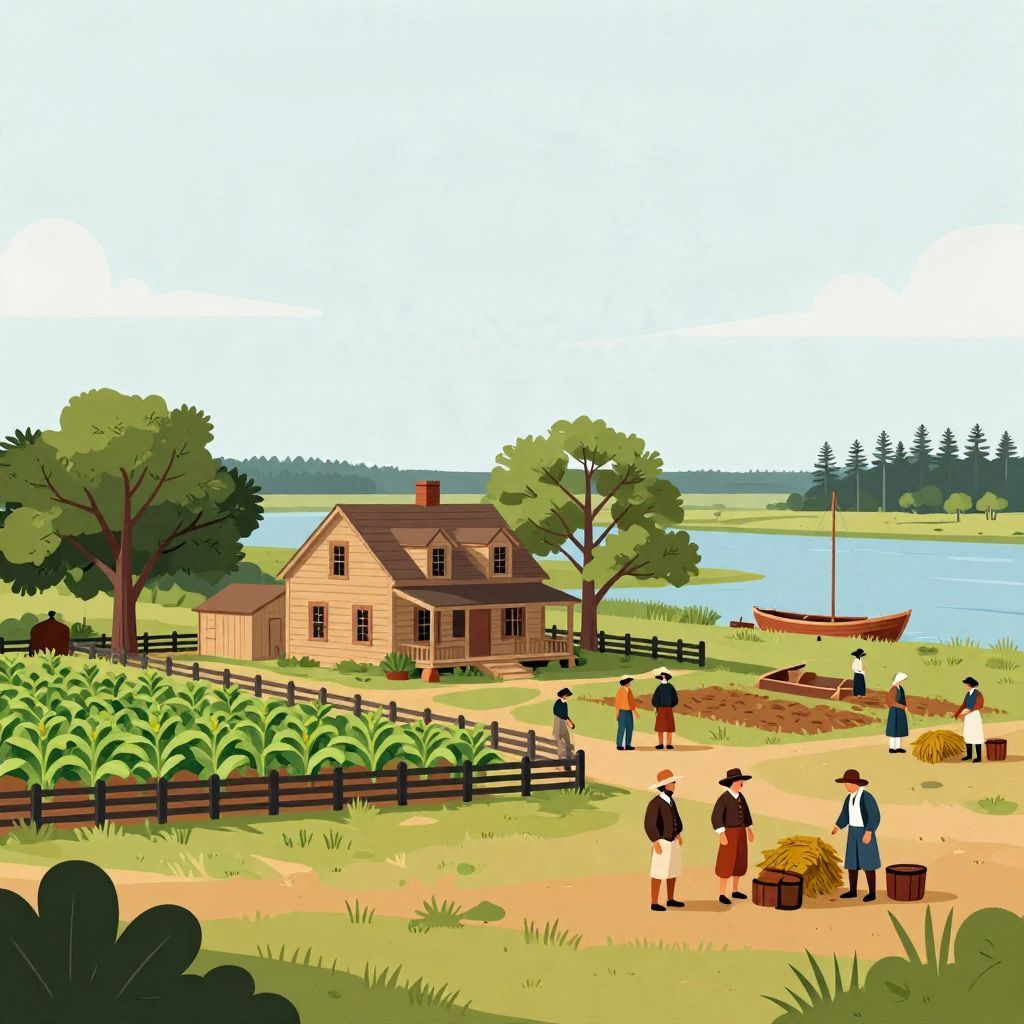
What are the Southern Colonies? In the history of British North America, the Southern Colonies were the group of English colonies that developed in the Chesapeake and the Lower South, eventually becoming part of the United States. They were shaped by plantation agriculture, enslaved labor, and a warm climate that encouraged large-scale cash crops.
These colonies played a major role in the colonial economy and in the political tensions that led to the American Revolution. Their society, economy, and settlement patterns differed sharply from those of New England and the Middle Colonies.
What Are the Southern Colonies?
The Southern Colonies were the British colonies in North America located south of the Middle Colonies, usually including Maryland, Virginia, North Carolina, South Carolina, and Georgia. They were known for plantation farming, tobacco, rice, indigo, and a labor system that increasingly depended on enslaved Africans.
Which Colonies Were in the South?
Historians generally group five colonies as the Southern Colonies, though the exact boundaries of colonial regions could shift over time. The standard list is Maryland, Virginia, North Carolina, South Carolina, and Georgia.
The five Southern Colonies
- Virginia — founded at Jamestown in 1607, the first permanent English settlement in North America.
- Maryland — founded in 1634 as a proprietary colony under the Calvert family.
- North Carolina — developed from the Carolina colony and became a separate colony in 1712.
- South Carolina — also separated from Carolina in 1712 and became a major plantation colony.
- Georgia — founded in 1732 as the last of the thirteen colonies.
Some textbooks treat the Carolinas together when discussing the earlier colonial period because they began as one colony. Others emphasize the later split into North and South Carolina. Maryland is sometimes described as a border colony because of its geography and mixed characteristics, but it is usually included in the Southern group.
Why Did the Southern Colonies Develop Differently?
The Southern Colonies grew in a way that was strongly shaped by geography, climate, and economic opportunity. Their long growing seasons made them ideal for export crops, especially tobacco in the Chesapeake and rice and indigo in the Lower South. These crops encouraged large landholdings rather than compact towns.
Climate and geography
The South had warmer temperatures, fertile river valleys, and navigable waterways that made it easier to transport crops to ports. Because plantations often sat along rivers, settlers could ship goods directly to Atlantic markets. This created a dispersed settlement pattern rather than the village-centered life common in New England.
Cash crops and profit
Colonists in the South were tied to the Atlantic economy. Tobacco became the dominant export in Virginia and Maryland during the seventeenth century. In South Carolina and parts of Georgia, rice and indigo became important later. These crops brought wealth to some planters but also deepened social inequality.
How Were the Southern Colonies Founded?
The Southern Colonies were established for different reasons, but profit, land, and imperial competition were central to all of them. English leaders wanted territory, trade, and strategic footholds in North America. Some colonies were founded by joint-stock companies, while others were created under royal or proprietary authority.
Virginia and the Chesapeake beginnings
Virginia was founded by the Virginia Company in 1607 at Jamestown. The colony struggled at first with disease, hunger, conflict, and poor planning. Its survival depended on tobacco cultivation, which became profitable after John Rolfe helped establish a marketable strain in the early 1600s. That success encouraged more migration and land expansion.
Maryland as a proprietary colony
Maryland was founded in 1634 under the leadership of the Calvert family, who hoped to create both a profitable colony and a place where English Catholics could settle with some measure of protection. In practice, Maryland developed into a plantation colony similar to Virginia, though religious tensions remained part of its history.
The Carolinas and Georgia
The Carolina colony was chartered in 1663 and later split into North and South Carolina in 1712. South Carolina developed a wealthy plantation elite centered around Charleston and the coastal lowcountry. Georgia was founded in 1732, partly as a buffer against Spanish Florida and as a settlement for debtors and the poor, though it later adopted plantation slavery as well.
What Was Life Like in the Southern Colonies?
Daily life in the Southern Colonies varied greatly by class, race, and region. Wealthy planters lived on large estates, while small farmers, indentured servants, tenant farmers, artisans, and enslaved people formed the broader population. Social hierarchy was strong, and political power usually stayed in the hands of elite landowners.
Plantation society
Plantations were more than farms; they were economic and social systems. A planter family might control hundreds or even thousands of acres, along with mills, wharves, and laborers. Wealth was measured in land and people, and the plantation elite often dominated local government and colonial assemblies.
Indentured servitude and slavery
In the early decades, many laborers in the Chesapeake came as indentured servants, agreeing to work for a set period in exchange for passage to America. Over time, however, enslaved Africans became the main source of labor, especially as plantation agriculture expanded. This shift was one of the most important developments in colonial American history.
Enslaved labor was central to the Southern colonial economy. Enslaved men, women, and children worked in fields, households, workshops, and ports. Their forced labor generated wealth for planters and merchants while creating a brutal system of racial slavery that would shape American history long after the colonial era ended.
What Crops Made the Southern Colonies Wealthy?
The Southern Colonies became wealthy through export agriculture. Their crops were grown not mainly for local use but for sale in Europe and other Atlantic markets. This made the region deeply dependent on trade, shipping, and credit.
Tobacco
Tobacco was the most important crop in Virginia and Maryland during much of the seventeenth and early eighteenth centuries. It required large amounts of labor and land, which encouraged plantation expansion and settlement along rivers. Tobacco also exhausted soil quickly, pushing colonists to move westward in search of fresh land.
Rice and indigo
In South Carolina and Georgia, rice became a major export crop, especially in low-lying coastal areas. Indigo, used to make blue dye, also became valuable. These crops were labor-intensive and profitable, and they increased the demand for enslaved African labor, particularly in regions where Africans brought agricultural knowledge that planters exploited.
What Was the Government Like in the Southern Colonies?
The Southern Colonies were governed under different colonial charters, but in practice local elites held significant power. Many colonies developed representative assemblies, though voting rights were usually limited to white men who owned property. The colonial governor, appointed by the crown or proprietor, represented imperial authority.
Political power and local elites
Because plantations were spread out, county governments often mattered more than town governments. Wealthy planters dominated county courts, assemblies, and militia leadership. This gave the region a political culture that was hierarchical but also strongly attached to local autonomy.
Religion and society
The Church of England was influential in much of the South, especially in Virginia and the Carolinas, though religious life was not uniform. Maryland had been founded with a degree of religious toleration for Catholics, but Protestant settlers soon outnumbered Catholics there too. Religion mattered, but class and land ownership often shaped daily life more strongly.
How Did the Southern Colonies Compare to Other Colonial Regions?
The Southern Colonies differed from New England and the Middle Colonies in economy, settlement, and social structure. New England relied more on small farms, towns, trade, and religious communities. The Middle Colonies were more ethnically diverse and had a mixed economy of grain farming, commerce, and crafts. The South was more plantation-based and more dependent on enslaved labor.
Key differences at a glance
- Economy: cash crops and export agriculture in the South.
- Settlement: scattered plantations rather than dense towns.
- Labor: increasing reliance on enslaved Africans.
- Politics: local planter elites held major influence.
- Social structure: sharper class divisions than in many northern colonies.
What Role Did the Southern Colonies Play in the American Revolution?
The Southern Colonies were important to the American Revolution both economically and militarily. Their planters often opposed British taxes and trade restrictions, but their society was also divided. Some colonists supported independence, while others remained loyal to the crown, and many enslaved people sought freedom by escaping to British lines or using wartime disruption to resist bondage.
By the 1770s, the South had become deeply tied to Atlantic trade and colonial self-government. When conflict with Britain intensified, leaders in Virginia and South Carolina became prominent in the patriot cause. Yet the Revolution did not create equality in the South; slavery remained intact and even expanded after independence.
Why Do the Southern Colonies Matter in American History?
The Southern Colonies matter because they helped shape the economic, political, and racial foundations of the United States. They produced some of the wealth that sustained the British Empire in North America, but that wealth depended heavily on enslaved labor. Their plantation system left a long legacy that extended far beyond the colonial period.
They also influenced the development of American regional identity. Ideas about landownership, local power, agriculture, and race were formed in the colonial South and continued to affect the nation after independence. Understanding the Southern Colonies helps explain both the rise of the early United States and the deep conflicts built into its history.
Quick Summary of the Southern Colonies
- They were the British colonies of Maryland, Virginia, North Carolina, South Carolina, and Georgia.
- They developed around plantation agriculture and export crops.
- They relied increasingly on enslaved African labor.
- They had scattered settlements, strong local elites, and limited town life.
- They played a major role in colonial trade and in the coming of the American Revolution.
In short, the Southern Colonies were the plantation-centered British colonies of the Chesapeake and the Lower South, and they became one of the most influential regions in colonial America. For more on regional distinctions, see whether Maryland was a Southern Colony and what a royal colony was.