
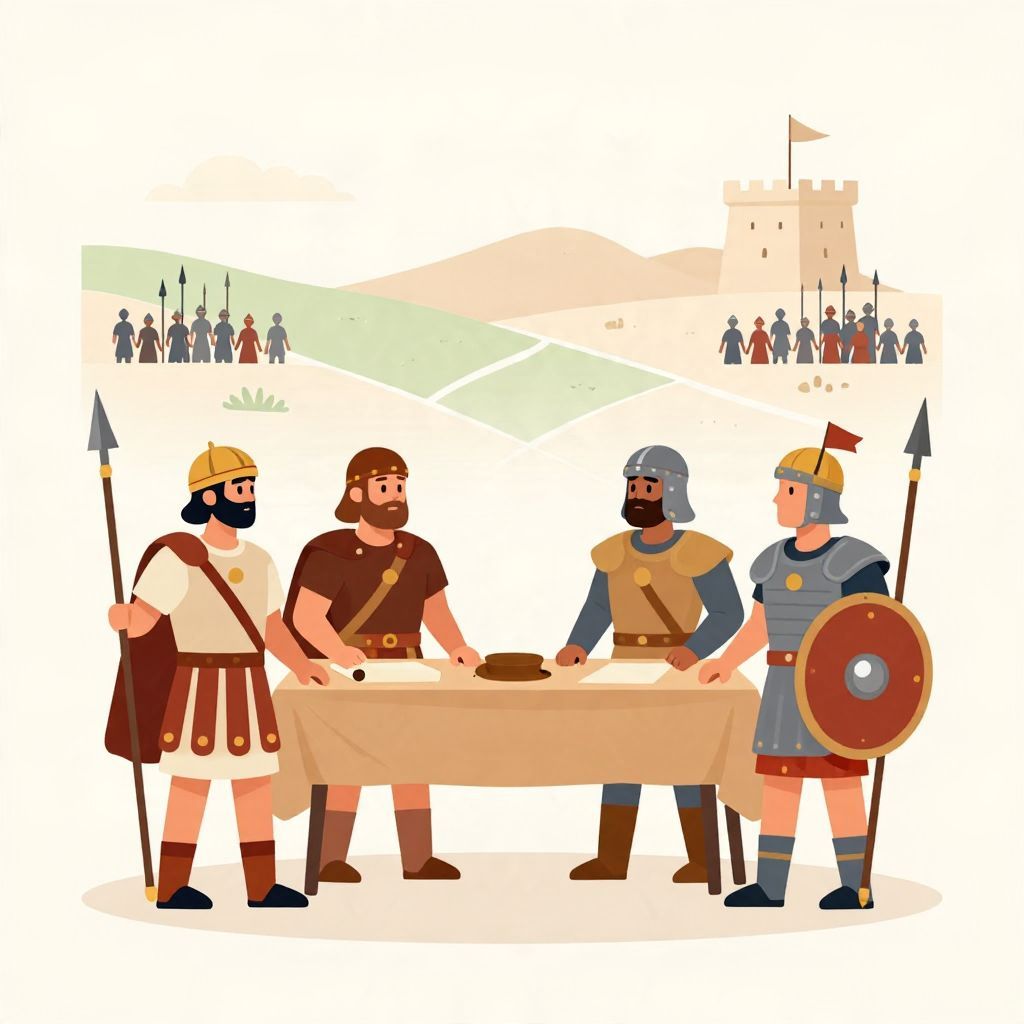
The phrase “the enemy of my enemy is my friend” sounds timeless, but it is really a summary of a very old political habit: people and states often cooperate with rivals when they face a bigger threat. Across history, alliances have formed not because trust was strong, but because danger was stronger. The idea is simple; the reality has usually been temporary, strategic, and fragile.
That pattern appears in ancient kingdoms, medieval wars, early modern empires, and modern geopolitics. Historians usually treat it not as a fixed law of history, but as a recurring principle of realpolitik: shared interests can outweigh deep hostility for a time.
What does “the enemy of my enemy is my friend” mean in history?
The phrase means that two groups who dislike or fear the same opponent may cooperate, even if they do not trust each other. Historically, this has produced temporary alliances, military coalitions, and diplomatic bargains. Such partnerships often end once the common enemy is defeated or the balance of power changes.
Where did the idea come from?
The exact wording is modern, but the logic behind it is ancient. Similar ideas appear in many cultures and political traditions, especially in contexts where survival depended on flexible alliances. The phrase is often linked to Middle Eastern political thought, though it is difficult to prove a single origin for the exact wording. What matters historically is that statesmen have long understood the value of joining with a lesser rival to confront a greater one.
Ancient diplomacy and shifting loyalties
In the ancient world, rulers regularly made and broke alliances based on immediate threats. City-states in Mesopotamia, Egypt, Greece, and later Rome all used this logic. A smaller power might support one neighbor against another, hoping to preserve autonomy or gain territory. These arrangements were rarely about friendship in a personal sense; they were about survival, leverage, and advantage.
One well-known example is the diplomacy of the Greek city-states. During the Persian Wars in the early 5th century BCE, rival Greek communities sometimes set aside their internal conflicts to resist Persian expansion. Their cooperation was real, but it was also uneven and tense. After the Persian threat weakened, internal rivalries quickly returned.
How has the idea worked in major historical events?
Throughout history, the principle has shaped wars, revolutions, and imperial politics. It has helped create coalitions that won battles and empires that survived. But it has also produced betrayals, unstable partnerships, and long-term resentment. The phrase describes a tactic, not a moral rule.
Medieval alliances and crusading politics
In the Middle Ages, rulers often allied with unlikely partners to counter stronger enemies. Christian princes, Muslim rulers, and local dynasties sometimes cooperated when political necessity outweighed religious or cultural division. The Crusades, for example, were not just simple religious wars; they also involved shifting alliances among competing powers in the Levant, Byzantium, and Western Europe.
Sometimes one side would seek help from a rival to defeat a more immediate threat. Such alliances could be practical, but they also carried risks. A ruler who invited outside help might later discover that the “friend” had become a new occupier or competitor. Medieval history is full of these uneasy bargains.
Early modern Europe and balance-of-power politics
By the 16th and 17th centuries, European states increasingly practiced balance-of-power diplomacy. A kingdom threatened by a stronger neighbor might ally with a former enemy to prevent domination. This was especially visible in the rivalry among France, Spain, the Habsburgs, and later Britain. Religious differences mattered, but strategic interests often mattered more.
A famous example is the alliance between Catholic France and the Muslim Ottoman Empire in the 16th century. To many contemporaries, this seemed shocking, but it made political sense: both powers wanted to weaken the Habsburgs. The alliance shows that historical actors often prioritized state interest over ideology when the stakes were high.
Revolutionary and modern coalitions
In the modern era, the pattern became even more visible. During the Napoleonic Wars, European powers repeatedly formed coalitions against France, even when they distrusted one another. Later, in the two world wars, states allied with partners they might otherwise have opposed because a greater enemy posed an existential threat.
During World War II, for example, the United States, Britain, and the Soviet Union cooperated against Nazi Germany despite deep ideological differences and mutual suspicion. This was perhaps one of the clearest modern examples of the principle in action. The alliance was essential to defeating Hitler, but it collapsed quickly after the war as the common enemy disappeared and Cold War tensions emerged.
Why do enemies become allies?
Historically, enemies become allies for practical reasons rather than affection. The most common motives are fear, necessity, and opportunity. Leaders may calculate that cooperation with a rival is less dangerous than facing a stronger threat alone. This is especially true when survival, territory, or regime stability is at stake.
- Shared threat: both sides fear the same opponent more than they fear each other.
- Short-term advantage: a temporary alliance can buy time, resources, or military support.
- Balance of power: weaker states often ally to stop one power from becoming dominant.
- Diplomatic flexibility: rulers may set aside ideology to protect immediate interests.
These alliances are often fragile because they rest on calculation, not trust. Once the common enemy is defeated, old conflicts usually return. That is why historians often describe such arrangements as marriages of convenience.
Is the phrase always true?
No. The saying is useful, but it is not a universal law. Shared enemies do not automatically create real friendship. In some cases, one side uses the other and then abandons it. In others, the alliance produces new conflict because the partners want different outcomes. The phrase captures a tendency, not a guarantee.
When the saying fails
History offers many examples where a common enemy was not enough to create lasting cooperation. Religious, ethnic, ideological, or territorial divisions could remain stronger than the shared threat. Some alliances collapsed before achieving their goals. Others succeeded militarily but left behind mistrust that shaped later wars.
For that reason, historians are careful with the phrase. It is best understood as a shorthand for strategic alignment, not a description of genuine friendship. In fact, the “friendship” may be entirely temporary and deeply suspicious on both sides.
What does this tell us about power in history?
The enduring value of the phrase is that it reveals how power often works. States and leaders rarely act from pure loyalty or hatred alone. They weigh risks, opportunities, and the likely behavior of others. When a stronger enemy appears, old enemies may cooperate because politics is often about choosing the least dangerous option.
This helps explain why history is full of unexpected partnerships. It also explains why such partnerships are usually unstable. Once the immediate threat changes, the alliance may disappear, and former partners may become rivals again. In that sense, the phrase is less a moral lesson than a practical observation about survival in competitive worlds.
Why historians still pay attention to this idea
Historians use this principle to understand diplomacy, war, and statecraft across different periods. It helps explain why alliances form quickly, why they can include strange partners, and why they often break apart just as quickly. The idea is especially useful for studying empires, borderlands, and periods of crisis, when leaders had fewer good options and more enemies than friends.
It also reminds us that historical actors were not always guided by ideology in the way modern readers may expect. Religion, nationalism, and identity mattered, but so did fear, survival, and opportunity. The phrase captures that hard reality in a compact form.
Conclusion
The enemy of my enemy is my friend is not a rule of history so much as a recurring strategy in moments of danger. From ancient diplomacy to modern world wars, people have repeatedly allied with rivals to confront a greater threat. These partnerships can be effective, but they are usually temporary and built on necessity rather than trust. For related reading, see Never Interrupt Your Enemy When He Is Making a Mistake and Why Did the Crusades Happen?