
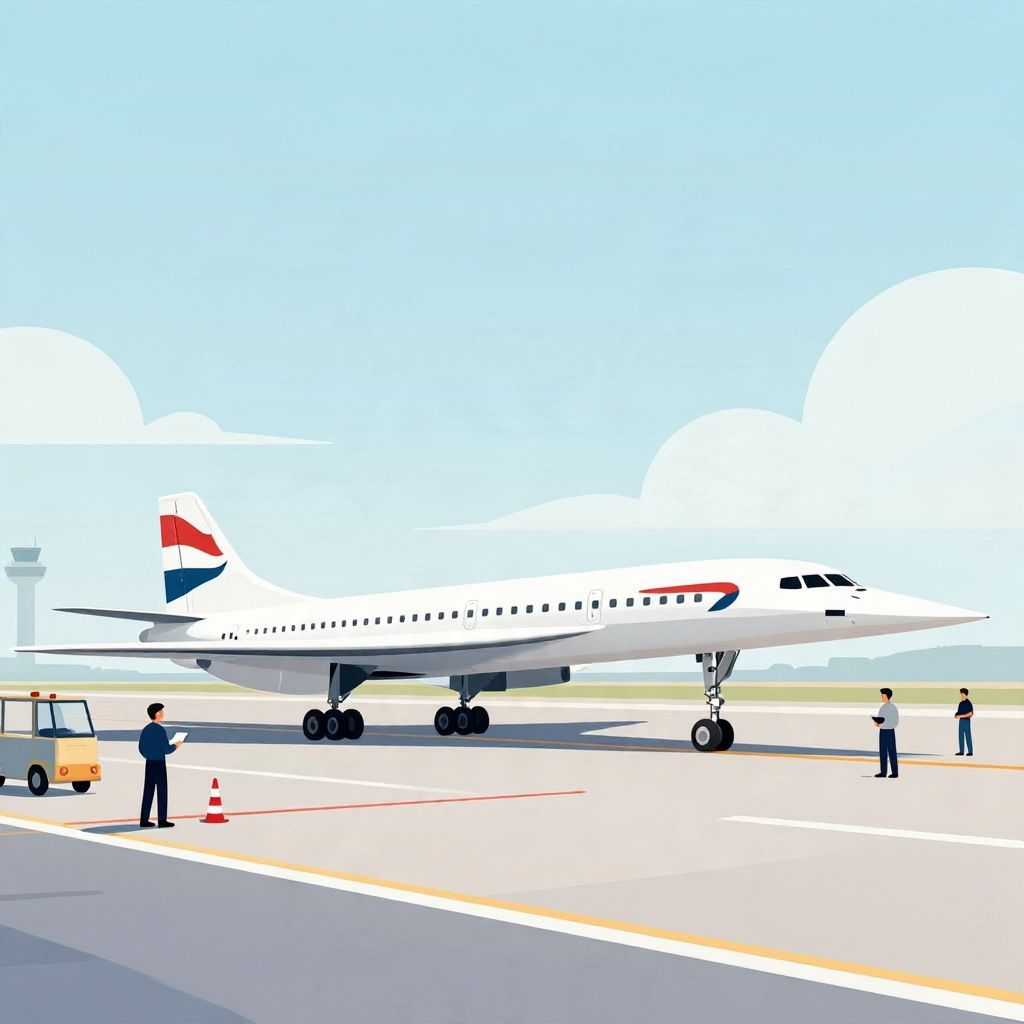
The Concorde was retired because it had become too expensive to operate, too limited in use, and increasingly difficult to justify after a fatal crash in 2000 damaged public confidence. The supersonic airliner was an extraordinary technological achievement, but by the early 2000s it was also an aging aircraft with high maintenance costs and a shrinking business case.
Its retirement in 2003 was not caused by a single event alone. It reflected decades of economic strain, changing airline priorities, environmental concerns, and the fact that only a very small number of passengers could afford or needed to fly on it.
Why was the Concorde retired?
The Concorde was retired because it was no longer economically viable. British Airways and Air France faced high fuel costs, expensive maintenance, limited seating capacity, and a small market for premium supersonic travel. After the 2000 crash and the post-9/11 downturn in aviation, the aircraft’s costs and risks outweighed the benefits of keeping it in service.
The Concorde’s promise and its problems
The Concorde entered commercial service in 1976 as a symbol of modernity, speed, and international cooperation between Britain and France. It could cross the Atlantic in about half the time of a conventional jet, which made it famous among business travelers, celebrities, and heads of state. But from the beginning, it was never a mass-market aircraft.
Only a small number were built, and only British Airways and Air France operated them in scheduled passenger service. The aircraft was technically impressive but commercially fragile. It was fast, but speed alone did not make it profitable.
A costly aircraft to run
The Concorde consumed enormous amounts of fuel compared with subsonic airliners. That mattered even more as oil prices rose over time. It also required specialized maintenance, highly trained crews, and careful inspection because of the stresses caused by supersonic flight. These costs were manageable only while ticket prices stayed high and demand remained strong enough.
Unlike larger long-haul jets, the Concorde carried relatively few passengers. That meant each flight had to generate very high revenue to cover operating expenses. In practice, the aircraft served a niche market rather than a broad one, and that niche was never large enough to guarantee long-term profitability.
Limited routes and limited flexibility
The Concorde’s route network was narrow. It mainly served transatlantic flights, especially between London or Paris and New York. Noise restrictions also limited where it could fly, because sonic booms made supersonic travel over land politically and environmentally controversial. As a result, the aircraft had few routes on which its speed advantage could be fully used.
This mattered because airlines depend on flexibility. A plane that can only operate on a small number of routes is harder to schedule efficiently, especially when demand shifts or external shocks affect travel patterns.
The crash of 2000 and the loss of confidence
The most dramatic blow to the Concorde’s reputation came on 25 July 2000, when Air France Flight 4590 crashed shortly after takeoff from Paris Charles de Gaulle Airport. All 109 people on board and four people on the ground were killed. Investigators found that debris on the runway had damaged a tire, which in turn caused a chain of events leading to an engine failure and fire.
The crash did not mean the Concorde was inherently unsafe in every circumstance, but it exposed vulnerabilities in the aircraft and in runway safety procedures. It also intensified public concern about an already aging fleet. Air France and British Airways grounded their Concordes while modifications were made, including tire and fuel tank improvements.
Why the crash mattered so much
Commercial aviation depends heavily on trust. Even when an aircraft has a strong safety record, a high-profile disaster can change public perception quickly. The Concorde had long carried an image of exclusivity and prestige, but after the crash, that image was harder to sustain. The aircraft returned to service in 2001, yet the market had already weakened.
In historical terms, the crash was not the sole reason for retirement, but it accelerated a process that was already underway. It increased costs, reduced confidence, and made the aircraft seem less like the future of aviation and more like a costly relic of an earlier technological era.
Why the Concorde became harder to justify after 2001
By the early 2000s, several forces were converging. The Concorde was expensive to operate, older than before, and dependent on a narrow customer base. Then the broader aviation environment worsened. The attacks of 11 September 2001 sharply reduced air travel demand, especially in premium international markets. Airlines everywhere faced lower traffic and tighter finances.
For a niche aircraft like the Concorde, this was especially damaging. It was not easy to fill seats consistently, and it was difficult to defend the aircraft’s operating costs when airlines were cutting back elsewhere. The economics no longer worked as they once had.
Age and maintenance
The Concorde fleet was also aging. The aircraft had been designed in the 1960s and introduced in the 1970s. By the 2000s, many components were old, and maintaining them became more difficult. Keeping a small fleet airworthy is always more expensive than maintaining a larger, widely used model, because parts, personnel, and expertise are spread over fewer aircraft.
That problem was especially severe for the Concorde because only a handful of aircraft remained in passenger service. The smaller the fleet, the less economical it becomes to continue investing in specialized support.
Environmental and political pressures
The Concorde also faced criticism over noise and environmental impact. Supersonic flight is loud, especially during takeoff and when breaking the sound barrier. Sonic booms made it unsuitable for many overland routes, and communities near airports often objected to its noise. In an era of growing environmental awareness, the aircraft’s fuel consumption and emissions were increasingly difficult to defend.
These concerns did not alone force retirement, but they limited the aircraft’s future. Airlines and governments were under pressure to think about efficiency, airport noise, and sustainability. The Concorde represented a different era of aviation, one in which speed and prestige often outweighed environmental cost.
The final decision in 2003
In 2003, both British Airways and Air France announced the end of Concorde service. Air France retired its fleet first, and British Airways followed later that year. The decision was based on a combination of factors: high operating costs, reduced demand, the age of the aircraft, and the difficulty of justifying continued investment in a very small fleet.
The retirement was not because the Concorde had become obsolete in the sense of being unimportant. On the contrary, it remained a remarkable aircraft. But history does not preserve machines simply because they are impressive. They survive when they are useful, affordable, and adaptable. The Concorde no longer met those tests.
Key reasons in brief
- High operating costs from fuel, maintenance, and specialized support
- Small passenger capacity and a narrow premium market
- Limited routes because of noise and sonic boom restrictions
- The 2000 crash and the resulting safety concerns
- Post-9/11 downturn in air travel demand
- Aging aircraft and the expense of keeping a tiny fleet in service
Was the Concorde retired because it failed?
Not exactly. The Concorde did what it was designed to do: it proved that commercial supersonic travel was possible. It was fast, elegant, and technically advanced. In that sense, it was a success. But it was also a product of a very specific historical moment, when governments were willing to support ambitious aerospace projects for reasons of prestige, innovation, and national pride.
What changed was the economic and political context. By the 2000s, airlines were expected to be far more cost-conscious, and the market for an expensive luxury service had narrowed. The Concorde did not fail as an engineering feat; it became unsustainable as a commercial airline product.
Historical significance of the Concorde’s retirement
The retirement of the Concorde marked the end of an era in aviation history. It symbolized the limits of prestige technology in a market-driven airline industry. The aircraft had embodied an optimistic belief that the future would be faster, more glamorous, and more daring. Its retirement suggested a shift toward efficiency, mass travel, and practical economics over spectacle.
At the same time, the Concorde left a lasting legacy. It remains one of the most famous aircraft ever built and a reminder that technological achievement does not always guarantee long-term commercial success. Its story is often used to explain the tension between innovation and profitability in modern transport history.
So, why was the Concorde retired? Because the aircraft became too expensive, too specialized, and too difficult to sustain after a fatal crash and changing economic conditions. If you want to explore the wider aviation context, you may also find why the Concorde stopped flying and why Pan Am went out of business useful for understanding how airline economics can shape history.