
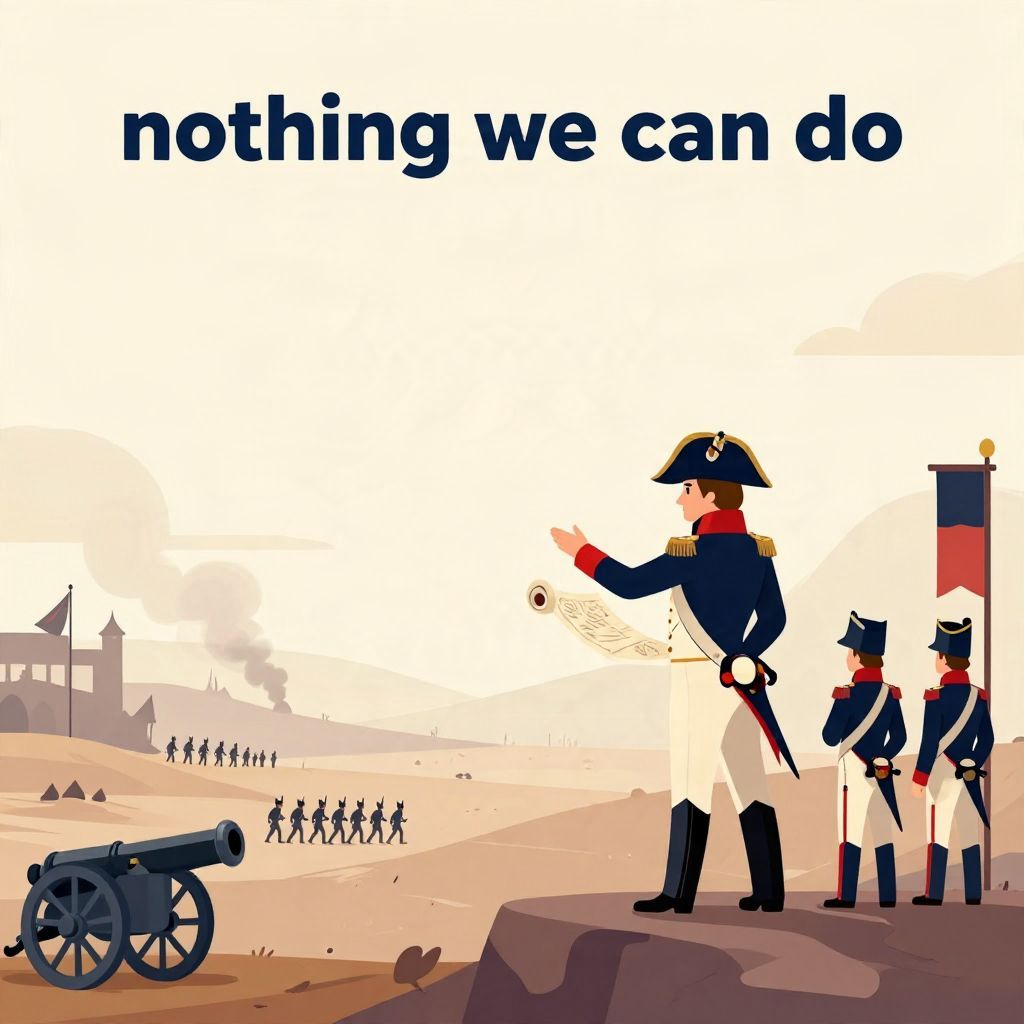
“Napoleon there’s nothing we can do” is a modern internet phrase, not a famous line from Napoleon Bonaparte’s own era. People usually use it as a joke, a meme, or a dramatic way to describe a situation that feels unstoppable, chaotic, or already decided. Historically, there is no well-known authentic quotation from Napoleon that matches this wording.
To understand the phrase properly, it helps to separate the meme from the man. Napoleon was one of the most influential military and political figures in modern European history, and his real story explains why his name still gets attached to ideas of inevitability, defeat, and overwhelming force.
What does “Napoleon there’s nothing we can do” mean historically?
The phrase is not a documented historical quote. It is a contemporary joke that borrows Napoleon’s name to signal helplessness, especially in situations where events seem beyond control. In historical terms, it reflects modern internet humor more than anything Napoleon actually said or wrote.
Why Napoleon’s name is used this way
Napoleon Bonaparte became a symbol of power, speed, and decisive action because of his rapid rise during the French Revolution and the Napoleonic Wars. He won major victories, reorganized governments, and reshaped Europe. Because his image is tied to forceful change, his name is often used in memes to suggest something overwhelming or unavoidable.
The real Napoleon: a brief historical context
Napoleon was born in 1769 in Corsica, just after the island had been transferred from Genoese to French control. He rose through the French army during the Revolution, became First Consul in 1799, and crowned himself Emperor of the French in 1804. His rule ended after defeat in 1815, first at Waterloo and then in exile on Saint Helena.
How the meme works
The humor usually comes from the contrast between a grand historical name and a small, everyday problem. Someone might use “Napoleon there’s nothing we can do” to dramatize a minor inconvenience, a doomed plan, or a situation where the outcome seems fixed. The joke depends on exaggeration, not historical accuracy.
Did Napoleon ever say anything like this?
No reliable historical evidence shows Napoleon saying, “there’s nothing we can do” in this exact form. Many quotations attributed to famous figures circulate without proof, and Napoleon is especially prone to misquotation because of his fame. If a line appears online without a traceable source, it should be treated cautiously.
Why fake quotes spread so easily
Napoleon is a convenient target for invented quotations because he is so widely recognized. Over time, people attach witty, cynical, or dramatic phrases to famous names to make them sound more memorable. This happens with many historical figures, especially those associated with power, war, or political upheaval.
Napoleon’s real historical significance
Napoleon mattered because he transformed France and helped reshape Europe after the French Revolution. He did not simply conquer territory; he also built institutions that outlasted him. His legal reforms, administrative changes, and military campaigns had consequences far beyond his lifetime.
Major developments under Napoleon
- 1799: Napoleon seized power in the coup of 18 Brumaire and became First Consul.
- 1804: He crowned himself Emperor and consolidated authority.
- 1804–1815: The Napoleonic Wars spread across much of Europe.
- 1804: The Napoleonic Code was introduced, influencing legal systems in France and beyond.
- 1812: The invasion of Russia became a turning point against him.
- 1815: He was defeated at Waterloo and sent into final exile.
The Napoleonic Code and lasting change
One of Napoleon’s most enduring legacies was the Civil Code, often called the Napoleonic Code. It standardized laws, protected property rights, and reinforced legal equality for male citizens, while also limiting women’s rights and strengthening patriarchal authority. Its influence spread through parts of Europe and beyond, making Napoleon important not only as a conqueror but also as a state-builder.
How Napoleon changed Europe
Napoleon’s wars redrew borders, toppled old regimes, and accelerated the spread of revolutionary ideas such as merit-based advancement and legal uniformity. At the same time, his empire provoked resistance and helped fuel modern nationalism in places like Spain, Germany, and Italy. His victories and defeats both changed European politics.
War and administration
Napoleon’s military success depended on speed, concentration of force, and flexible command. He was often able to defeat larger coalitions by moving quickly and exploiting mistakes. But his empire also depended on constant warfare, which eventually overstretched French resources and encouraged enemies to unite against him.
Resistance and limits
Napoleon was powerful, but he was never all-powerful. Guerrilla warfare in Spain, the disastrous Russian campaign, and the determination of Britain and other European powers all showed the limits of his control. In that sense, the meme phrase “there’s nothing we can do” is almost the opposite of the historical truth: people did resist, adapt, and eventually defeat him.
Why the phrase feels so fitting
The meme works because Napoleon’s historical image already carries a sense of inevitability. He is often remembered as a genius strategist who seemed to bend events to his will. When modern audiences use his name in a joke about helplessness, they are playing with that reputation for unstoppable momentum.
Napoleon in popular culture
Napoleon appears constantly in films, books, games, and online humor. Sometimes he is portrayed as a brilliant commander, sometimes as a symbol of ego and ambition, and sometimes simply as a shorthand for historical grandeur. Internet culture often strips away context and turns famous names into flexible symbols, which is exactly what happens in this phrase.
Separating history from meme culture
It is useful to remember that a meme is not a source. The phrase “Napoleon there’s nothing we can do” tells us more about modern online humor than about early nineteenth-century France. Still, the meme gains power because Napoleon’s real life was dramatic enough to support exaggerated jokes.
What historians can say with confidence
Historians can confidently say that Napoleon was a Corsican-born French leader who rose during revolutionary turmoil, dominated European politics for more than a decade, and left behind a powerful legacy. They cannot confirm the meme phrase as a genuine quotation. That distinction matters, especially when popular culture blurs fact and fiction.
Why Napoleon still matters today
Napoleon remains important because his career sits at the crossroads of revolution, empire, law, and modern state power. He helped define the political world of the nineteenth century. Even now, his name evokes ambition, command, and the consequences of overreach. That is why a joke using his name still lands so easily.
So, “Napoleon there’s nothing we can do” is best understood as a modern meme built on a famous historical figure, not as a real Napoleon quote. The phrase is funny because it exaggerates helplessness, but the history behind Napoleon is far richer: revolutionary France, imperial war, legal reform, and a legacy that still shapes how we talk about power. For related reading, see Never interrupt your enemy when he is making a mistake and Why did Marie Antoinette get executed?.