
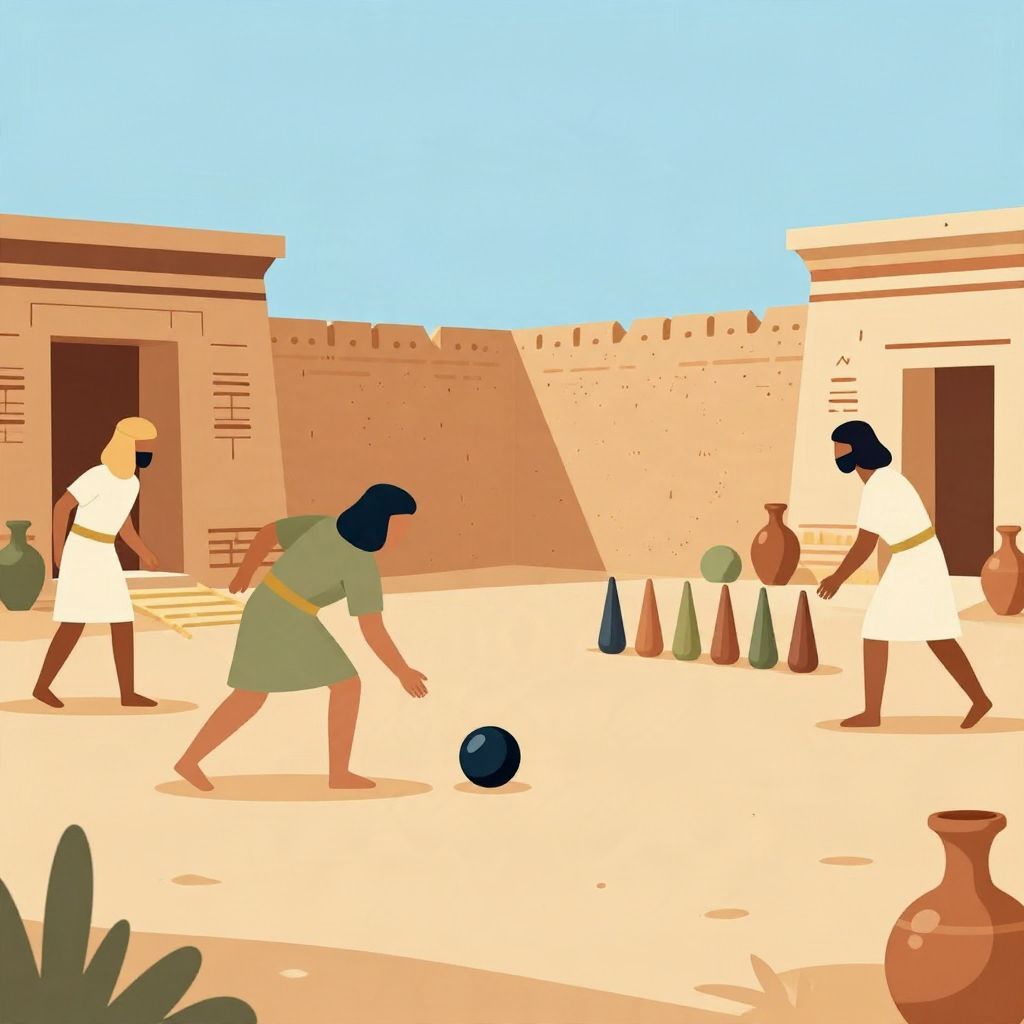
When was bowling invented? The short answer is that bowling is very old, with evidence of pin-and-ball games going back to ancient Egypt, but the version most people recognize today developed much later in Europe and North America. There is no single invention date. Instead, bowling emerged gradually over centuries as different cultures adapted similar games.
That makes bowling less a one-time invention than a long historical evolution. The story moves from ancient ritual objects and medieval games to standardized indoor lanes, rules, and ten pins in the modern era.
When was bowling invented?
Bowling was not invented on one exact date. The earliest known predecessors date to around 3200 BCE in ancient Egypt, where archaeologists found objects that may have been used in a pin-like game. The modern sport, however, took shape much later, especially in Europe during the Middle Ages and in the United States in the 19th century.
The ancient roots of bowling
Long before bowling became a leisure sport, people in several ancient societies played games that involved rolling a ball toward targets. These early forms are the reason historians describe bowling as an ancient game family rather than a single invention.
Egyptian evidence and early ball games
One of the most cited pieces of evidence comes from a child’s tomb in ancient Egypt, where archaeologists found objects that some scholars interpret as a form of early bowling equipment. The dating is commonly placed around 3200 BCE. The evidence is suggestive, not absolute, but it shows that the basic idea of rolling a ball at standing objects is very old.
Other ancient cultures
Similar games appeared in other places too. The Romans, Germans, and various peoples of northern and western Europe played versions of target-ball games. These were not identical to modern bowling, but they shared the same core action: aim, roll, and knock down objects. Over time, local customs shaped the rules, number of pins, and playing surfaces.
How bowling developed in medieval Europe
Bowling became more recognizable in medieval Europe, especially in German-speaking regions and England. By the Middle Ages, people were playing outdoor games that used wooden pins or stones as targets. These games were often tied to festivals, social gatherings, and even religious or moral concerns.
From pastime to public concern
In some places, authorities worried that bowling encouraged gambling or distracted people from military training and work. In England, for example, versions of bowls and skittles were sometimes restricted because rulers wanted men to practice archery instead. That tension is important because it shows bowling was already popular enough to attract regulation.
Bowls, skittles, and regional differences
Medieval and early modern Europe did not have one universal bowling game. Instead, there were many related forms:
- Bowls, often played on grass and involving biased balls that curved as they rolled.
- Skittles, in which players aimed at upright pins, usually indoors or in enclosed spaces.
- Kegel or nine-pin games in German lands, which strongly influenced later bowling traditions.
These regional games are the ancestors of today’s bowling, but they were still diverse and locally defined.
When did modern bowling begin?
Modern bowling began to take shape in the 19th century, especially in the United States. Immigrants brought European pin games with them, and American players gradually standardized rules, lane dimensions, and equipment. The modern indoor game we now call ten-pin bowling is the result of that process.
The move from nine pins to ten pins
In the United States, nine-pin bowling became popular in the 1800s. But because gambling was often associated with nine-pin alleys, some states banned the game. A common response was to add a tenth pin and alter the arrangement, creating a version that could be presented as a different, more respectable sport. This is one reason ten-pin bowling became dominant.
Standardization and the rise of leagues
As bowling spread in American cities, clubs and leagues helped standardize the game. Indoor wooden lanes, set pin spacing, and agreed-upon ball sizes made bowling more consistent from place to place. By the late 19th and early 20th centuries, bowling had become a major recreational sport for working- and middle-class Americans.
A brief timeline of bowling’s evolution
The history of bowling is best understood as a sequence of developments rather than a single invention moment. A simplified timeline helps show how the game changed over time.
- c. 3200 BCE: Possible early pin-and-ball game evidence in ancient Egypt.
- Classical antiquity: Similar target games appear in parts of the Roman world and elsewhere in Europe.
- Middle Ages: Bowling-like games spread in Europe, especially in German and English regions.
- 16th–18th centuries: Bowling and bowls become popular social games, sometimes restricted by authorities.
- 19th century: American ten-pin bowling emerges from older nine-pin traditions.
- 20th century: Bowling becomes a highly standardized indoor sport with national and international organizations.
Why there is no single “inventor” of bowling
Unlike a machine or a patented device, bowling developed through repeated cultural adaptation. Different societies invented similar games independently or borrowed and modified them from neighbors. That is why no single person can be credited as the inventor of bowling.
A game shaped by many cultures
Ancient Egyptians, Europeans, and later Americans all contributed to the history of bowling in different ways. The basic human pleasure of rolling a ball toward a target is simple enough that it could arise in many places. What changed over time was the meaning of the game, the rules, and the social setting.
Folklore versus historical evidence
Popular stories sometimes claim bowling was invented by one nation or one ruler, but these claims usually oversimplify the evidence. The historical record supports a broader view: bowling is a family of games with deep roots and many local versions. Where the evidence is uncertain, historians prefer to say “earliest known evidence” rather than “first invention.”
How bowling became the sport we know today
The modern image of bowling—indoor lanes, polished balls, ten pins, and scorekeeping—came together in the industrial age. Urbanization made indoor recreation more attractive, while mass production made equipment cheaper and more uniform. Bowling alleys became common social spaces in cities and towns.
Technology and standard rules
Standardized lanes and manufactured balls changed the game significantly. Once equipment was consistent, it became easier to compare scores across different alleys and organize competitions. This helped bowling move from a casual pastime to a formal sport with leagues, tournaments, and records.
Bowling in the 20th century
By the 20th century, bowling was especially popular in the United States and parts of Europe. Mechanical pinsetters, improved lane maintenance, and televised competitions helped expand its audience. The sport became associated with family recreation, social clubs, and professional competition all at once.
So, when was bowling invented?
If you mean the earliest ancestor of bowling, the answer is ancient times, at least around 3200 BCE. If you mean the modern sport of ten-pin bowling, the answer is the 19th century, when older European pin games were standardized in the United States. In other words, bowling was not invented once; it evolved over thousands of years.
That long evolution is what makes bowling historically interesting. It connects ancient play, medieval custom, immigration, urban leisure, and modern sport. For readers interested in how everyday activities change across cultures, you may also enjoy more historical context on daily life and culture and this related look at cultural divergence.