
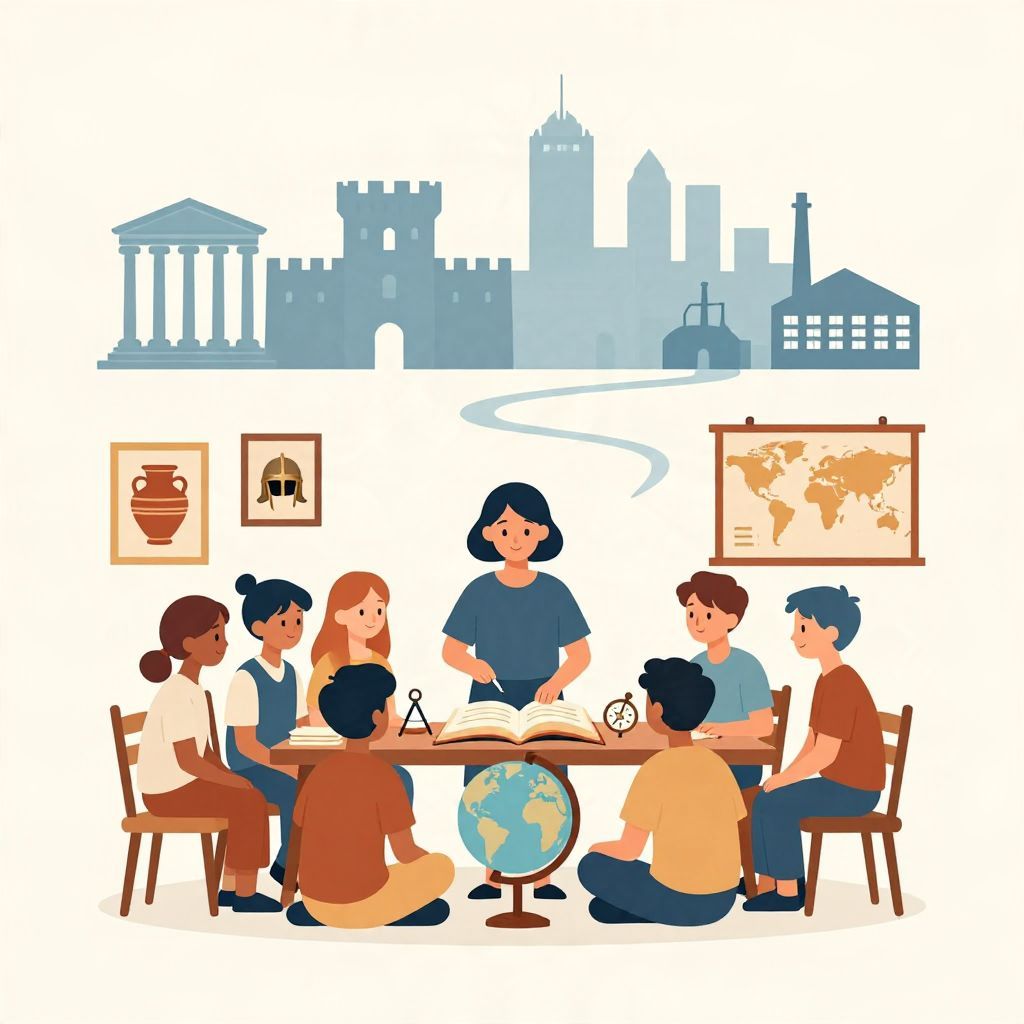
Why is it important to study history? The short answer is that history helps us understand how societies change, why conflicts begin, how institutions develop, and why the present looks the way it does. It is not just a record of the past; it is a tool for interpreting the world.
By studying history, we learn to weigh evidence, recognize patterns, and see that many modern debates have deep roots. History also shows that human choices matter: ideas, leadership, technology, migration, and power have all shaped outcomes in ways that still affect daily life.
Why Is It Important To Study History?
It is important to study history because it explains how the present came to be. History reveals the origins of laws, borders, traditions, inequalities, and freedoms, while also teaching critical thinking about evidence and interpretation. It helps people make informed decisions by showing how earlier choices produced lasting consequences.
History Helps Us Understand Change Over Time
One of the most valuable things history teaches is that societies are not fixed. Governments rise and fall, economies expand and collapse, and cultural values evolve. What seems normal in one era may be unusual in another. That perspective makes change easier to understand and less likely to feel random.
Examples of long-term change
- Political systems: Monarchies, empires, republics, and democracies have all developed under different conditions.
- Economic life: Farming societies, industrial economies, and digital economies each changed how people worked and lived.
- Social norms: Ideas about gender, family, citizenship, and rights have shifted across centuries.
History also shows that change is often uneven. A legal reform may be passed in one decade, but its effects may take generations to reach everyone. That is why historians pay attention not only to major events, but also to slow transformations in everyday life.
History Shows Cause and Effect
Historical study is valuable because it asks why events happened, not only what happened. Wars, revolutions, migrations, and reforms usually have multiple causes. Economic stress, political conflict, religion, ideology, leadership, and geography can all interact. This makes history a disciplined way of thinking about causation.
Why this matters
When people study the French Revolution, for example, they do not just memorize 1789. They examine debt, food shortages, social inequality, political ideas, and state weakness. In the same way, the outbreak of World War I cannot be explained by a single assassination alone; it involved alliances, militarism, imperial rivalries, and crisis management. History teaches that complex events usually have complex roots.
History Teaches Critical Thinking and Evidence
Another reason it is important to study history is that it trains people to evaluate sources. Historians compare documents, artifacts, speeches, letters, laws, images, and oral traditions. They ask who created a source, when, for what purpose, and what it leaves out. That habit of mind is useful far beyond the study of the past.
How historians work with evidence
- They identify the source and its context.
- They compare it with other evidence.
- They separate fact, interpretation, and later myth.
- They revise conclusions when new evidence appears.
This matters because historical memory is often incomplete or selective. Public stories about nations, leaders, and wars can become simplified over time. Studying history helps people distinguish reliable evidence from legend, propaganda, or hindsight.
History Helps Us Understand Identity and Culture
People do not live in a vacuum. Languages, religions, customs, laws, and national identities all have histories. Studying those histories helps explain why communities value certain traditions and how those traditions were formed through contact, conflict, and exchange.
Culture is shaped by contact
Many cultures developed through migration and interaction rather than isolation. Trade routes connected Africa, Asia, Europe, and the Americas long before the modern era. Ideas, crops, technologies, and beliefs moved with merchants, travelers, soldiers, and pilgrims. History shows that cultural identity is often the result of long exchange, not pure separation.
This is especially important in a global world. Understanding the historical roots of language, religion, and nationality can reduce stereotypes and encourage more accurate views of other societies. It also helps people understand their own background with greater depth.
History Explains Rights, Laws, and Institutions
Modern institutions did not appear overnight. Parliaments, constitutions, courts, school systems, and civil rights protections were created through long struggles and compromises. Studying history shows how these institutions developed and why they remain contested.
Examples of historical development
- Magna Carta in 1215 became part of a longer tradition of limiting royal power, though it did not create modern democracy.
- The abolition of slavery in different countries came through activism, war, law, and economic change over many decades.
- Universal suffrage expanded gradually, often after intense political struggle and resistance.
These examples show that rights are usually won, defended, and expanded through history rather than granted automatically. Knowing that history can make citizens more aware of how fragile institutions can be and how much effort it takes to preserve them.
History Helps Us Learn From Successes and Failures
People often say that history repeats itself, but that is too simple. The past does not repeat exactly. Still, historical study can reveal patterns in leadership, diplomacy, economic policy, and social unrest. It can also show what happens when warning signs are ignored.
Lessons from past crises
Economic depressions, pandemics, and wars have repeatedly shown the importance of preparation, trust, and public coordination. The Black Death in the 14th century transformed labor systems and social structures. The influenza pandemic of 1918 demonstrated how quickly disease can spread in a connected world. The Great Depression showed how financial instability can affect politics and society for years. These events do not provide simple formulas, but they do offer perspective.
At the same time, history also records achievements: peace settlements, democratic reforms, scientific advances, and social movements that expanded human freedom. Studying both failure and success prevents a one-sided view of the past.
History Encourages Empathy Without Erasing Difference
Historical study can deepen empathy because it places people in their own time. It asks readers to understand how ordinary men and women lived under different expectations, limits, and dangers. This does not mean excusing injustice, but it does mean seeing the past on its own terms.
Why empathy matters in history
A person living in ancient Rome, medieval West Africa, or 19th-century India did not know the future. Their decisions were shaped by what they could see, believe, and survive. History helps us imagine those constraints. That kind of understanding can make public debate less simplistic and more humane.
Empathy also matters when studying difficult subjects such as slavery, colonialism, genocide, and war. These are not abstract topics. They affected real people, families, and communities. History gives those experiences context while still allowing moral judgment.
History Helps Us Understand Power
Power is one of the central themes of history. Who governs? Who benefits? Who is excluded? Who gets to tell the story? These questions appear in every era. Studying history reveals how power is gained, used, challenged, and sometimes abused.
Power in different forms
- Political power: control of laws, armies, and institutions.
- Economic power: control of land, labor, trade, and wealth.
- Cultural power: control of ideas, education, media, and symbols.
Historical research often uncovers voices that were ignored in official records: workers, enslaved people, women, colonized populations, religious minorities, and others who were not always represented by rulers. That makes history more complete and more honest.
History Is Useful in Civic Life
Citizens in any society benefit from historical knowledge because public debates often involve claims about tradition, national identity, reform, and responsibility. Without history, it is easy to accept slogans or myths. With history, people are better equipped to ask informed questions.
History in public decision-making
When governments debate immigration, education, war, voting rights, or memorials, historical context matters. Past policies may have produced unintended consequences. Earlier reforms may show what worked and what failed. History does not dictate policy, but it improves judgment.
It also helps people recognize when political arguments distort the past for modern purposes. Historical memory can be used honestly, but it can also be manipulated. A historically informed public is harder to mislead.
History Makes the Present More Meaningful
Many people study history because it gives depth to the present. A city street, a national holiday, a border, or a monument may seem ordinary until its background is known. Then it becomes part of a longer story of conflict, exchange, memory, and change.
Everyday life has a history
Food, clothing, housing, work, and entertainment all have historical roots. The way people shop, travel, communicate, and learn has changed dramatically over time. Even familiar technologies have histories shaped by invention, business, and social need. History turns the ordinary into something explainable.
That does not make the present less important. It makes it more legible. Understanding where things came from can reduce confusion and increase appreciation for how much human societies have built, lost, and rebuilt.
The Limits of History Matter Too
Studying history is important, but it also requires humility. The past is incomplete. Many people left no written records, and surviving sources often reflect the views of the powerful. Historians must therefore work carefully, acknowledging uncertainty where evidence is limited.
What history cannot do
History cannot predict the future with certainty. It cannot recover every lost voice. It cannot turn the past into a simple moral lesson. What it can do is provide grounded understanding, careful comparison, and a better sense of how human societies actually function.
That honesty is part of its value. A good historical account does not pretend that the past is easy to summarize. It shows complexity, contradiction, and change.
Conclusion: Why History Still Matters
It is important to study history because it teaches how the world became what it is, how evidence should be judged, and how human choices shape long-term outcomes. History strengthens memory, critical thinking, empathy, and civic awareness. Most of all, it reminds us that the present is part of a much longer story. For more related reading, see why history is important and how Martin Luther King changed the world.