
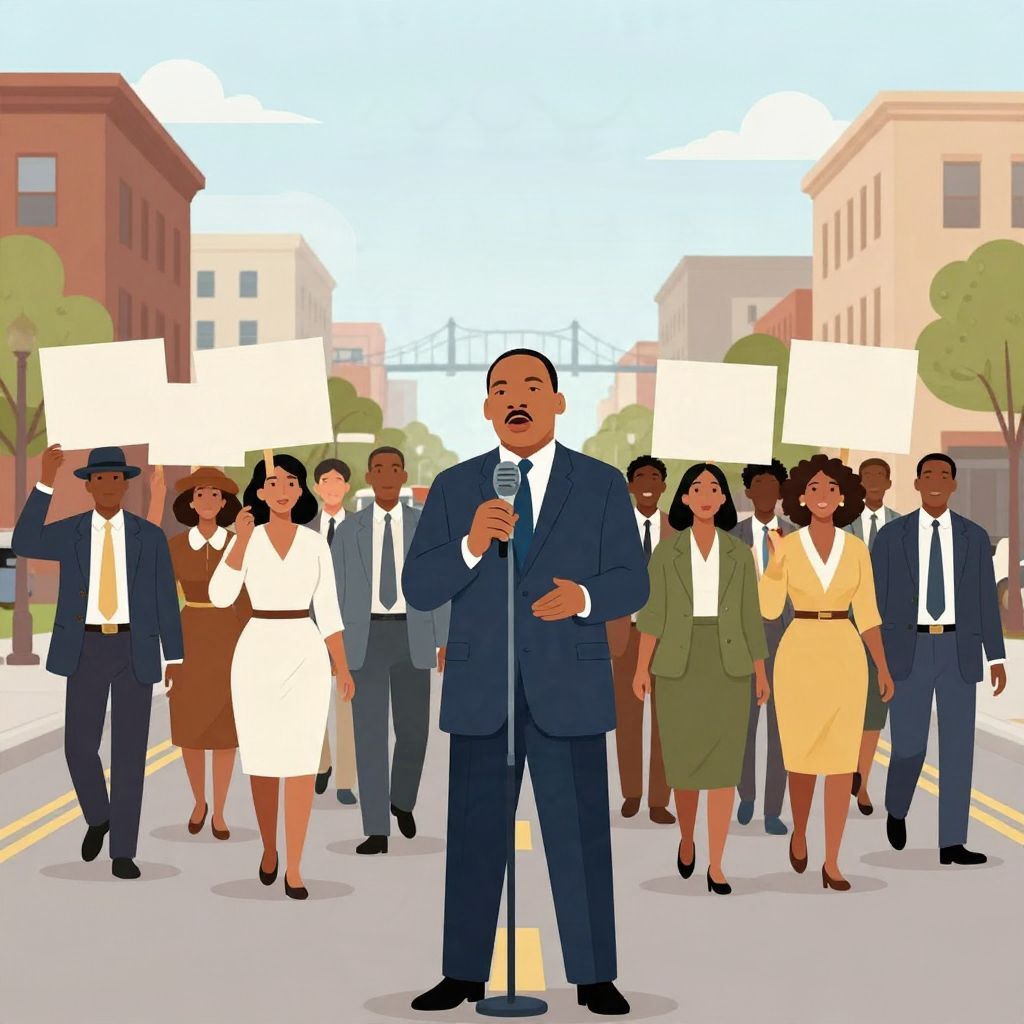
How did Martin Luther King change the world? He helped transform the United States by making nonviolent protest a powerful force for civil rights, helping break legal segregation, and pushing the country toward a broader idea of democracy. His leadership did not end racism, but it changed the law, public life, and the language of justice in lasting ways.
King became the best-known leader of the mid-20th-century American civil rights movement. Through speeches, marches, boycotts, and strategic organizing, he helped turn local struggles against segregation into a national moral and political crisis that the federal government could no longer ignore.
How did Martin Luther King change the world?
Martin Luther King Jr. changed the world by helping make nonviolent mass protest a successful tool against racial segregation and discrimination in the United States. His leadership in the Montgomery Bus Boycott, the Birmingham campaign, the March on Washington, and the Selma movement helped win landmark civil rights laws and inspired later movements for justice around the world.
The historical problem King confronted
King’s work unfolded in a United States shaped by Jim Crow segregation, especially in the South, where Black Americans were denied equal access to schools, transportation, voting, housing, and public facilities. Even after slavery ended in 1865, racial inequality remained deeply embedded in law and custom. By the 1950s, many Black Americans were challenging that system through courts, churches, local organizing, and direct action.
Why the civil rights movement needed a new approach
Legal victories alone were not enough. The Supreme Court’s Brown v. Board of Education decision in 1954 declared school segregation unconstitutional, but implementation was slow and often violently resisted. King and other activists understood that public pressure, media attention, and disciplined protest would be needed to force real change.
King’s rise as a leader
Martin Luther King Jr., born in Atlanta in 1929, was a Baptist minister with strong training in theology and a deep commitment to social ethics. He emerged as a national figure in 1955–56 during the Montgomery Bus Boycott, after Rosa Parks’s arrest for refusing to give up her seat to a white passenger. The boycott showed that organized, sustained, nonviolent action could challenge segregation effectively.
Montgomery and the power of collective action
The boycott lasted more than a year and ended with a Supreme Court ruling against bus segregation. It was a turning point because it demonstrated that ordinary people, led by careful organizing, could disrupt unjust systems without armed revolt. King’s role in Montgomery made him a symbol of a new kind of leadership: moral, strategic, and nationally visible.
Nonviolence as a political strategy
King did not invent nonviolence; he drew from Christian teachings and from the example of Mahatma Gandhi. But he adapted it to the American struggle for civil rights. For King, nonviolence was not passive waiting. It was a disciplined method of protest intended to expose injustice, win public sympathy, and pressure institutions to change.
What nonviolence accomplished
- It reduced the chance that segregationists could portray activists as a violent threat.
- It placed moral responsibility on local authorities who used police dogs, fire hoses, arrests, and beatings against peaceful demonstrators.
- It helped draw national television coverage to Southern racism.
- It brought together churches, students, labor supporters, and northern allies into a broad coalition.
This strategy mattered because it shifted the struggle from a local racial issue to a national question about American democracy itself.
Major campaigns that changed U.S. history
Birmingham, 1963
The Birmingham campaign became one of the most important moments in the civil rights movement. In Birmingham, Alabama, activists faced brutal repression from police under Commissioner Eugene “Bull” Connor. Images of peaceful protesters being attacked by dogs and fire hoses shocked many Americans. The campaign helped force negotiations and made the violence of segregation impossible to ignore.
The March on Washington, 1963
Later that year, King helped lead the March on Washington for Jobs and Freedom. The event brought together a massive multiracial crowd and highlighted both civil rights and economic justice. King’s “I Have a Dream” speech became one of the most famous speeches in American history, not because it solved the movement’s problems, but because it gave powerful language to the idea of an integrated, democratic future.
Selma and voting rights, 1965
In Selma, Alabama, activists fought for Black voting rights in the face of intimidation and violence. The confrontation at the Edmund Pettus Bridge, known as “Bloody Sunday,” helped build support for federal intervention. The result was the Voting Rights Act of 1965, one of the most important civil rights laws in U.S. history.
The laws King helped make possible
King did not pass laws by himself, and many other organizers, lawyers, church leaders, students, women, and local activists were essential. Still, his leadership helped create the political pressure that made landmark legislation possible. The main federal achievements associated with the movement included the Civil Rights Act of 1964 and the Voting Rights Act of 1965.
What those laws changed
- The Civil Rights Act of 1964 outlawed segregation in public accommodations and banned many forms of employment discrimination.
- The Voting Rights Act of 1965 targeted barriers that had long prevented Black citizens from voting, such as literacy tests and discriminatory registration practices.
- These laws strengthened the federal government’s role in protecting civil rights.
In practical terms, these changes did not end inequality, but they made legalized racial exclusion far harder to defend.
How King changed the world beyond the United States
King’s influence spread far beyond American borders. His speeches, tactics, and moral arguments inspired activists in other countries who were confronting colonialism, dictatorship, poverty, and racial oppression. He became a global symbol of principled resistance, especially for movements that wanted change without civil war or armed revolution.
An international moral language
King helped popularize the idea that oppressed people could claim justice through organized, peaceful pressure. That message resonated in anti-apartheid struggles, student movements, labor campaigns, and later human rights activism. His example showed that a local struggle could become a global moral issue when framed in universal terms such as dignity, equality, and freedom.
King’s later years and broader vision
By the mid-1960s, King’s focus expanded beyond segregation alone. He increasingly spoke about poverty, economic inequality, and the Vietnam War. This broader agenda sometimes made him controversial, even among supporters who preferred a narrower civil rights message. Yet it reflected his belief that legal equality meant little without social and economic justice.
The Poor People’s Campaign
In 1968, King was preparing the Poor People’s Campaign, which aimed to pressure the federal government to address poverty across racial lines. This effort showed that King’s vision had grown from ending Jim Crow to challenging deeper structures of inequality. He was assassinated in Memphis in April 1968 while supporting striking sanitation workers, a reminder that his activism remained tied to labor and economic justice as well as civil rights.
Why Martin Luther King matters today
King matters because he changed what many people believed protest could do. He showed that disciplined, nonviolent mass action could alter laws, reshape public opinion, and expose injustice on a national scale. His life also reminds us that major change usually comes from collective organizing, not from one speech or one leader alone.
His lasting legacy
King’s legacy can be seen in civil rights law, in later struggles for voting access and equal treatment, and in the continued use of peaceful protest around the world. At the same time, historians also stress that his victories were incomplete. Racial inequality, political backlash, and voter suppression remained real after 1968 and continue to shape debate today. That is part of why his work still matters: it changed the world, but it also left unfinished business.
In short, Martin Luther King changed the world by helping turn the American civil rights struggle into a national and global model for nonviolent resistance, legal reform, and moral leadership. If you want to explore more about his legacy, you may also be interested in where Martin Luther King Jr. is buried and other stories of influential leaders in history.