
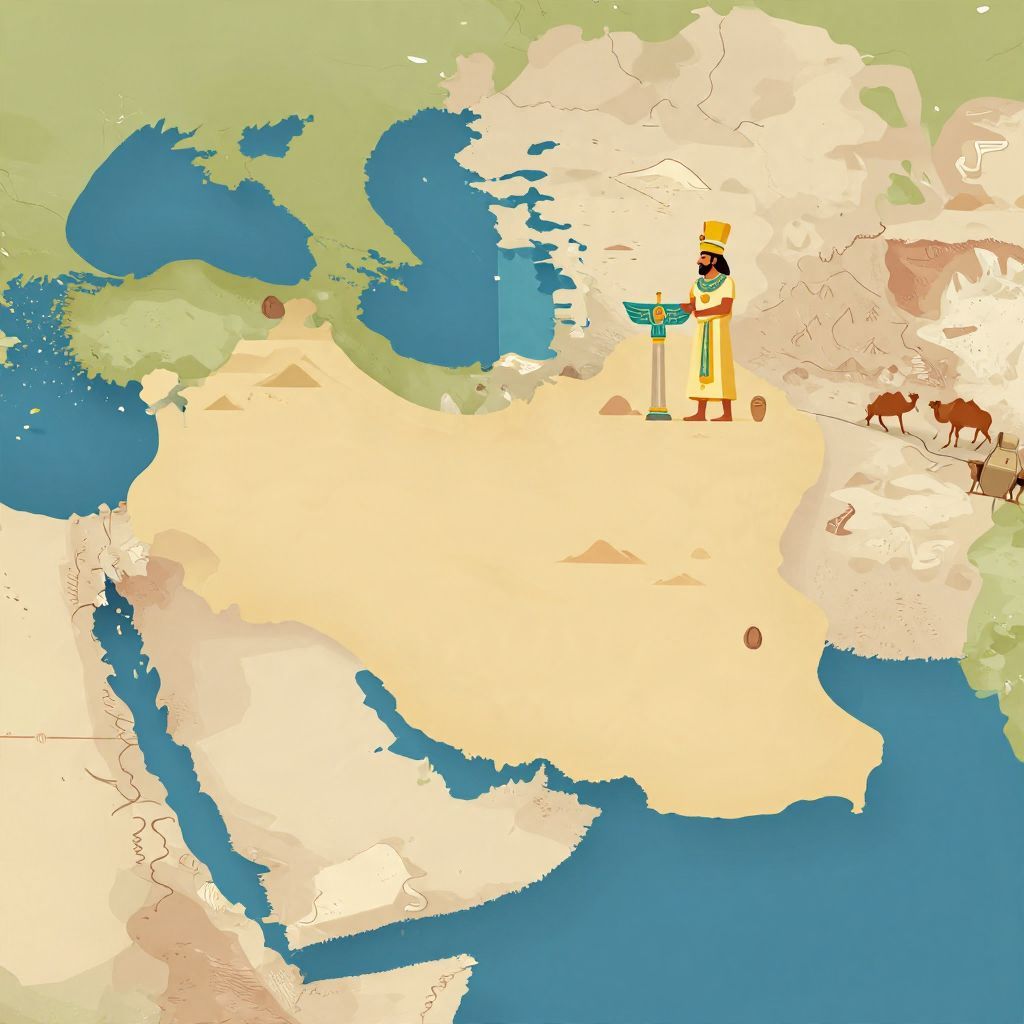
Persia was the historical name most commonly used in the Greek and European world for the region that is now Iran. In different eras, “Persia” could mean the land of the Persian people in southwestern Iran, the larger Iranian plateau, or the empire ruled by Persian dynasties.
So when people ask where Persia was, the short answer is: in southwestern and central Asia, centered on modern-day Iran, with its heartland in the ancient region of Fars (Pars) near the Persian Gulf.
Where Was Persia?
Persia was located mainly in what is now Iran. The name originally came from Pars or Fars, a region in southwestern Iran where the Persians first rose to political power. Over time, “Persia” came to refer not just to one province but to a vast empire stretching across the Middle East, parts of Central Asia, and beyond.
The original Persian homeland
The earliest Persian homeland was in the south of the Iranian plateau, especially the area around modern Fars Province. This region lies inland from the Persian Gulf and includes the ancient centers associated with early Persian power, such as Pasargadae and Persepolis. From there, the Persians expanded under the Achaemenid dynasty in the 6th century BCE.
Persia as an empire
When historians speak of the Persian Empire, they usually mean a series of states ruled by Persian dynasties, beginning with the Achaemenids and later including the Parthians and Sasanians. At its greatest extent, Persia controlled lands from Egypt and Anatolia in the west to parts of Afghanistan, Central Asia, and the Indus Valley in the east.
Why the Name “Persia” Can Be Confusing
The word “Persia” was widely used in Europe for centuries, but the people living there traditionally called their land Iran or related forms of that name. “Persia” comes from the Greek Persis, which referred to the Persian homeland in Fars. Because Greek writers encountered the Persians through that region, the name spread into many European languages.
In 1935, the Iranian government asked foreign governments to use “Iran” in official contexts, though “Persia” remained common in historical writing and cultural references. Today, both terms may appear, but they do not mean exactly the same thing. “Iran” is the modern state; “Persia” is the older historical and cultural name often used for the ancient empire and its traditions.
Persia in Ancient History
Persia became famous in the ancient world because its rulers built one of history’s largest and most sophisticated empires. The rise of Persian power transformed the political map of the ancient Near East and brought together many peoples, languages, and religions under one imperial system.
The Achaemenid Empire
The first great Persian empire was the Achaemenid Empire, founded by Cyrus the Great in the mid-6th century BCE. Cyrus conquered Media, Lydia, and Babylon, and his successors expanded the empire further. Under rulers such as Darius I and Xerxes I, Persia became a major imperial power with administrative centers, royal roads, tribute systems, and satrapies, or provincial governorships.
This empire was not limited to the small homeland of Fars. It stretched across a huge arc of territory that included modern Iran, Iraq, Turkey, Syria, Lebanon, Israel, Egypt, Afghanistan, and parts of Pakistan and Central Asia. For that reason, “Persia” in ancient history often means a transcontinental empire rather than a single geographic region.
Capital cities and royal centers
Several important Persian centers help locate the empire geographically:
- Pasargadae – the early Achaemenid capital associated with Cyrus the Great
- Persepolis – a ceremonial and administrative center in Fars, famous for its monumental ruins
- Susa – an older Elamite city used by Persian rulers as an important administrative center
- Babylon – a major Mesopotamian city incorporated into the Persian Empire after Cyrus’s conquest
These sites show that Persia was both rooted in southwestern Iran and connected to a much wider imperial world.
Where Was Persia on the Modern Map?
If you place Persia on a modern map, the core answer is Iran. More specifically, the ancient Persian homeland lay in the southwest of the country, around Fars Province, while the later Persian empires ruled across a broad zone of the Middle East and neighboring regions.
Modern countries once ruled by Persian empires
At different times, Persian dynasties controlled or influenced territories that are now part of:
- Iran
- Iraq
- Turkey
- Syria
- Lebanon
- Israel and Palestine
- Egypt
- Afghanistan
- Pakistan
- Armenia, Azerbaijan, and parts of Central Asia
That wide reach is one reason Persia is remembered as an empire rather than just a place. Its political center changed over time, but its cultural and dynastic core remained tied to the Iranian plateau.
Persia Through Different Dynasties
“Persia” did not refer to one unbroken state. The region saw repeated changes in ruling houses, foreign conquest, and imperial revival. Still, the name remained attached to the land and its culture.
After the Achaemenids
After Alexander the Great conquered the Achaemenid Empire in the late 4th century BCE, Persia did not disappear. The region passed through Hellenistic rule and later came under the Parthians, who governed a large Iranian empire from about the 3rd century BCE to the 3rd century CE. The Parthians were Iranian rulers, though not the same dynasty as the Achaemenids.
The Sasanian Empire
The Sasanian Empire, lasting from the 3rd to the 7th century CE, is often seen as the last great pre-Islamic Persian empire. It centered in Iran and competed with the Roman and Byzantine empires. Under the Sasanians, Persian culture, religion, administration, and art flourished, and the imperial identity remained strongly tied to the Iranian homeland.
Persia after the Islamic conquests
In the 7th century, Arab Muslim armies conquered the Sasanian Empire. Persia as an independent imperial power ended, but the region remained culturally important. Over time, Persian language and literature became influential across a much broader Islamic world, from Central Asia to India. In this sense, Persia survived as a civilization even when its ancient empire did not.
What Made Persia Important?
Persia mattered because it linked geography, empire, and culture. Its position on the Iranian plateau placed it between Mesopotamia, Central Asia, the Indian subcontinent, and the Persian Gulf. That location made it a crossroads for trade, military movement, and cultural exchange.
Trade and communication
The Persians developed roads and administrative systems that helped govern a huge territory. The famous Royal Road under the Achaemenids improved communication across the empire. Caravans, messengers, merchants, and officials moved through Persian lands carrying goods and ideas.
Religion and cultural influence
Persia was also important in religious history. Zoroastrianism became a major faith in the region and strongly influenced Persian identity, especially under the Sasanians. Later, Persian language and literature became central to court culture across much of Asia. Poets, scholars, and administrators used Persian far beyond the borders of modern Iran.
Persia, Iran, and the Historical Record
Historians usually distinguish between the ancient Persian homeland, the Persian empires, and the modern state of Iran. This distinction matters because “Persia” can mean different things depending on the period.
Three common meanings of Persia
- The original region: Fars in southwestern Iran
- The imperial realm: the vast territories ruled by Persian dynasties
- The cultural-historical name: a traditional term for Iran in many Western languages
When reading ancient history, “Persia” often refers to the empire. When reading geography, it usually points to Iran. When reading cultural history, it may describe a civilization whose influence extended well beyond any single border.
Why the Question Still Matters
Asking where Persia was is really asking how a place became an empire and how an empire became a cultural memory. Persia began as a region in southwestern Iran, expanded into one of the ancient world’s great powers, and left a legacy that still shapes ideas about the Middle East, Iran, and classical antiquity.
In short, Persia was in Iran, but historically it was much more than a modern country name. It was a homeland, an empire, and a civilization whose influence spread across continents. For a related overview of the name change and modern identity, see what Persia is called now, and for another ancient Near Eastern context, read about what happened to Babylon.