
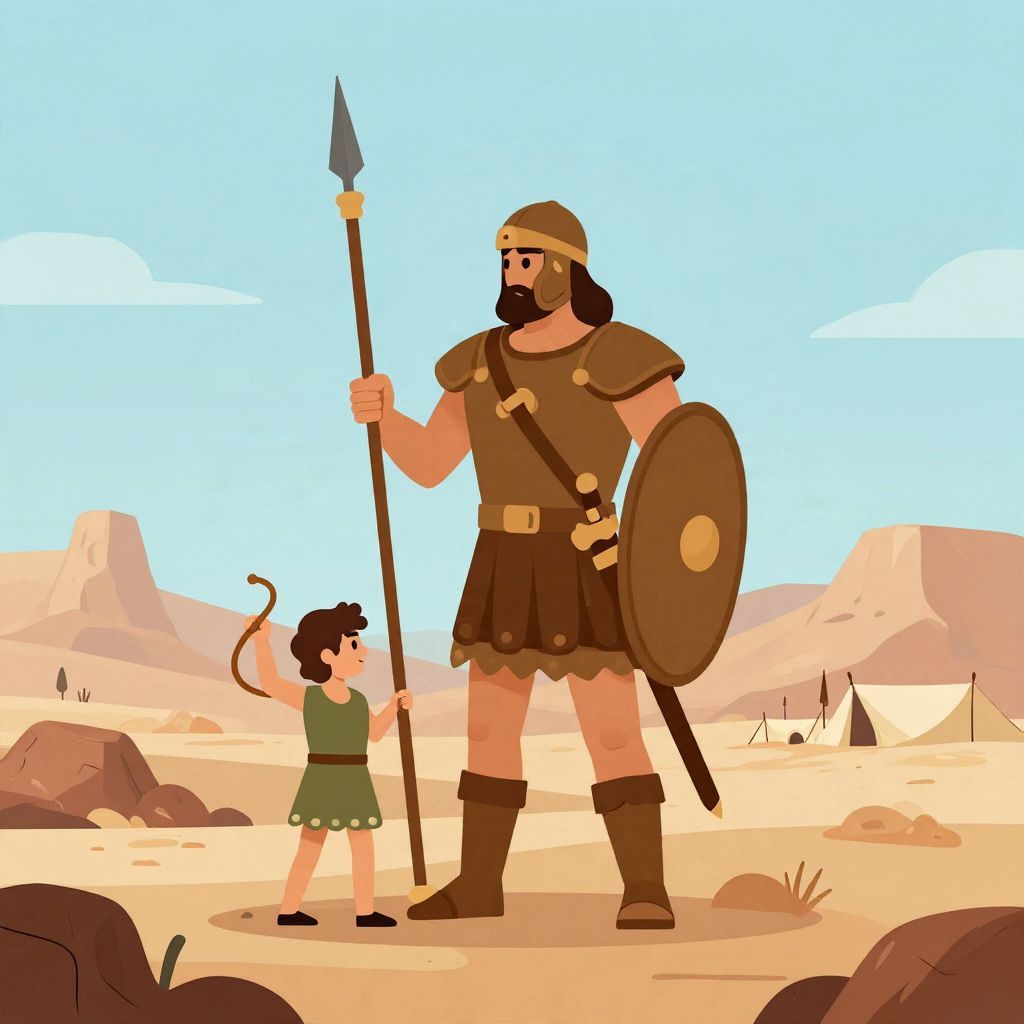
How big was Goliath in the Bible? The short answer is that the biblical text gives him a towering height, but the exact number depends on which ancient manuscript tradition you follow. In the best-known Masoretic Text, Goliath is said to be “six cubits and a span,” while some older manuscripts and ancient translations give a shorter reading.
That means the question is not as simple as one fixed measurement. Historians and biblical scholars look at the manuscript evidence, ancient measuring units, and the literary purpose of the story to understand what the text is actually saying.
How big was Goliath in the Bible?
In the Masoretic Text of 1 Samuel 17, Goliath is described as “six cubits and a span” tall, which is usually estimated at about 9 feet 9 inches, or roughly 2.97 meters. However, some ancient witnesses, including the Dead Sea Scrolls and the Septuagint, preserve a reading of “four cubits and a span,” closer to 6 feet 9 inches, or about 2.06 meters.
What the Bible actually says about Goliath’s height
The story of David and Goliath appears in 1 Samuel 17. In the most familiar Hebrew text, Goliath’s height is given as six cubits and a span. A cubit was an ancient unit based on the forearm, and a span was roughly half a cubit. Because ancient cubits varied, modern estimates are approximate rather than exact.
The two main readings
- Six cubits and a span — about 9 feet 9 inches, or around 2.97 meters.
- Four cubits and a span — about 6 feet 9 inches, or around 2.06 meters.
The difference matters because it changes how readers imagine Goliath. The longer reading presents him as a near-giant even by legendary standards. The shorter reading still makes him exceptionally tall for the ancient world, but not impossibly so.
Why there are different numbers in ancient sources
The variation in Goliath’s height comes from the complicated history of biblical transmission. The Hebrew Bible was copied by hand for centuries, and small differences entered the text over time. Scholars compare the Masoretic Text with older witnesses such as the Dead Sea Scrolls and the Greek Septuagint to reconstruct earlier forms of the story.
Manuscript evidence and textual history
Most modern readers encounter the Masoretic Text, the standard medieval Hebrew textual tradition. But some earlier evidence suggests a shorter Goliath. The Dead Sea Scrolls, which preserve fragments of Samuel from before the Common Era, and the Septuagint, a Greek translation made centuries before the medieval Hebrew text, both support the “four cubits and a span” reading in some versions of the passage.
That does not prove one reading is automatically correct, but it does show that the text was not perfectly uniform. For historians, this is a reminder that biblical books have a manuscript history, not just a single frozen wording.
How tall is that in modern terms?
Ancient measurements are approximate, so any modern conversion should be treated as an estimate. Still, the usual calculations are straightforward. A cubit is often taken as about 18 inches, and a span as about 9 inches, though actual ancient cubits could differ by region and period.
Approximate conversions
- Six cubits and a span: about 9 feet 9 inches, or 2.97 meters.
- Four cubits and a span: about 6 feet 9 inches, or 2.06 meters.
Even the shorter figure would make Goliath unusually large for the ancient Near East, though not beyond the range of real human height. The longer figure moves the story into the realm of extraordinary literary symbolism as well as physical description.
Was Goliath a real giant?
Historically, there is no independent archaeological proof that a man named Goliath exactly as described in 1 Samuel existed. The story belongs to the biblical narrative world, and its main purpose is theological and literary: it contrasts a young shepherd with a terrifying Philistine champion. That does not mean the account is meaningless as history, but it does mean the text should not be read like a modern biographical record.
Historical setting of the story
The David and Goliath narrative is set in the early Iron Age, in the long conflict between Israelites and Philistines. The Philistines were a coastal people in the southern Levant, active in the region during the 12th to 10th centuries BCE. The story reflects a world of local warfare, champions, and tribal conflict, even if the final written form of the tale may be later.
Goliath is identified as coming from Gath, one of the Philistine city-states. This detail fits the broader biblical picture of Philistine power, though scholars continue to debate how much of the narrative preserves early memory and how much is shaped by later storytelling.
Why the size of Goliath matters in the story
Goliath’s height is not just a detail; it drives the drama. In ancient literature, physical size often signals military power, intimidation, and status. Goliath’s armor, weapons, and battlefield challenge all reinforce the image of an overwhelming enemy. David’s victory then becomes a story about divine favor, courage, and reversal of expectations.
Size as symbolism
The biblical author uses Goliath’s body to make a larger point. The Philistine champion appears unbeatable, yet he is defeated by a youth with a sling. Whether one reads Goliath as nearly ten feet tall or simply very tall, the narrative works by magnifying the contrast between human appearance and divine outcome.
That literary purpose helps explain why the story became so enduring. It is not only about a battle; it is about how power is portrayed, challenged, and overturned.
How scholars interpret the height problem
Scholars generally approach Goliath’s height in three ways. Some emphasize the Masoretic reading and accept the taller figure as the biblical text’s standard form. Others argue that the shorter reading is earlier and more likely original. A third approach focuses less on the exact number and more on the story’s rhetorical function.
Three common scholarly views
- The traditional reading: Goliath was about 9 feet 9 inches tall in the received Hebrew text.
- The textual-critical reading: the original text may have said four cubits and a span, about 6 feet 9 inches.
- The literary reading: the exact number is less important than the image of a fearsome champion.
These views are not mutually exclusive. A scholar can recognize the textual variation while also acknowledging that the story’s power does not depend entirely on one exact measurement.
What ancient people thought about unusually tall men
Ancient societies knew that some people were exceptionally tall, and such individuals could become figures of wonder, fear, or legend. Biblical texts sometimes describe unusually large warriors, and other ancient literatures do the same. In that world, height was often associated with strength, but also with danger and the uncanny.
Goliath fits that pattern. He is not just an enemy soldier; he is a champion whose body itself becomes part of the challenge. The narrative uses that physical presence to intensify the stakes of the confrontation.
The lasting significance of Goliath’s size
Goliath’s height has remained a topic of interest because it sits at the intersection of faith, text, and history. For believers, the story highlights divine deliverance. For historians, it raises questions about manuscript transmission and ancient storytelling. For general readers, it remains one of the Bible’s most memorable images.
The key historical takeaway is that the Bible does not give only one uncontested measurement. The famous “giant” of 1 Samuel 17 appears differently depending on the manuscript tradition, and that variation is part of the history of the text itself.
If you want to explore the broader biblical background, you may also enjoy reading about where Goliath was from and the wider context of biblical figures such as Abraham.