
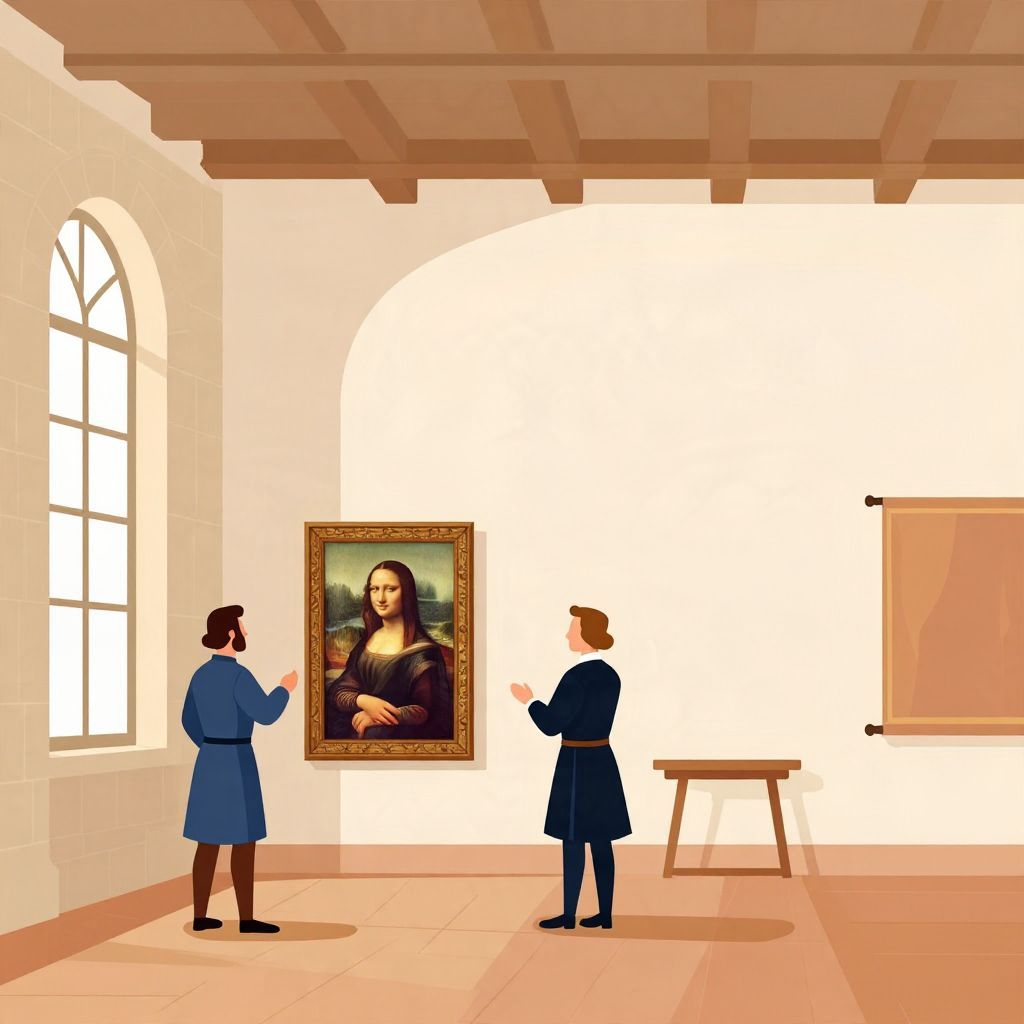
Where did King Francis keep the Mona Lisa? The short answer is that Francis I of France likely kept Leonardo da Vinci’s painting in the royal collection at his residences in the Loire Valley, especially at the Château de Fontainebleau, after Leonardo entered French royal service in the final years of his life.
The story is tied to the French Renaissance and to how artworks moved through royal patronage. The Mona Lisa was not originally made for Francis, but it became part of the French crown’s holdings after Leonardo’s death in 1519, eventually becoming one of the best-known paintings in France.
Where Did King Francis Keep the Mona Lisa?
King Francis I most likely kept the Mona Lisa in his royal collection at French palaces associated with the court, especially Fontainebleau in the Loire Valley. The painting was in royal hands after Leonardo da Vinci came to France in 1516, and it remained part of the crown’s collection rather than a single fixed room in one palace.
The Mona Lisa’s Journey to France
To understand where Francis kept the painting, it helps to trace how it arrived in France. Leonardo da Vinci brought the portrait with him when he moved from Italy to France in 1516 at the invitation of Francis I. Leonardo spent his last years under royal protection at the Château du Clos Lucé near Amboise, and after his death in 1519, several of his works entered the French royal collection.
The Mona Lisa itself had been painted earlier, probably in Florence around 1503 to 1506, though some scholars argue Leonardo continued refining it later. It was not created for Francis I. Instead, it was likely acquired by the French king because Leonardo had it with him in France and because Francis admired the artist deeply.
Leonardo and Francis I
Francis I saw Leonardo as a symbol of Renaissance prestige and learning. The king supported artists and imported Italian cultural influence into France. Leonardo was given a pension and a residence, and Francis reportedly valued him not just as a painter but as an intellectual and designer. This relationship explains why Leonardo’s paintings, including the Mona Lisa, ended up in the royal orbit.
Was the Mona Lisa Kept at Fontainebleau?
Fontainebleau is the most likely answer if you are asking where Francis kept the painting in practical terms. The château became one of the chief royal residences of the French kings, and royal artworks were displayed there and in other palaces. However, historians cannot prove that the Mona Lisa sat in one permanently documented spot during Francis’s lifetime. It was part of a traveling royal collection, not a museum piece with a fixed gallery label.
Royal collections in the 16th century were mobile. Kings moved between palaces, taking selected artworks with them or storing them in residences under royal control. So when people say Francis kept the Mona Lisa at Fontainebleau, they usually mean that it was housed within the royal collection centered there, not that it was locked in one room for decades.
Why Fontainebleau matters
Fontainebleau became especially important because later French kings expanded it into a major artistic center. The château’s School of Fontainebleau helped shape French Renaissance art. Even if the Mona Lisa was not continuously displayed there, Fontainebleau represents the kind of royal setting where Francis’s collection was preserved and admired.
How the Painting Moved Through the French Court
After Leonardo’s death, the painting passed into the French royal collection and was later associated with several royal residences. Over time, it moved through the hands of French rulers and remained a prized possession of the monarchy. By the 17th century, the artwork was still in royal custody and later became part of the Louvre’s collections after the French Revolution transformed royal property into national property.
The painting’s movement reflects a broader historical shift: art in Renaissance Europe was often treated as a dynastic possession. A masterpiece could travel with a court, be inherited by a ruler, or be absorbed into a state collection. The Mona Lisa survived this process because it was valued as both a work of art and a symbol of royal sophistication.
What We Know and What We Do Not Know
There is strong historical agreement on a few points: Leonardo brought the painting to France, Francis I admired him, and the work entered the French royal collection. What is less certain is the exact room or exact year it was displayed in a particular palace. Surviving records from the early 1500s are incomplete, and royal inventories do not always provide a detailed exhibition history.
That means careful history should avoid overstating the evidence. It is accurate to say Francis kept the Mona Lisa in his royal collection, probably at Fontainebleau or another royal residence associated with the court. It is less accurate to imagine a single, fixed location that can be documented with modern precision.
Why the uncertainty exists
- Royal collections were frequently moved between palaces.
- Early inventories often listed artworks without precise room-by-room placement.
- Later traditions sometimes simplified the story into one memorable location.
Why Francis I Valued the Mona Lisa
Francis I’s interest in the painting was part of a larger cultural strategy. He wanted to make France a center of Renaissance art and learning, and Leonardo represented the highest level of Italian artistic achievement. The king’s patronage helped bring Renaissance styles, artists, and ideas into France, influencing architecture, portraiture, and court culture.
The Mona Lisa was especially valuable because it was linked to Leonardo himself. In the Renaissance, the fame of the artist increasingly mattered alongside the subject of the painting. Francis was not simply collecting a portrait; he was collecting a masterpiece by one of Europe’s most celebrated creators.
From Royal Treasure to National Icon
The painting’s later fame should not be projected backward onto Francis’s court. Today the Mona Lisa is a global icon, but in the 16th century it was one remarkable work among many in a royal collection. Its modern celebrity grew much later, especially after it entered the Louvre and after events such as its theft in 1911 turned it into an international sensation.
Still, Francis I’s role was crucial. Without his patronage of Leonardo and the preservation of the painting in the French royal collection, the Mona Lisa might not have survived in the same way or gained the same historical path to fame.
Historical Bottom Line
So, where did King Francis keep the Mona Lisa? Most likely in the French royal collection centered at Fontainebleau and other royal residences of the Loire Valley, rather than in one permanently documented room. The painting came to France with Leonardo da Vinci, entered royal hands after his death, and remained there until it became part of France’s national artistic heritage.
If you want to explore the artistic side of the painting further, see how Leonardo da Vinci created mood in the Mona Lisa. For broader French historical context, you may also find why Marie Antoinette was executed useful for understanding how France’s monarchy later changed.