
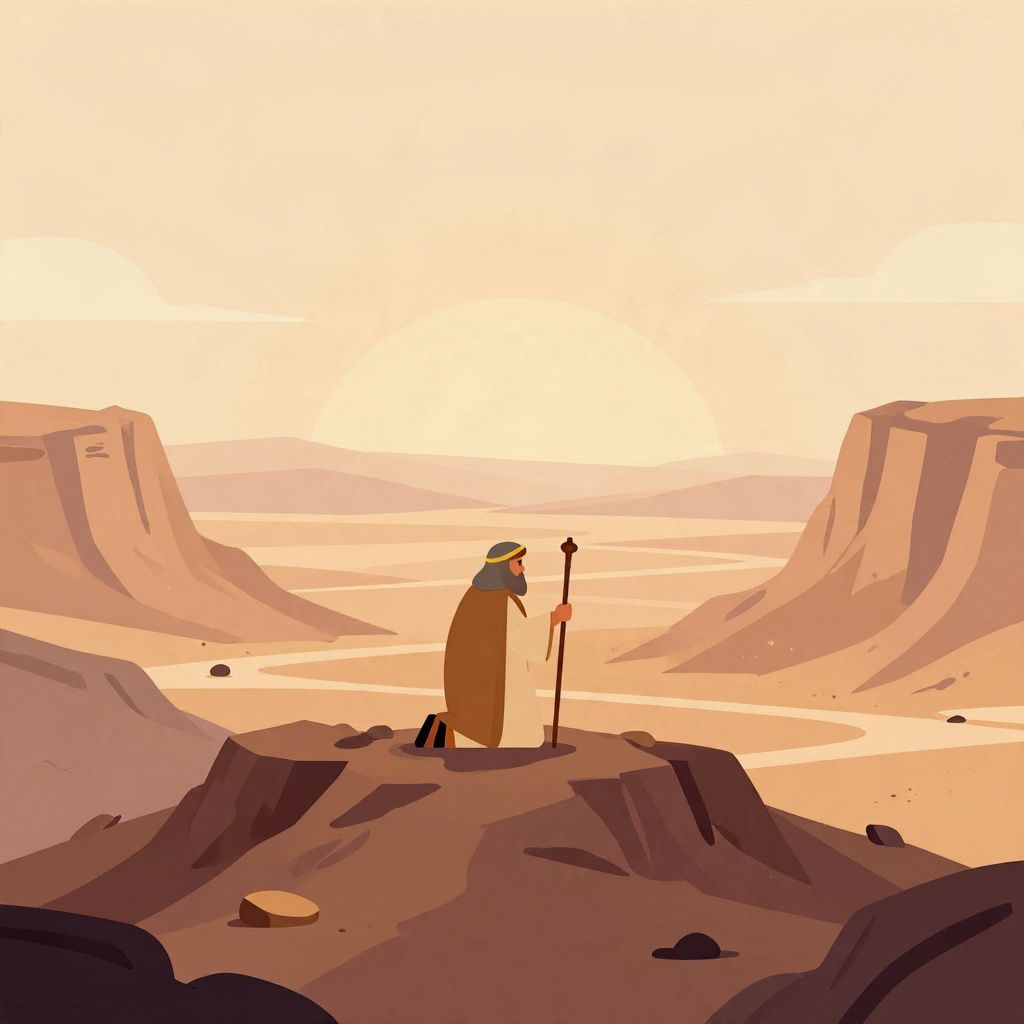
How did Moses die? In the biblical tradition, Moses did not die in battle or by illness; he died in old age on Mount Nebo, overlooking the land of Canaan, after being told he would not enter it. The story is found in Deuteronomy and is central to Jewish, Christian, and Islamic memory of Moses as a lawgiver and leader.
Historically, the exact circumstances cannot be verified outside the religious texts. What can be said with confidence is that the account of Moses’ death became one of the most important endings in the Hebrew Bible, shaping later ideas about leadership, obedience, and unfinished promise.
How did Moses die?
According to Deuteronomy 34, Moses died in the land of Moab, on Mount Nebo, at about 120 years old. The text says God showed him the land of Canaan from afar, then Moses died there and was buried in an unknown place. The Bible presents his death as a peaceful, divinely directed end rather than a violent one.
The biblical account of Moses’ death
Mount Nebo and the view of Canaan
The clearest narrative is in Deuteronomy 34:1–7. Moses climbs Mount Nebo, part of the Abarim range east of the Jordan River, and looks across toward the land promised to the Israelites. He sees the territory but does not enter it. The text then says that Moses died there “according to the word of the Lord.”
This scene matters because it completes a long journey that began with the Exodus from Egypt. Moses leads the Israelites through wilderness, receives the law, and brings them to the edge of the promised land, but he himself does not cross over. The story emphasizes that the mission continues beyond the leader’s lifetime.
Why Moses was not allowed to enter the land
The Bible links Moses’ exclusion to an earlier episode at Meribah, where he struck a rock to bring forth water instead of speaking to it as commanded. In Numbers 20, this act is treated as a failure of obedience. Different biblical passages phrase the reason a little differently, but the overall message is consistent: even Moses is accountable.
That interpretation is important in the religious tradition. Moses is honored as a uniquely great prophet, yet the text does not portray him as above moral or spiritual discipline. His death outside Canaan becomes a lesson about leadership, trust, and the limits placed on human authority.
What the text says happened after he died
Deuteronomy says that Moses was buried in an unknown location in Moab, and “no one knows his burial place to this day.” This detail has encouraged centuries of interpretation. Some readers see it as a safeguard against pilgrimage to a grave; others see it as a literary way of preserving Moses’ special status and preventing his tomb from becoming an ordinary shrine.
The same chapter adds that “his eye was undimmed and his vigor unabated,” a phrase suggesting that Moses died not from visible decline but at the close of a full life. The text also notes that the Israelites mourned him for thirty days, marking him as a national figure of extraordinary importance.
Was Moses’ death historical?
From a historical standpoint, Moses is difficult to verify. There is no external contemporary record that confirms his life or death, and scholars generally treat the biblical account as a religious tradition shaped over time rather than a modern-style biography. That does not make the story meaningless; it means the account belongs to the world of ancient Israelite memory, theology, and identity.
Many historians think the figure of Moses may preserve memories of early Israelite origins, lawgiving, and liberation traditions, but the details of his death are known only through scripture. The Mount Nebo scene likely reflects the theological aims of the text more than a recoverable eyewitness report.
Why historians approach the story cautiously
- The biblical books were written and edited over long periods, not at the moment the events were said to occur.
- Ancient Near Eastern texts often combine history, law, theology, and national memory.
- There is no archaeological evidence that can confirm the exact location or circumstances of Moses’ death.
So, while the biblical tradition gives a clear answer about how Moses died, historians distinguish between the religious narrative and independently verifiable fact.
How different traditions understand Moses’ death
Judaism
In Jewish tradition, Moses’ death is a solemn and formative event. He is remembered as the greatest prophet and the mediator of the Torah, yet he remains human. The unknown burial place has often been understood as a sign that Moses belongs to God in a unique way and should not be reduced to a local cult figure.
Christianity
Christian readers also treat Moses’ death as significant, especially because it symbolizes the law leading to but not completing salvation history. In this reading, Moses represents the covenant and the wilderness generation, while Joshua represents the next stage of entry into the land. The story is often used to contrast promise and fulfillment.
Islam
In Islam, Musa is a major prophet, and later tradition includes many stories about his final moments. The Qur’an does not narrate his death in the same detailed way as Deuteronomy, but Islamic literature preserves reverence for him as a chosen messenger. As with other ancient religious figures, later devotional traditions expanded on the sparse scriptural core.
Why Moses’ death matters in history
Moses’ death is not only the end of a biography; it is a turning point in the story of a people. The narrative marks the transition from wilderness wandering to settlement under Joshua. More broadly, it establishes a pattern in biblical history: leaders may guide a community to the threshold of change without personally entering the new era themselves.
That pattern has had lasting influence. Moses’ death became a powerful symbol in Jewish, Christian, and Islamic thought for unfinished work, faithful endurance, and the idea that a leader’s greatest achievement may be preparing others to continue. It also reinforces the Bible’s recurring theme that no human leader, however exalted, is ultimate.
Key consequences of the story
- The leadership of Israel passes from Moses to Joshua.
- The people are shown mourning and then moving forward.
- Moses’ grave is left unknown, preserving his exceptional status.
- The story becomes a lasting symbol of promise seen but not personally possessed.
What we can say with confidence
In the biblical account, Moses died peacefully on Mount Nebo in Moab, after viewing Canaan but before entering it. He was buried in an unknown place, and the Israelites mourned him for thirty days. Historically, the event cannot be independently confirmed, but the story’s meaning is clear: Moses is portrayed as the great lawgiver whose life ended at the boundary of fulfillment.
If you want to place the story in its wider setting, it also helps to understand the geography of the promised land and the age of Joshua’s leadership after Moses. You may also want to read about how old Joshua was when Moses died and where Canaan was located. In the end, Moses’ death matters because it turns a personal ending into a lasting historical and religious symbol.