
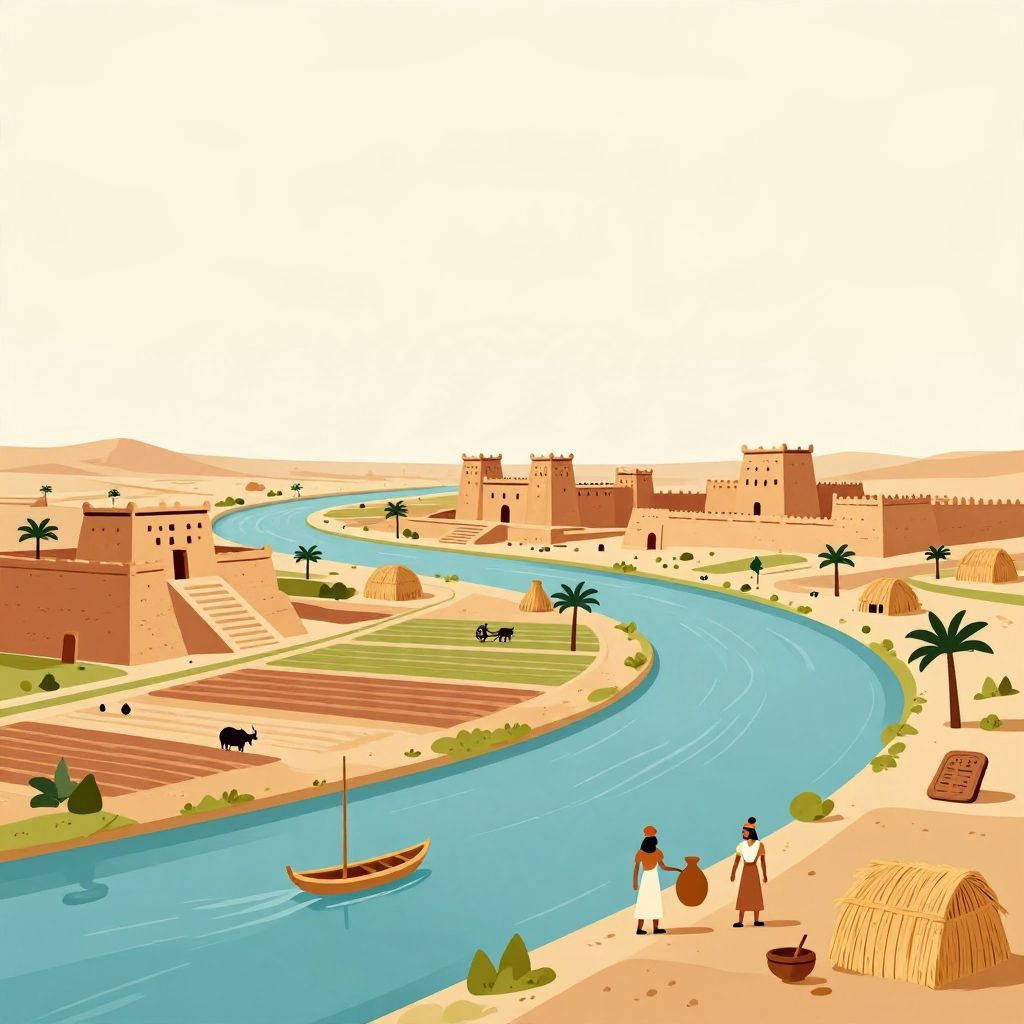
When was Mesopotamia? The short answer is that Mesopotamia was not a single kingdom with one founding date, but a historic region in southwest Asia whose civilization emerged in the late 4th millennium BCE and lasted in many forms until the classical era and beyond.
It is often called the “cradle of civilization” because some of the earliest cities, writing systems, laws, and states developed there. To answer the question properly, we need to separate the region itself from the many civilizations that rose and fell within it.
When was Mesopotamia?
Mesopotamia existed as a geographic and cultural region for thousands of years, but its earliest urban civilization began around 3500 BCE in southern Mesopotamia. Major Mesopotamian powers then followed one another from the Sumerian city-states through the Akkadian, Babylonian, Assyrian, and later Persian periods, with Mesopotamian culture continuing well into the first millennium BCE and beyond.
What Mesopotamia was, and why the date is complicated
Mesopotamia means “the land between rivers,” referring to the Tigris and Euphrates. It was not a country with fixed borders in the modern sense. Instead, it was a broad region that included parts of modern Iraq and neighboring areas. Because of that, asking “when was Mesopotamia” can mean several different things: when the region was inhabited, when its first cities appeared, or when Mesopotamian civilization reached its peak.
The region was inhabited long before cities existed. Farming communities were present by the Neolithic period, thousands of years before writing. But the Mesopotamia most people mean in history books—the world of Sumer, Babylon, and Assyria—began when urban life, administration, and written records emerged in the late 4th millennium BCE.
The earliest Mesopotamian civilization: around 3500 BCE
The best-established starting point for Mesopotamian civilization is roughly 3500 BCE, when large settlements in southern Mesopotamia began to grow into true cities. This period is associated with the rise of Uruk, one of the first major urban centers in world history. By then, people were building temples, organizing labor, managing trade, and developing systems of record-keeping.
Writing appeared soon after, around 3200 BCE, in the form of early cuneiform. At first it was mainly used for accounting and administration, not literature. This matters because writing gives historians a clearer view of Mesopotamia than they have for earlier prehistoric societies. In other words, the “date” of Mesopotamia depends partly on when written evidence begins.
Why Uruk matters
Uruk is often treated as a turning point because it shows the transition from village life to complex urban society. It had large temples, specialized workers, and administrative systems that required record-keeping. These developments did not happen overnight, but they mark the moment when Mesopotamia became one of the world’s first urban civilizations.
A brief timeline of Mesopotamia
Mesopotamian history spans several major phases. A simplified chronology helps show how long the region remained important:
- Before 3500 BCE – Farming villages and early settled communities develop in the region.
- c. 3500–3000 BCE – The Uruk period: cities, administration, and early writing emerge.
- c. 2900–2334 BCE – Sumerian city-states dominate southern Mesopotamia.
- c. 2334–2154 BCE – The Akkadian Empire forms under Sargon and creates one of the first large territorial empires.
- c. 2000–1600 BCE – Old Babylonian period, including the reign of Hammurabi.
- c. 1350–612 BCE – Assyrian power rises, culminating in the Neo-Assyrian Empire.
- c. 626–539 BCE – Neo-Babylonian period.
- 539 BCE onward – Persian rule begins after the conquest of Babylon.
This timeline shows that Mesopotamia was not “one era” but a long sequence of civilizations sharing a common geography and many cultural traditions.
The major civilizations of Mesopotamia
Sumer: the first city-states
Sumer is usually considered the earliest historical civilization in Mesopotamia. Its city-states, including Ur, Uruk, Lagash, and Eridu, were politically independent and often competed with one another. Sumerian society produced temples, mathematics, literature, and administrative systems that influenced later cultures in the region.
There was no single “Sumerian empire” at first. Instead, power shifted among cities and rulers. This decentralized political world is one reason Mesopotamian history is so complex: the region was culturally connected, but politically fragmented for long periods.
Akkad: the first known empire
Around 2334 BCE, Sargon of Akkad unified much of Mesopotamia under a central authority. The Akkadian Empire is often described as one of the world’s first empires because it ruled multiple cities and regions under a single king. It did not last forever, but it set an important precedent for later imperial rule in Mesopotamia.
Babylon: law, kingship, and influence
Babylon became one of the most famous Mesopotamian cities, especially under Hammurabi in the 18th century BCE. His reign is associated with a famous law code, though the idea that it was the “first law code” is too simple; earlier legal traditions existed. Still, Babylon became a symbol of political power, scholarship, and urban culture.
Assyria: military power and administration
Assyria, centered farther north, rose to great power especially in the first millennium BCE. The Neo-Assyrian Empire built a highly organized military and administrative system and controlled a vast territory. Its fall in 612 BCE marked a major turning point, but Assyrian culture and population did not simply disappear.
When did Mesopotamia end?
Mesopotamia did not end all at once. If the question means “when did Mesopotamia stop being an independent political world,” a major turning point came in 539 BCE, when the Persian king Cyrus the Great conquered Babylon. After that, Mesopotamia became part of larger empires rather than a region ruled primarily by its own local dynasties.
If the question means “when did Mesopotamian civilization disappear,” the answer is later and less exact. Mesopotamian traditions continued under Persian, Hellenistic, Parthian, and Roman influence, and local languages and religious practices survived for centuries. Cuneiform writing itself lasted into the early centuries CE before finally fading away.
Why 539 BCE is important
The Persian conquest of Babylon is often used as a dividing line because it ended the last native Babylonian kingdom. But even after that, Mesopotamia remained a vital cultural and economic region. So while political independence changed, the region’s historical importance did not suddenly vanish.
Mesopotamia after the great kingdoms
After the fall of Babylon, Mesopotamia entered a new phase under imperial rule. The region was governed by Persians, then later by Macedonian and Hellenistic rulers after Alexander the Great. In the centuries that followed, Mesopotamia remained a crossroads of trade, religion, and language.
Aramaic became increasingly important as a spoken and written language across the Near East, gradually replacing older local languages in everyday use. Even so, Mesopotamia remained historically significant because its cities, irrigation systems, and scholarly traditions continued to shape the wider ancient world.
Why Mesopotamia matters in world history
Mesopotamia matters because many features of later civilization were developed or refined there. These include city life, state bureaucracy, legal traditions, monumental architecture, long-distance trade, and writing. The region also produced some of the earliest known literature, including myths and epics that reveal how ancient people understood kingship, the gods, and human life.
It is also important not to imagine Mesopotamia as a single, unchanging civilization. It was a dynamic region where peoples, languages, and states changed over time. Sumerians, Akkadians, Babylonians, Assyrians, and others all belonged to the broader Mesopotamian world, but they were not identical cultures.
So, when was Mesopotamia?
In the broadest sense, Mesopotamia was a region occupied for millennia. In the historical sense most people mean, Mesopotamian civilization began around 3500 BCE with the rise of cities such as Uruk. Its political independence ended gradually, with a major turning point in 539 BCE when Babylon fell to the Persians. Mesopotamia was therefore not a single date, but a long and foundational chapter in human history.
If you want to follow that story further, you can also read about when Babylon fell and what happened to Babylon.