
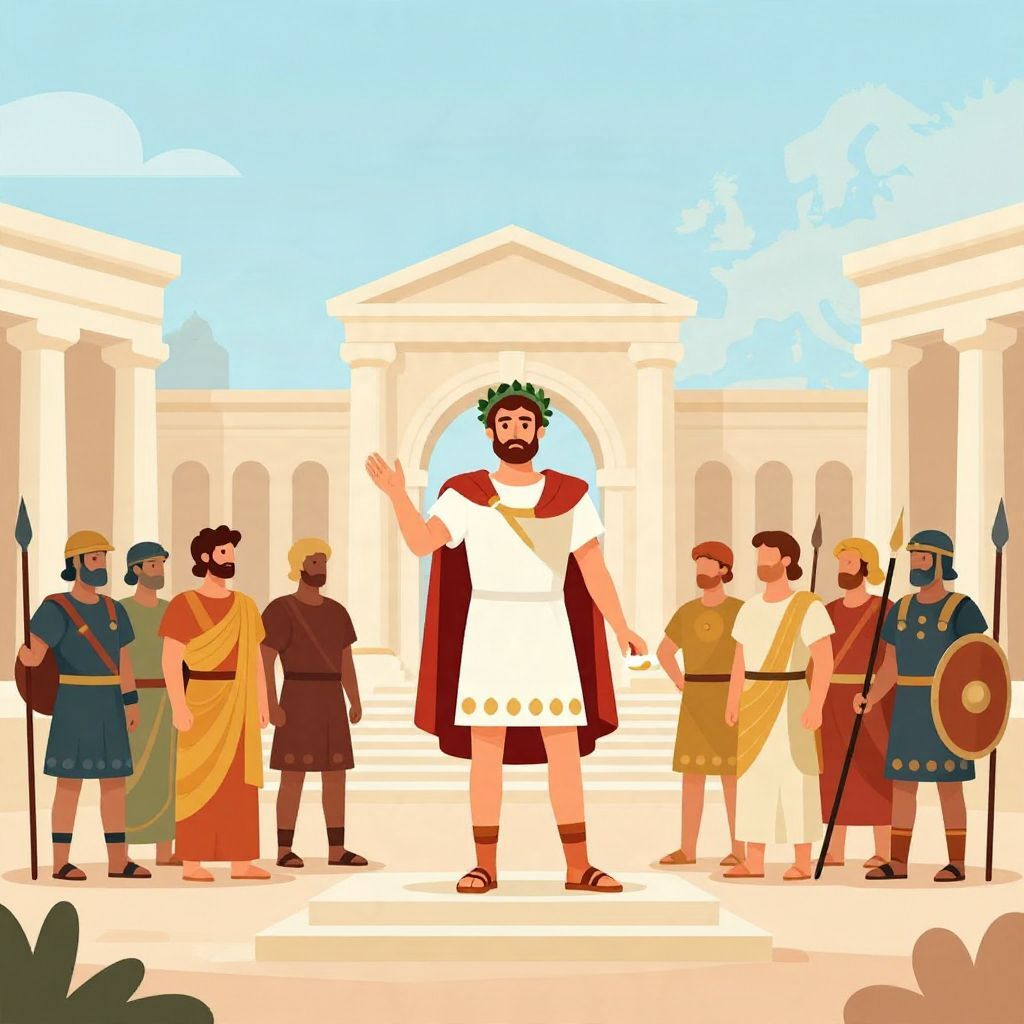
Julius Caesar is one of the most famous figures in ancient history, but the question “What did Julius Caesar do?” has a surprisingly broad answer. He was a Roman politician, general, writer, and reformer whose actions helped end the Roman Republic and set the stage for the Roman Empire.
Over a career that stretched from military conquest to political revolution, Caesar changed Rome through war, alliances, reforms, and personal ambition. His life ended in assassination in 44 BCE, but his influence lasted far beyond his death.
What Did Julius Caesar Do?
Julius Caesar rose from Roman politics to become one of the most powerful men in the Mediterranean world. He conquered Gaul, fought and won a civil war, became dictator of Rome, and introduced reforms that reshaped Roman government. His rise and murder marked the collapse of the old Republic and the beginning of a new political order.
Who Was Julius Caesar?
Gaius Julius Caesar was born in 100 BCE into a patrician family, though not one of the richest in Rome. He came of age during a period of intense political conflict, when Roman elites competed for power through elections, patronage, and military command. Caesar was ambitious, highly skilled, and unusually effective at turning military success into political influence.
He was not an emperor in the later Roman sense. Instead, he became a dictator within the Roman Republic, a system that still formally had elected offices and a Senate. That distinction matters, because Caesar’s career shows how a republic can weaken when one person gains too much power.
How Did Julius Caesar Rise to Power?
Caesar built his career through a combination of public office, alliances, and military achievement. He served in Rome’s political system as quaestor, aedile, and praetor before becoming governor of provinces, where he gained command experience and loyal soldiers. His political rise was helped by the First Triumvirate, an informal alliance with Pompey and Crassus around 60 BCE.
This alliance was not a legal government, but a practical power-sharing arrangement. Pompey had military prestige, Crassus had wealth, and Caesar had political energy and growing popularity. The partnership helped Caesar secure the consulship in 59 BCE and then a major provincial command in Gaul.
Why Gaul mattered
Gaul, roughly modern France and Belgium, was the arena where Caesar became a legendary commander. His campaigns from 58 to 50 BCE expanded Roman control, brought him enormous wealth, and gave him a battle-hardened army that was personally loyal to him. That loyalty would later make him dangerous to his political enemies in Rome.
What Did Caesar Do in Gaul?
Caesar’s conquest of Gaul was his most famous military achievement. In a series of campaigns, he defeated many Gallic groups, subdued resistance, and expanded Roman influence north of the Alps. The war was brutal and destructive, though ancient sources often present it from Caesar’s perspective and therefore emphasize his skill and legitimacy.
One of the most important episodes was the revolt led by Vercingetorix in 52 BCE. Caesar defeated him at the siege of Alesia, a victory that became one of the most celebrated in Roman military history. The conquest made Caesar rich, increased his fame, and gave him the military power to challenge his rivals in Rome.
- 58–50 BCE: Caesar’s Gallic campaigns
- 52 BCE: Victory over Vercingetorix at Alesia
- Result: Roman control expanded into Gaul
How Did Caesar Help End the Roman Republic?
Caesar’s conflict with the Senate and with Pompey became a civil war after political compromise broke down. In 49 BCE, Caesar crossed the Rubicon River with his army, an act that symbolized open rebellion against Rome’s authority. The phrase “crossing the Rubicon” later became a shorthand for making an irreversible decision.
The civil war was not simply about one man’s ambition. It reflected deeper problems in Roman politics: elite rivalry, dependence on armies loyal to generals rather than the state, and growing distrust between popular leaders and the Senate. Caesar defeated Pompey’s forces and emerged as the dominant figure in Roman politics.
The war against Pompey
Pompey, once Caesar’s ally, became his main rival. After Caesar crossed the Rubicon, Pompey and many senators fled Rome. Caesar pursued the war across the Mediterranean world, defeating Pompeian forces in several campaigns. Pompey was eventually killed in Egypt in 48 BCE, though not directly by Caesar himself.
What Did Caesar Do in Egypt and Beyond?
After defeating Pompey, Caesar became involved in the political struggle in Egypt. There he supported Cleopatra VII in her conflict with her brother Ptolemy XIII. Caesar’s relationship with Cleopatra became famous in later tradition, but historians are careful to separate political reality from romantic legend.
Caesar spent time in Egypt, helped secure Cleopatra’s position, and later had a son with her, Caesarion. He also campaigned in Asia Minor, where he quickly defeated King Pharnaces II of Pontus in 47 BCE. His reported message after that victory, “Veni, vidi, vici” (“I came, I saw, I conquered”), is one of the best-known lines associated with him, though it reflects Caesar’s own style of self-presentation and should be understood in that context.
What Reforms Did Julius Caesar Make?
As dictator, Caesar tried to stabilize Rome and strengthen central authority. Some of his reforms were practical, while others increased his personal power. He reorganized parts of Roman administration, settled veterans, expanded citizenship in some areas, and adjusted the calendar. The Julian calendar, introduced in 46 BCE, was one of his most lasting achievements and became the basis for later European timekeeping.
He also addressed debt, public works, and the administration of provinces. Caesar wanted to reduce chaos and reward supporters, but his concentration of power alarmed many senators. To them, his rule looked less like reform and more like monarchy in all but name.
Main reforms associated with Caesar
- Reorganization of the calendar into the Julian system
- Expansion and restructuring of the Senate
- Settlement of veterans in colonies
- Measures to manage debt and urban disorder
- Administrative changes in Roman provinces
Was Julius Caesar a Dictator?
Yes, but the title needs explanation. In the Roman Republic, a dictator was originally an emergency magistrate appointed for a limited time. Caesar was appointed dictator several times and eventually became dictator perpetuo, or dictator for life, in 44 BCE. That title made many Romans fear that the Republic was being replaced by one-man rule.
His enemies saw the title as proof that he intended to become king, a deeply unpopular idea in Roman political culture. Whether Caesar truly planned to crown himself king is debated, but it is clear that his accumulation of honors and offices made him appear dangerously powerful.
How Did Julius Caesar Die?
Caesar was assassinated on the Ides of March, 15 March 44 BCE, by a group of senators led by Brutus and Cassius. The conspirators believed they were defending the Republic from tyranny. They attacked Caesar during a Senate meeting and killed him with multiple stab wounds.
His death did not restore the old political order. Instead, it triggered more civil war. Rome soon moved toward the rule of Caesar’s heir Octavian, later Augustus, who became the first Roman emperor. In that sense, Caesar’s assassination was not the end of the crisis, but a turning point that accelerated it.
Why Is Julius Caesar Still Important?
Caesar matters because he helped transform Rome from a republic dominated by competing elites into a system that could be ruled by a single supreme leader. His military success, political skill, and willingness to use force made him one of the most consequential figures in ancient history. He was also a writer whose commentaries on the Gallic War shaped how later generations understood him.
At the same time, Caesar is remembered through a mix of history and legend. Later writers, artists, and political thinkers turned him into a symbol of ambition, genius, betrayal, and state power. The historical Caesar was more complex: a brilliant commander, a ruthless political operator, and a man whose career exposed the weaknesses of the Republic.
What Did Julius Caesar Do, in Short?
Julius Caesar conquered Gaul, defeated his rivals in a civil war, became dictator of Rome, introduced major reforms, and was assassinated by senators who feared his power. His actions helped destroy the Roman Republic and prepare the way for the Roman Empire. Few ancient figures changed history so dramatically.
If you want to explore the wider Roman world around Caesar, you may also be interested in what the Roman Forum was and how it functioned in Roman politics, or in the later story of how Brutus died after Caesar’s assassination.