
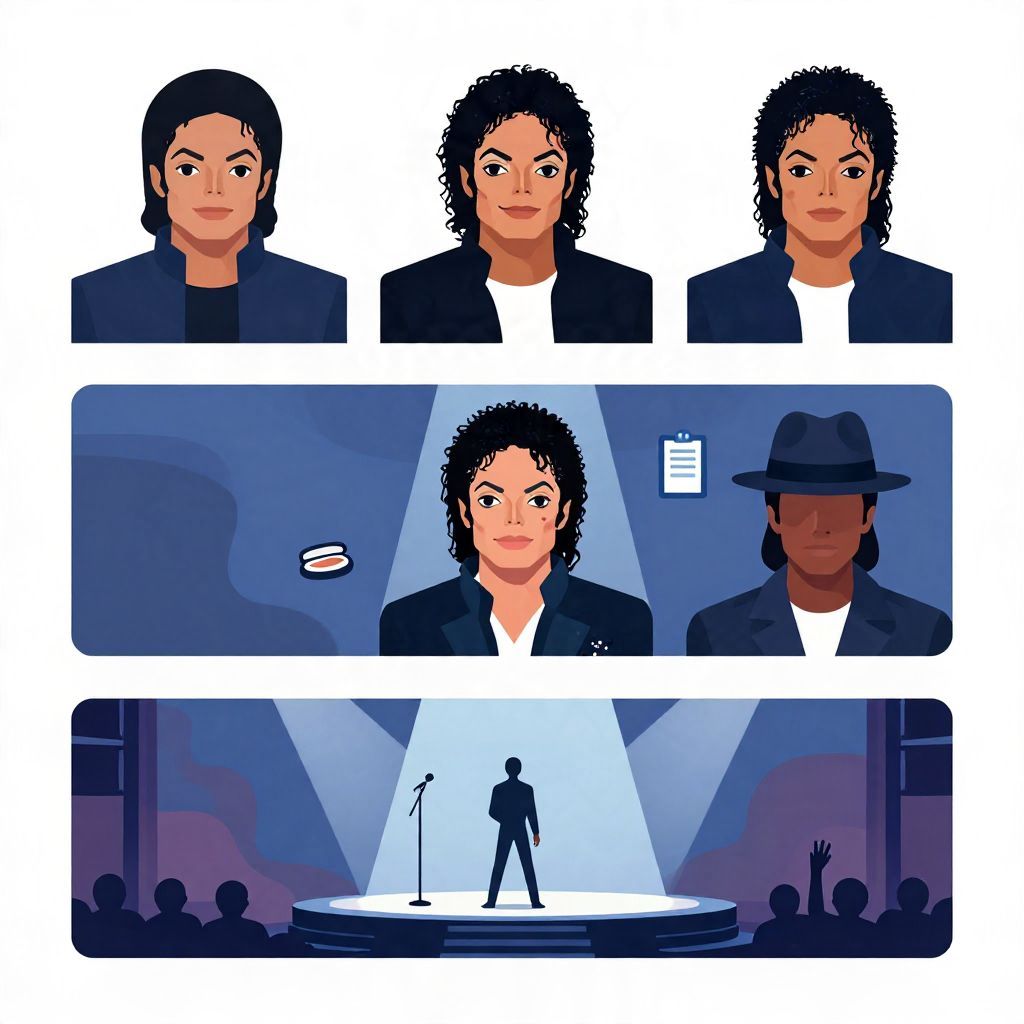
The question “Why is Michael Jackson white?” usually refers to the dramatic change in his appearance over time, especially the lightening of his skin in the 1980s and 1990s. The short historical answer is that Jackson did not become “white” in a racial sense; rather, he developed a severe skin condition called vitiligo and also used makeup and cosmetic procedures that altered how he looked in public.
Because Jackson was one of the most famous people in the world, his changing appearance became a global story. That story mixed medical facts, celebrity culture, racism, tabloid speculation, and the pressures placed on a Black performer in the modern entertainment industry.
Why is Michael Jackson white?
Michael Jackson was not white by ancestry or identity. He was a Black American man who developed vitiligo, a disorder that causes patches of skin to lose pigment. Over time, those patches became more visible, and he reportedly used makeup and treatments to even out his complexion, which made him appear much lighter in photographs and on television.
What actually changed in Michael Jackson’s appearance?
Jackson’s appearance changed for several reasons at once. The most important was vitiligo, a long-term skin condition that creates irregular loss of pigment. In addition, he used cosmetic products, stage makeup, and likely skin-lightening approaches to create a more uniform look. Public misunderstanding turned this medical reality into rumors that he was trying to become white.
Vitiligo and uneven pigmentation
Vitiligo can affect any skin tone, but it is especially noticeable on darker skin because the contrast between affected and unaffected areas is stronger. In Jackson’s case, the condition reportedly spread across his body and face. Rather than leaving patchy discoloration visible, he appears to have used makeup and other cosmetic methods to mask the difference.
Why the change looked so dramatic
Jackson was constantly photographed, filmed, and scrutinized. Lighting, camera technology, and makeup can all intensify or soften skin tone. Over years of public appearances, the combination of vitiligo, cosmetic covering, and changing fashion made him look progressively lighter. To many viewers, that looked like a transformation, even though the underlying cause was medical.
The historical context: race, celebrity, and public judgment
Jackson’s appearance cannot be separated from the racial climate of late 20th-century America. As a Black superstar whose fame crossed racial boundaries, he was under intense pressure to present himself in ways that satisfied record executives, television audiences, advertisers, and fans. His body became a public text on which people projected fears, fantasies, and prejudice.
A Black artist under extraordinary scrutiny
Jackson rose to fame first with the Jackson 5 in the late 1960s and then as a solo artist in the 1970s and 1980s. By the time he became the world’s biggest pop star, every change in his face, skin, hair, or clothing was treated as news. For a Black performer, this scrutiny was especially loaded because American culture has long policed Black appearance and identity.
The burden of beauty standards
In popular entertainment, lighter skin has often been favored by colorist beauty standards rooted in slavery, segregation, and colonial hierarchies. That does not mean Jackson’s condition was caused by such standards, but it does help explain why rumors about “wanting to be white” spread so easily. His changing face was interpreted through a culture already obsessed with race and appearance.
Did Michael Jackson try to become white?
There is no reliable historical evidence that Michael Jackson was trying to become white in a racial or ideological sense. The more established explanation is that he had vitiligo and used cosmetic methods to manage the visible effects. Some observers also pointed to his changing hairstyle, clothing, and facial surgery, but these are separate issues from his skin color.
What is known from public statements
Jackson publicly said he had vitiligo, and his autopsy later confirmed the presence of the condition. That does not answer every question about his personal choices, but it does support the medical explanation for his lighter skin. Claims that he intentionally changed race are popular simplifications rather than solid historical conclusions.
Cosmetic surgery and public image
Jackson also underwent cosmetic surgeries that altered the shape of his nose and other facial features. Those changes, combined with makeup and lighting, encouraged the idea that he was remaking himself into someone else. In reality, his appearance was shaped by a mixture of health issues, artistic self-presentation, and the demands of fame.
How vitiligo works and why it mattered so much
Vitiligo is an autoimmune-related condition in which pigment-producing cells are damaged or destroyed. It is not contagious and does not affect a person’s racial identity. For someone as visible as Jackson, however, it could be emotionally and professionally difficult because the condition was visible in an industry built on image.
Medical treatment and camouflage
Treatments for vitiligo have varied over time and include topical medications, light therapy, and cosmetic camouflage. In Jackson’s era, these options were less effective than modern approaches in many cases. A performer who needed consistent onstage and on-camera appearance would often rely on makeup to create a uniform skin tone.
The role of media misunderstanding
Many people assumed that a lighter face meant a deliberate rejection of Blackness. That assumption ignored the medical reality and reflected a broader tendency to reduce complex personal circumstances to scandal. The media often preferred a sensational explanation over a careful one, and that shaped public memory for decades.
Why the rumor became so persistent
The “Why is Michael Jackson white?” question persisted because it was simple, provocative, and emotionally charged. It fit tabloid storytelling, reinforced stereotypes, and invited endless speculation. Once a dramatic narrative takes hold around a celebrity, especially one as famous as Jackson, it can outlast the facts.
Fame made his body a public battlefield
Jackson’s life was marked by extraordinary public visibility. Every change in his face was discussed as if it were a political statement. That is a recurring pattern in celebrity history: famous people are often denied privacy, and their bodies become sites of public interpretation, moral judgment, and rumor.
Race, identity, and suspicion
Because Jackson was a Black man who achieved global fame in a predominantly white entertainment system, some people read his appearance through suspicion. Was he rejecting his heritage? Was he trying to “pass”? Was he ashamed of being Black? These questions reveal more about the anxieties of observers than about Jackson’s actual medical condition.
What historians can say with confidence
From a historical perspective, the safest conclusion is straightforward: Michael Jackson’s skin became much lighter because he had vitiligo and used cosmetic methods to conceal uneven pigmentation. He was not “white” in the racial sense, though his public image became increasingly difficult for many people to interpret without that label.
- Established fact: Jackson had vitiligo.
- Established fact: He used makeup and cosmetic presentation to manage his appearance.
- Likely but not fully knowable in detail: The exact extent of every treatment or cosmetic choice he made at different times.
- Not supported by evidence: The claim that he literally became white by ancestry or racial identity.
Why this question still matters
The question endures because it sits at the intersection of medicine, celebrity, and race. Jackson’s changing appearance was real, but the meaning people attached to it was often distorted by prejudice and sensationalism. Studying the issue carefully shows how public memory can turn a medical condition into a moral narrative.
In the end, Michael Jackson did not “become white”; he lived with vitiligo, adapted his appearance for a global stage, and became the subject of intense speculation because he was one of the most scrutinized entertainers in modern history. For more context on his life and legacy, see when Michael Jackson passed away. If you are interested in how rumor and public judgment shape historical memory, you may also like why Marie Antoinette was executed.