
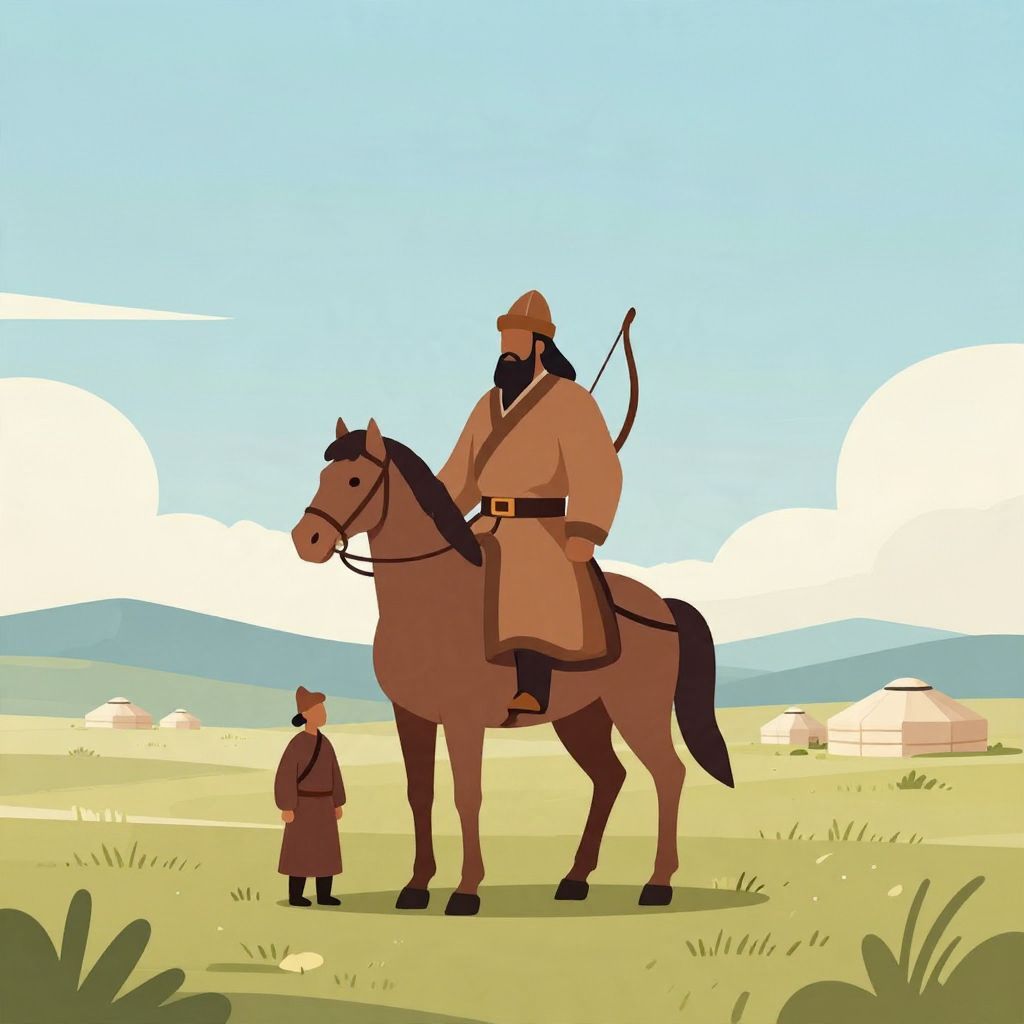
How tall was Genghis Khan? It is a popular question, but history cannot answer it with a precise measurement. No surviving contemporary source gives his exact height, and the Mongol Empire’s founder left no body record that modern historians can verify.
What can be said is that Genghis Khan was likely of average height for a man of the steppe world in the 12th and early 13th centuries. The more important historical fact is not his exact stature, but how he was remembered: as a powerful, disciplined, and charismatic leader whose appearance became part of legend.
How tall was Genghis Khan?
There is no reliable historical evidence for Genghis Khan’s exact height. Most historians would treat any specific number as speculation. He was probably around average height for a Mongol man of his era, but that is an informed estimate, not a documented fact.
Why historians cannot give an exact height
Unlike modern rulers, Genghis Khan was never measured in a way that survives in trustworthy records. He lived in a nomadic society where written documentation about personal physical details was limited, and the sources we do have were often written decades later by outsiders or descendants.
The problem with medieval sources
The main historical texts about Genghis Khan focus on his lineage, campaigns, alliances, victories, and laws. They are far more interested in his political and military role than in his body measurements. Medieval chroniclers sometimes described a ruler’s appearance, but those descriptions were usually broad and symbolic rather than exact.
Later legends are not measurements
Over time, stories about Genghis Khan grew larger than life. Some traditions portrayed him as physically imposing, while others emphasized his intensity, intelligence, or fearsome reputation. These accounts help explain how people imagined him, but they do not prove how tall he actually was.
What historians can reasonably infer
Although no exact height is known, historians can make cautious inferences based on the physical environment, diet, and general population patterns of medieval Inner Asia. These are broad estimates, not certainties.
A likely average for his time and place
Genghis Khan was born around 1162 in the Mongolian steppe region. Men in pastoral societies often had strong, lean builds shaped by horseback riding, travel, and a diet based on meat and dairy. That does not automatically mean great height, but it does suggest a physically hardened lifestyle. He may have stood somewhere around average adult male height for his region and period.
Why “average” matters more than “tall”
In historical contexts, being a great leader did not require being exceptionally tall. Genghis Khan’s authority came from military success, political skill, and the ability to unite rival tribes. His reputation rested on power and organization, not on unusual physical stature.
What the historical sources actually say about his appearance
Sources about Genghis Khan are more likely to mention his character than his measurements. Some describe him as strong, broad-shouldered, or commanding, but these are interpretive descriptions rather than standardized physical data. They tell us how he was perceived, not how many inches or centimeters tall he was.
The Secret History of the Mongols
The most famous early Mongol source, The Secret History of the Mongols, is invaluable for understanding his rise and personality. It gives a vivid picture of his life and leadership, but it does not provide a reliable height measurement. Its value lies in narrative detail, not biometric precision.
Persian and Chinese chroniclers
Later writers from the Persian and Chinese worlds described Genghis Khan and his successors in ways shaped by politics, fear, admiration, and cultural distance. Such accounts can be useful, but they often mix observation with moral judgment. A ruler’s physical description could be exaggerated to emphasize greatness or menace.
Why people still ask how tall Genghis Khan was
The question persists because height is often linked in the modern imagination to leadership, strength, and dominance. People want to know whether a famous conqueror looked physically intimidating. In Genghis Khan’s case, that curiosity is understandable, but it can also distort the historical picture.
Height is not the same as power
Many influential rulers were not especially tall, and many tall people never became leaders. Genghis Khan’s success came from strategy, discipline, intelligence, and adaptation. He built a system that rewarded loyalty, merit, and mobility, which mattered far more than his exact physical stature.
Legend often enlarges famous figures
Historical memory tends to make major figures seem larger than life. That can happen literally, too. A conqueror who reshaped Eurasia can easily become imagined as physically giant, even if there is no evidence for that. The myth says more about his legacy than his body.
Genghis Khan’s real historical significance
Focusing only on height misses the far more important story. Genghis Khan transformed the Mongol tribes into a powerful empire that changed the political map of Eurasia. His campaigns affected trade, warfare, diplomacy, and state formation across a vast region.
From tribal leader to empire builder
After uniting the Mongol tribes, Genghis Khan launched campaigns against neighboring powers and created a military machine known for speed, discipline, and coordination. His empire expanded across northern China, Central Asia, and beyond. This expansion was one of the most consequential in world history.
How his image became part of his legacy
Because he was so influential, later generations tried to explain him through both fact and myth. Physical descriptions became part of that process. A ruler who inspired fear and admiration could easily be imagined as unusually tall, even if the evidence does not support that idea.
Common claims about his height
Online discussions often repeat specific numbers for Genghis Khan’s height, but these are usually unsupported. It is important to separate historical evidence from modern guesswork.
- Exact measurements: not known from reliable sources.
- Average height estimate: plausible, but only approximate.
- “He was very tall”: a popular idea, not a documented fact.
- “He was short”: also unsupported by solid evidence.
The safest historical answer is that his height is unknown. Any stronger claim should be treated cautiously unless it is clearly labeled as speculation.
How historians approach questions like this
Questions about a famous person’s height may seem simple, but they reveal how history works. Historians depend on surviving evidence, and when evidence is missing, they must avoid pretending certainty. That discipline matters, especially for figures surrounded by legend.
Evidence over assumption
It is tempting to fill gaps with confident guesses. But a responsible historical answer distinguishes between what is known, what is likely, and what is merely imagined. For Genghis Khan, the known fact is that no trustworthy measurement survives.
Context over celebrity trivia
His height is a minor detail compared with his impact on the medieval world. Still, asking about it can lead to a better understanding of how historical myths form and why some details remain unknowable. That is one reason the question remains interesting.
The bottom line
Genghis Khan’s exact height is unknown, and no reliable historical source gives a precise measurement. He was probably of average height for a man of his time and region, but that remains an estimate. What history can say with confidence is that his true stature lay in his ability to build an empire that reshaped Eurasia. For more on his image and legacy, see what Genghis Khan looked like and, for a different kind of historical scale, how tall the Tower of Babel was.