
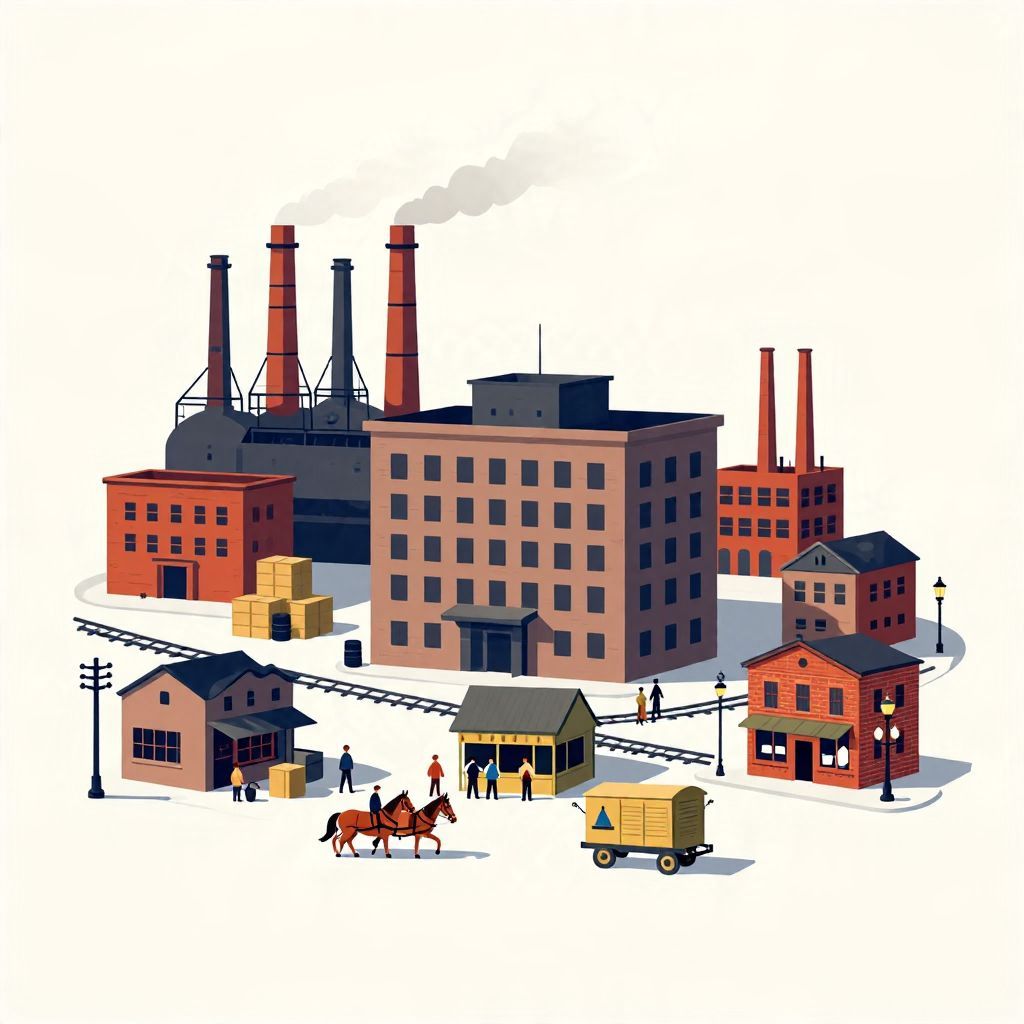
In the Gilded Age, monopolies reshaped American business by concentrating power in the hands of a few giant corporations. For many small businesses, this meant higher costs, fewer customers, and intense pressure to sell out, shut down, or specialize in narrow local markets.
The period roughly from the 1870s to the early 1900s saw rapid industrial growth, railroad expansion, and aggressive corporate consolidation. Small firms often struggled to compete against companies that could undercut prices, control transportation, and influence suppliers and distributors.
In the Gilded Age, how did monopolies affect many small businesses?
Monopolies and near-monopolies often harmed small businesses by controlling prices, transportation, raw materials, and access to markets. Large firms could sell more cheaply, force unfavorable terms on suppliers, and absorb losses that independent shops, mills, and producers could not survive, pushing many out of business or into dependence.
What a monopoly meant in the Gilded Age
In the late 19th century, a monopoly did not always mean one company literally controlled every business in a field. More often, it referred to a dominant corporation or trust that could shape an entire industry. These firms used size, capital, and coordination to limit competition and raise barriers for smaller rivals.
Trusts, holding companies, and vertical integration
Business leaders in the Gilded Age developed new corporate forms to consolidate power. Some created trusts, which allowed separate companies to be managed together. Others used holding companies to control multiple firms. In industries such as oil, steel, meatpacking, and railroads, these arrangements made it easier to dominate markets.
Large corporations also used vertical integration, meaning they controlled multiple stages of production and distribution. A company that owned raw materials, factories, transportation, and sales networks could operate more efficiently than a small independent business that had to buy each service separately.
How monopolies hurt small businesses day to day
Small businesses were affected in practical, immediate ways. They often had to pay more for supplies, pay more to ship goods, and sell into markets where giant firms could slash prices. Even when a small business was well run, it might still be squeezed by forces beyond its control.
1. Price-cutting and unfair competition
Large corporations could temporarily lower prices below the level small firms could match. Because they had deeper reserves, they could absorb short-term losses until competitors failed. Once rivals disappeared, dominant firms often regained control over prices. This tactic made survival difficult for independent shops, mills, and producers.
2. Control of transportation
Railroads were especially important in the Gilded Age economy. If a railroad favored a large shipper with lower freight rates, small businesses paid more to move the same goods. This unequal treatment could decide whether a local manufacturer made a profit or lost money. Transportation discrimination was one of the most damaging tools of monopoly power.
3. Dependence on suppliers and distributors
Small businesses often depended on wholesalers, rail lines, grain elevators, or large manufacturers for access to materials and markets. When a dominant company controlled those channels, independent firms had little bargaining power. They might be forced to accept higher prices for inputs or lower returns for their finished products.
4. Limited access to credit and capital
Big corporations could borrow more easily and attract investors because they seemed safer and more profitable. Small businesses, by contrast, often relied on local banks or personal savings. In a volatile economy, they were more vulnerable to debt, recessions, and sudden changes in demand. A monopoly-dominated market made that vulnerability worse.
5. Pressure to sell or merge
Many independent owners eventually sold their businesses to larger firms, sometimes under pressure and sometimes because no realistic alternative remained. Others merged into larger corporate systems to survive. This did not always mean immediate destruction, but it often meant the loss of independence that had defined small enterprise in earlier decades.
Industries where small businesses felt the pressure most
The impact of monopoly power varied by industry, but some sectors were especially hard hit. Businesses that depended on railroads, bulk raw materials, or large-scale processing faced the strongest pressure from giant firms.
Oil
Standard Oil, associated with John D. Rockefeller, became the most famous example of corporate concentration in the Gilded Age. By controlling refining, transportation arrangements, and pricing strategies, it overwhelmed many smaller refiners. Independent oil firms found it hard to compete against a company that could move faster, buy in larger quantities, and negotiate better rates.
Steel
The steel industry also moved toward concentration under leaders such as Andrew Carnegie and later U.S. Steel. Large-scale production lowered costs, but it also made it difficult for smaller steelmakers to survive. Firms that lacked modern equipment or access to cheap raw materials struggled to keep pace with the efficiency of giant integrated corporations.
Meatpacking and food processing
Big meatpacking firms used rail access, refrigerated cars, and large-scale distribution to dominate national markets. Small butchers and local processors often could not match their prices or distribution networks. Consumers may have benefited from cheaper products, but independent businesses frequently lost ground.
Retail and local manufacturing
Even businesses far from the giant trusts felt the effects. Local retailers could be squeezed by large wholesalers, mail-order firms, and manufacturers that bypassed traditional middlemen. Small factories often faced competition from corporations that could standardize production and flood markets with low-cost goods.
Why monopolies grew so powerful in the Gilded Age
Monopolies did not appear by accident. They grew out of the economic conditions of the late 19th century: rapid industrialization, limited regulation, new technologies, and a legal environment that often favored corporate expansion. The United States was becoming a national market, and large firms were often better positioned to exploit it.
Railroads and national markets
Before the Civil War, many businesses served local or regional markets. By the Gilded Age, railroads linked distant cities and states into one larger economy. That expansion rewarded scale. Companies that could produce in huge quantities and ship widely gained advantages over small firms that served only one town or county.
Technology and economies of scale
New machinery and industrial methods often made large production cheaper per unit. This is called economies of scale. While these efficiencies helped lower consumer prices, they also meant that small businesses could no longer compete on equal terms with giant enterprises that spread costs across vast output.
Weak regulation
Federal and state governments initially had limited tools to restrain corporate consolidation. The Interstate Commerce Act of 1887 and the Sherman Antitrust Act of 1890 were important steps, but enforcement was uneven in the early years. For much of the Gilded Age, large firms operated with considerable freedom.
Did monopolies always destroy small businesses?
Not always. Some small businesses survived by adapting. They served niche markets, offered specialized goods, relied on personal relationships, or operated in places where large firms had not yet fully penetrated. In some communities, small shops remained essential because they were closer to customers and more responsive to local needs.
Adaptation and specialization
Independent businesses sometimes survived by focusing on quality, custom work, or local service rather than mass production. A neighborhood grocer, tailor, or repair shop could still thrive if it offered something large corporations could not easily standardize. But survival often required flexibility and constant adjustment.
Cooperation among small producers
Some small businesses tried to fight back by forming cooperatives, local alliances, or trade associations. These efforts could improve bargaining power, but they rarely matched the financial strength of the largest trusts. Cooperation helped some firms endure, yet it did not erase the structural imbalance of the era.
How ordinary people experienced the change
For many Americans, the rise of monopolies was visible in everyday life. A local merchant might notice that wholesalers had raised prices. A mill owner might lose railroad discounts. A farmer might find that a grain elevator or shipping line controlled access to distant markets. These were not abstract economic trends; they shaped livelihoods and communities.
At the same time, some consumers welcomed lower prices and wider access to goods. This is one reason the monopoly question was so politically contentious. Large firms could make products cheaper and more abundant, but they often did so by weakening competition and concentrating power. The result was a mixed legacy, with lower prices on one side and reduced economic independence on the other.
Political and legal responses to monopoly power
Public anger over trusts and monopolies helped drive the antitrust movement. Reformers argued that concentrated corporate power threatened fair competition, democracy, and the independence of small producers. Journalists, politicians, and farmers’ organizations all played roles in pushing the issue into national debate.
The Sherman Antitrust Act
Passed in 1890, the Sherman Antitrust Act was the first major federal law aimed at limiting monopolies. In practice, early enforcement was inconsistent, and courts sometimes interpreted the law narrowly. Still, it marked an important turning point: the federal government had begun to recognize that unchecked corporate concentration could damage the broader economy.
Progressive Era reforms
By the early 20th century, Progressive reformers built on Gilded Age criticism of monopoly power. They sought stronger regulation, fairer competition, and greater oversight of railroads and large corporations. These reforms did not restore the older world of tiny independent firms, but they did reflect widespread concern about what monopolies had done to small business life.
The lasting significance of monopoly power in the Gilded Age
The Gilded Age transformed the American economy from a landscape of many local competitors into one increasingly dominated by national corporations. For small businesses, the result was often pressure, consolidation, and decline. Some adapted, but many could not match the scale, pricing, and market control of giant firms.
That history matters because it shows how economic growth can create winners and losers at the same time. Monopolies helped build modern industry, but they also narrowed opportunities for independent businesses and fueled demands for regulation. If you want more background on the broader economic changes of the era, see the Market Revolution and the Homestead Act.