
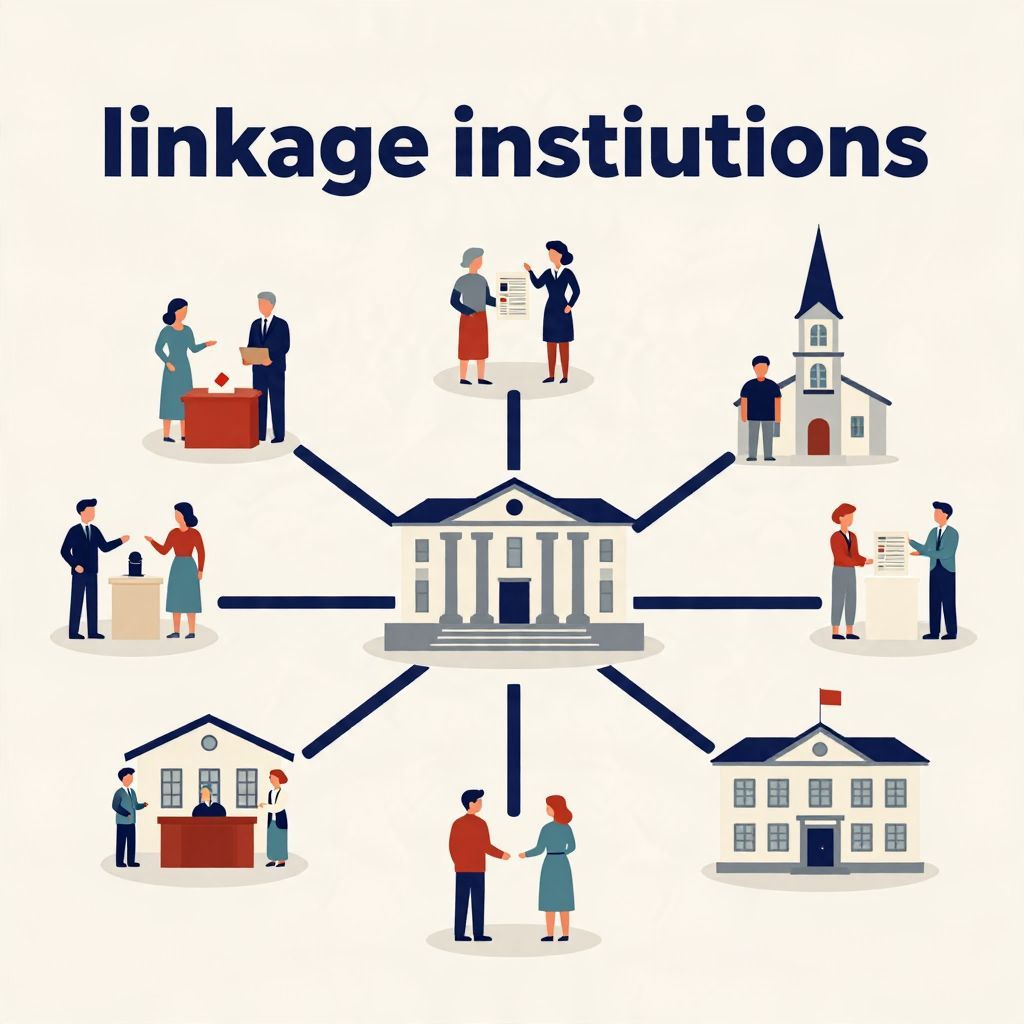
What is a linkage institution? In political history, the term refers to the organizations and channels that connect ordinary people to government. These institutions help translate public opinion into political action by linking citizens, parties, elections, interest groups, the media, and sometimes other civic bodies to the state.
The concept is especially useful for understanding modern representative democracy, where governments do not simply act on their own but respond to pressure, participation, and communication from society. It is a political science term rather than an ancient historical one, but it helps explain how modern political systems developed and functioned.
What Is a Linkage Institution?
A linkage institution is any structure that connects people to their government and helps turn public preferences into political influence. Common examples include political parties, elections, interest groups, and the media. These institutions matter because they make participation possible, shape debate, and help governments learn what citizens want.
Where Did the Idea Come From?
The phrase linkage institution comes from modern political science, not from a specific historical event or ancient thinker. The idea grew out of 20th-century efforts to study how democratic systems actually work in practice. Scholars wanted to understand not just constitutions and laws, but also the everyday mechanisms that connect society to the state.
That concern became especially important in the era of mass democracy, when voting rights expanded, political parties became more organized, newspapers and broadcast media reached larger audiences, and pressure groups learned to influence policy. In that setting, the question was no longer only who rules? but also how do rulers hear from the public?
Historical background
Earlier political systems often relied on narrow elites, monarchs, or small assemblies. As representative government expanded in the 18th, 19th, and 20th centuries, the need for intermediaries grew. Citizens were now expected to participate through elections, petitions, parties, unions, and public debate rather than through direct rule. Linkage institutions emerged as a way to describe those connections.
Why Are Linkage Institutions Important in History?
Linkage institutions are important because they help explain how political power is organized in modern states. They shape which voices are heard, how conflicts are expressed, and how governments respond to social demands. Without them, citizens would have far fewer ways to influence policy or hold leaders accountable.
Historically, these institutions have been central to the rise of democracy, mass politics, and public opinion. They also help explain why some governments are stable and responsive while others become disconnected from the people they govern. In that sense, linkage institutions are not just administrative tools; they are part of the political history of participation itself.
Key functions
- Representation: They help express public interests in government.
- Participation: They give citizens ways to take part in politics.
- Communication: They carry information between leaders and the public.
- Accountability: They allow voters and groups to reward or punish officials.
- Agenda setting: They influence which issues become politically important.
Main Types of Linkage Institutions
Different countries use different institutions to connect citizens and government, but several forms appear repeatedly in modern political history. The most familiar are political parties, elections, interest groups, and the media. Each works differently, but all help channel public opinion into political action.
Political parties
Political parties are among the strongest linkage institutions. They organize voters, recruit candidates, create platforms, and help people understand political choices. In the 19th and 20th centuries, parties became major vehicles for mass politics in Europe, the United States, and many other regions. They linked ordinary citizens to legislatures and executive power.
Parties also simplify politics. Rather than forcing each voter to evaluate every issue separately, parties bundle ideas into programs and identities. That makes government more legible, though it can also create polarization when party loyalty becomes stronger than policy debate.
Elections
Elections are one of the clearest linkage institutions because they directly connect public opinion to government authority. Through voting, citizens choose representatives, approve leaders, or reject them. The spread of regular elections in the 18th, 19th, and 20th centuries was a major step in the history of democratic governance.
Elections do more than select officials. They also signal public mood, encourage campaigning, and force political leaders to respond to voters. In that sense, they are both a mechanism of choice and a mechanism of pressure.
Interest groups
Interest groups represent specific causes, professions, industries, or social movements. They try to influence policy through lobbying, public campaigns, legal action, or organizing supporters. Historically, they became especially important as modern states grew more complex and specialized interests sought a voice in government.
Interest groups can broaden participation by giving smaller or less powerful communities a way to be heard. But they can also reflect unequal influence, since groups with more money, access, or organization often have greater political reach.
The media
The media connect citizens to politics by reporting news, framing issues, and shaping public discussion. Print newspapers played this role in the 18th and 19th centuries, while radio, television, and digital media expanded it in the 20th and 21st centuries. The media do not only report politics; they also help define what people think is important.
Historically, the growth of mass media transformed political life. It made national politics more immediate, allowed leaders to communicate with large audiences, and gave citizens more information than ever before. At the same time, media concentration, propaganda, and misinformation have shown that this linkage can be powerful but imperfect.
How Linkage Institutions Developed Over Time
The history of linkage institutions is closely tied to the rise of modern representative government. As states expanded, populations grew, and voting rights widened, political systems needed more organized ways to connect leaders with the public. The development was uneven, and not all countries adopted the same institutions at the same pace.
- Early representative bodies: Parliaments, estates, and assemblies created limited channels between rulers and elites.
- Expansion of suffrage: More people gained the right to vote, increasing the need for mass political organization.
- Rise of parties: Political parties formed to coordinate voters and candidates.
- Growth of mass media: Newspapers, radio, and television connected politics to a wider public.
- Modern advocacy: Interest groups, unions, and advocacy networks multiplied in industrial and postindustrial societies.
Democratization and mass politics
In many countries, linkage institutions became stronger as democracy expanded. The 19th century saw broader suffrage in parts of Europe and North America, while the 20th century brought further democratization in many regions after war, decolonization, and political reform. As more citizens gained political rights, systems needed better ways to organize participation.
This did not happen smoothly. In some places, elites resisted broad participation; in others, authoritarian governments used parties and media as tools of control rather than genuine linkage. That distinction matters: the same institution can connect citizens to government in one system and manipulate them in another.
Industrial society and organization
Industrialization changed political life by creating large urban populations, labor movements, and new social classes. Workers, business owners, reformers, and activists all needed ways to organize and advocate. Trade unions, mass parties, and newspapers became crucial linkage institutions because they gave structure to these new political demands.
As governments became more complex, citizens could no longer rely only on local personal contact with rulers. They needed institutional channels. Linkage institutions filled that gap.
What Makes a Good Linkage Institution?
A strong linkage institution is one that is accessible, representative, and effective. It should allow people to express views, transmit them to decision-makers, and see some response. In practice, no institution does this perfectly, but democracies usually depend on several working together.
Features of effective linkage
- Accessibility: ordinary people can use it without excessive barriers.
- Representation: it reflects a range of interests, not just a narrow elite.
- Transparency: people can see how influence is being exercised.
- Responsiveness: government reacts to signals from society.
- Legitimacy: citizens accept it as a fair part of politics.
When these features weaken, political systems can become detached from public needs. Low voter turnout, weak parties, captured media, or overly powerful interest groups can all reduce the quality of linkage between people and government.
Examples in Historical Context
Linkage institutions appear differently across time and place. In the United States, elections, parties, and the press became central to democratic life in the 19th century and beyond. In Britain, parliamentary parties and newspapers played a major role in connecting voters to policy. In many other states, unions, religious organizations, or revolutionary movements served similar functions.
In authoritarian regimes, the picture is more complicated. Some governments create official parties, state media, or controlled mass organizations that appear to link citizens to power but actually limit genuine feedback. Historians and political scientists often distinguish between real linkage and managed participation.
Not just a Western story
Although the term is often taught in relation to modern Western democracies, the underlying problem is global: how do rulers and ruled communicate? Different societies have answered that question through councils, assemblies, local notables, unions, parties, religious networks, and modern digital media. The forms vary, but the political need is universal.
Why the Term Still Matters Today
The idea of linkage institutions remains useful because modern politics still depends on channels of communication and participation. Social media, online campaigns, and digital activism have added new forms of linkage, though they also raise new problems such as misinformation, fragmentation, and unequal access.
Looking at history through this concept helps explain why some political systems adapt successfully while others struggle. Institutions that connect people to power tend to make government more responsive, but they can also be weakened by distrust, inequality, censorship, or polarization.
Conclusion
A linkage institution is a political bridge between the public and the government. Historically, the concept helps explain the growth of modern democracy, the rise of mass politics, and the many ways citizens have tried to influence power. Whether through parties, elections, interest groups, or the media, these institutions shape how societies govern themselves. For related background on political and social systems, see what a feudal system was and what American imperialism was.