
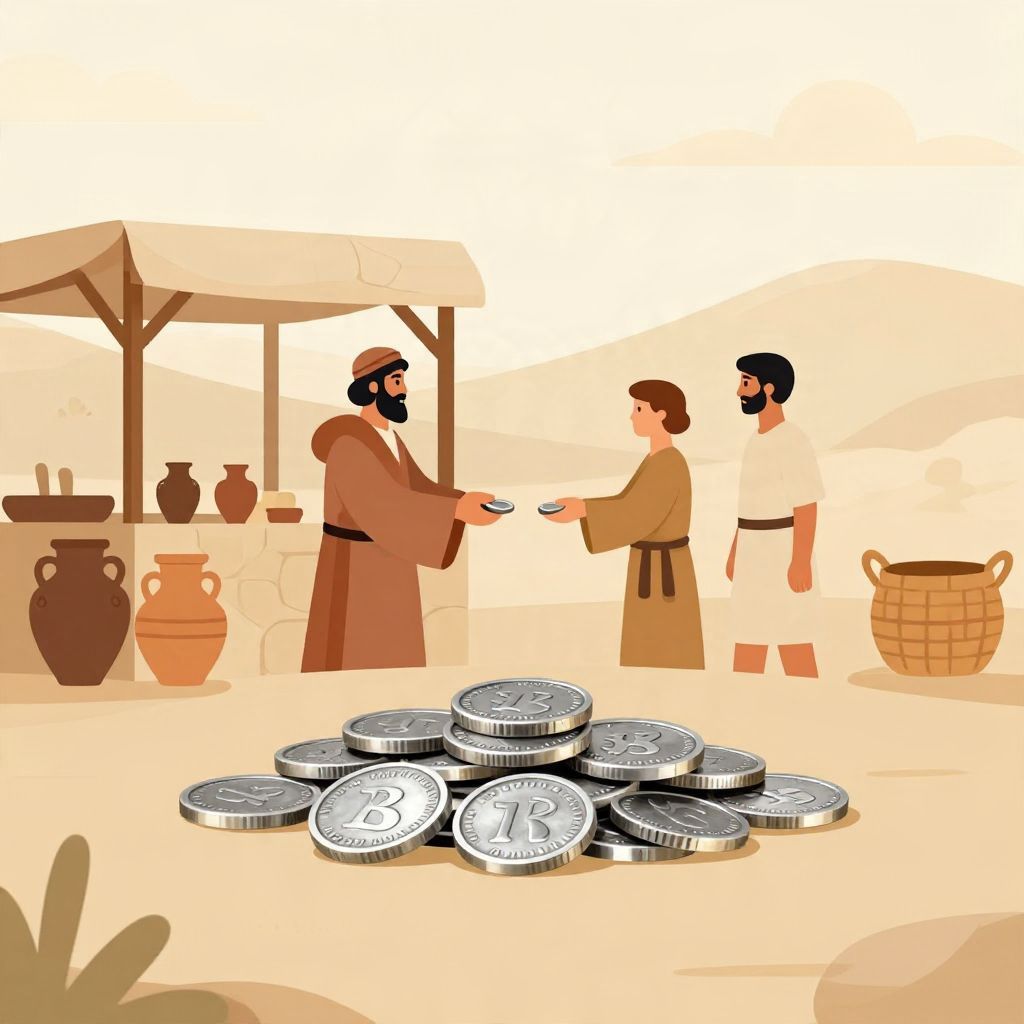
How much is 30 pieces of silver worth today? The short answer is that there is no single exact modern price, because the phrase comes from an ancient payment described in the New Testament and the original “piece of silver” is usually understood as a silver coin from the ancient Near East. Depending on which coin and which silver standard you use, the value can range from a few hundred dollars to well over a thousand.
That uncertainty matters. “30 pieces of silver” is best known as the payment associated with Judas Iscariot’s betrayal of Jesus, but historians have to work from ancient coinage, weight, and purchasing power rather than a neat modern exchange rate. The result is an estimate, not a fixed number.
How much is 30 pieces of silver worth today?
Most estimates place 30 pieces of silver at roughly the value of 30 ancient silver coins, often identified as Tyrian shekels or a similar silver currency. By silver content alone, that is commonly translated into something like $300 to $1,500+ today, depending on the coin type, weight, and whether you measure metal value or historical buying power.
Why there is no exact answer
The phrase “30 pieces of silver” is a translation, not a precise denomination that maps cleanly onto modern money. Ancient sources do not give a universally agreed modern equivalent, and scholars debate which coin was intended. Some readers imagine a single type of coin, but in the ancient world silver payments could be counted by weight, by coin, or by local standard.
There are three main ways historians and economists try to estimate the value:
- Metal value: the silver content of the coins.
- Ancient purchasing power: what that amount could buy in the first century.
- Symbolic value: the rhetorical meaning of the sum in the biblical story.
What were the “30 pieces of silver” in historical terms?
In the Gospel of Matthew, Judas is paid 30 pieces of silver for handing Jesus over to the authorities. The text does not name the coin directly, but many historians think the payment likely involved Tyrian shekels or another silver standard used in the eastern Mediterranean during the late Second Temple period, roughly the first century BCE to first century CE.
Tyrian shekels and other possibilities
Tyrian shekels were widely used because of their high silver purity and acceptance in temple-related payments. A shekel was not a tiny coin in the modern sense; it was a meaningful silver unit. If the “30 pieces” were shekels, then the total represented a substantial but not enormous sum—enough to matter, but not a fortune.
Some scholars caution that the Gospel writer may have chosen the number for theological and literary reasons as well as historical ones. In Jewish scripture, 30 shekels appears in connection with the compensation for a slave gored by an ox in Exodus 21:32, and the number may evoke that legal tradition. That means the phrase may carry symbolic weight beyond its cash value.
How much silver was 30 pieces of silver?
If the coins were Tyrian shekels, the total silver content would be roughly around 200 to 250 grams of silver, depending on the exact coin standard used. That is about 7 to 8 troy ounces of silver, though estimates vary because ancient coin weights were not perfectly uniform.
From ancient weight to modern money
Using modern silver prices, that amount of silver metal alone is not especially large. If silver trades at, for example, around $25 to $35 per troy ounce, then 7 to 8 troy ounces would be worth roughly $175 to $280 in raw metal value. But that is only the bullion value, not the historical value of the coins themselves.
Ancient coins were not valued only by their metal. Their accepted use, local trust, and role in taxation or temple life mattered too. A coin’s real economic power in the first century could exceed its modern melt value by a wide margin.
What could 30 pieces of silver buy in the ancient world?
To understand the historical value, it helps to compare the sum with ancient wages. In the Roman world, a laborer or soldier might earn roughly a denarius a day in some contexts, though pay varied by place and time. If 30 silver coins were equivalent to about 30 denarii, the amount could represent about a month’s wages for a working man, before expenses.
Buying power versus metal value
That makes the payment more meaningful than a simple silver-weight calculation suggests. A month’s income was not trivial. It could pay for food, clothing, or rent-like obligations, and in a subsistence economy even modest sums had real force. Still, it was not the kind of money that would make someone wealthy for life.
This helps explain why the phrase became so powerful in later tradition. The sum was large enough to be morally significant, yet small enough to feel sordid and transactional. That tension is part of why “30 pieces of silver” became a lasting symbol of betrayal for a price.
Why the phrase became so famous
The historical payment matters, but the phrase’s lasting power comes from its literary and religious meaning. In Christian tradition, Judas’ payment became shorthand for treachery, greed, and the corruption of loyalty. Over time, “30 pieces of silver” entered broader language as a metaphor for selling out one’s principles.
Scriptural and symbolic background
The number 30 also resonates with older biblical themes. In the Hebrew Bible, 30 shekels appears as compensation in legal contexts, and later readers connected that legal value to the betrayal narrative. Whether the Gospel writer intended a direct allusion or a layered symbolic echo, the number clearly carried meaning beyond ordinary bookkeeping.
That is why asking “How much is 30 pieces of silver worth today?” has two answers at once: a material answer and a cultural one. The material answer is a modest sum of silver. The cultural answer is priceless in the sense that the phrase has become one of the most enduring symbols of betrayal in Western tradition.
Historical estimates in plain language
Because modern readers often want a simple number, here is the clearest way to think about it:
- If you mean silver content only, 30 pieces of silver may be worth a few hundred dollars today.
- If you mean ancient purchasing power, it could represent around a month’s wages for a laborer, which may translate to roughly $1,000 or more in modern income terms depending on how wages are compared.
- If you mean symbolic value, the phrase has no direct price tag; its importance is historical and cultural rather than monetary.
These estimates are not contradictory. They simply measure different things. A coin’s metal, its buying power, and its meaning in a text are related but not identical.
What historians can say with confidence
There are a few points historians can state carefully. First, the “30 pieces of silver” in the Gospel of Matthew refers to a real monetary payment in an ancient silver-based economy. Second, the exact coin type is debated, though Tyrian shekels are a strong possibility. Third, any modern dollar figure is approximate and depends on the method used.
What historians should avoid is pretending that one exact conversion exists. Ancient economies did not work like modern currency markets. Silver value changed by region, purity, and time, and the Gospel account itself is shaped by theological writing as much as by economic detail.
The bottom line
So, how much is 30 pieces of silver worth today? In raw silver terms, probably only a few hundred dollars. In ancient purchasing power, perhaps roughly a month’s wages for a laborer, which can be translated into a larger modern equivalent. But historically, its most important value is not financial at all: it is the enduring symbol of betrayal that has shaped language and memory for centuries.
If you want to explore the broader historical setting behind this phrase, you may also find background useful in articles on cultural divergence and feudal systems, which help show how societies assign meaning and value across time.