
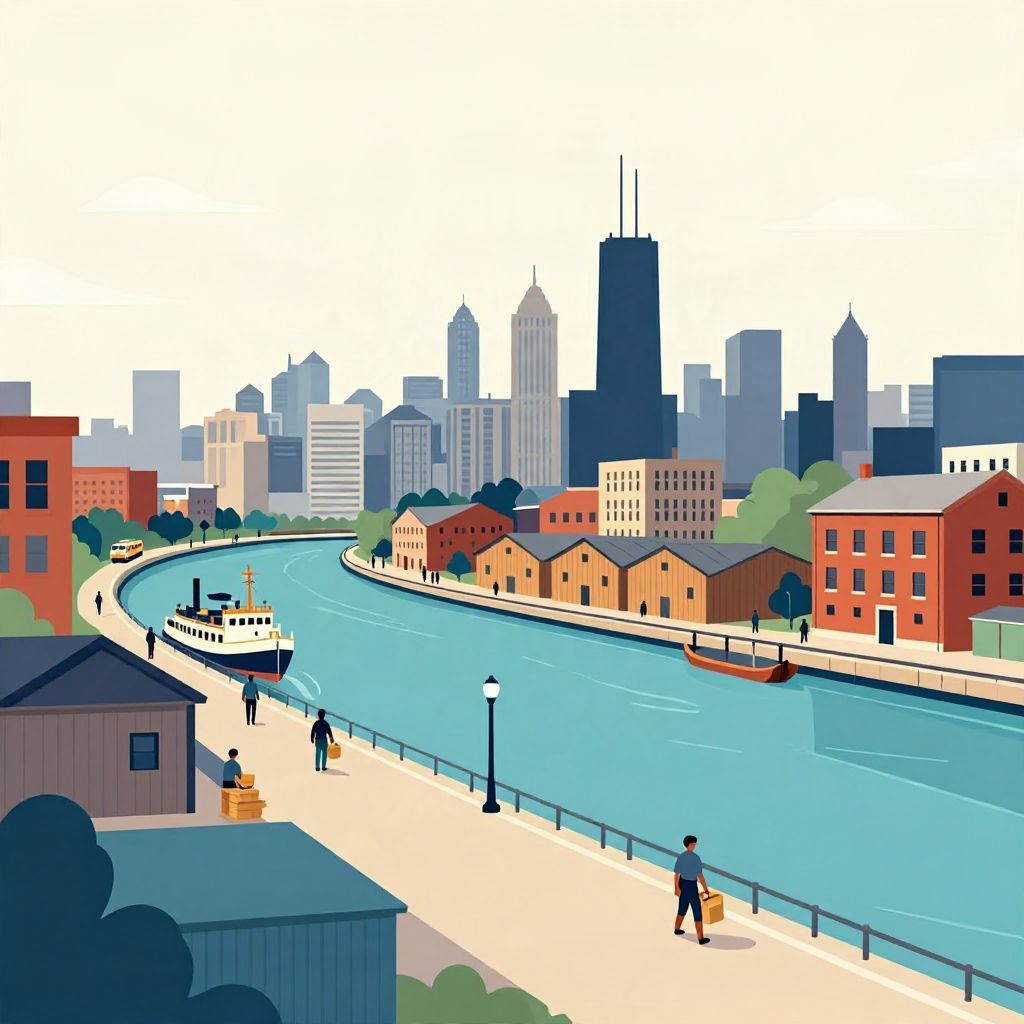
What is Chicago about? At its core, Chicago is about reinvention: a city that rose from a small Great Lakes settlement into one of the most important urban, industrial, and cultural centers in the United States. Its history is shaped by geography, migration, transportation, labor, fire, architecture, and politics.
Chicago’s story is also about the meeting of many peoples and economies in one place. From Native American trade routes to railroads, stockyards, skyscrapers, jazz, blues, and neighborhood life, the city became a symbol of modern urban America while continuing to wrestle with inequality, segregation, and change.
What Is Chicago About?
Chicago is about the rise of a modern American metropolis at the crossroads of land and water. Founded in the early 19th century and transformed by railroads, industry, and immigration, it became a city known for commerce, architecture, labor conflict, cultural innovation, and political power.
Where Chicago Began
Long before it became a city, the Chicago area was part of a Native American world connected by rivers, lakes, and portage routes. The name “Chicago” comes from an Indigenous word often associated with wild onions or leeks growing in the marshy landscape, though exact linguistic details vary by interpretation.
Native routes and early settlement
The site mattered because it sat near a short overland link between the Great Lakes and the Mississippi River basin. That portage made the area strategically valuable for trade, travel, and military movement. French explorers and traders reached the region in the 17th century, but permanent Euro-American settlement came much later.
Chicago’s earliest non-Indigenous development grew around trade, forts, and transportation. Fort Dearborn, established in 1803, marked an early federal presence, though the area remained contested and vulnerable. The fort’s destruction during the War of 1812 and its later rebuilding reflected the unstable frontier conditions of the time.
How Chicago Grew So Fast
Chicago’s explosive growth came from geography and infrastructure. Its location near the Great Lakes and the Mississippi watershed made it a natural transfer point for goods and people. In the 19th century, canals, railroads, and later grain elevators and stockyards turned Chicago into a national transportation hub.
Transportation made the city
The opening of the Illinois and Michigan Canal in 1848 linked the Great Lakes to the Mississippi system and helped Chicago become a commercial gateway. Railroads soon expanded that role dramatically. By the mid-19th century, Chicago was no longer just a frontier town; it was becoming a central node in the American economy.
That growth was astonishing. The city’s population surged from a few thousand in the 1830s to hundreds of thousands by the end of the century. This rapid expansion was driven by migration from the eastern United States, Europe, and later the American South, each wave reshaping the city’s neighborhoods, politics, and labor force.
Immigration and neighborhood life
Chicago became a city of immigrants. Irish, German, Scandinavian, Polish, Italian, Jewish, Czech, Lithuanian, and many other communities built churches, businesses, newspapers, and mutual aid networks. These groups did not simply blend into a single culture; they created distinct neighborhoods and institutions while also influencing the city as a whole.
In the 20th century, the Great Migration brought hundreds of thousands of African Americans from the South to Chicago. They came seeking industrial work and escape from Jim Crow segregation, but they also encountered housing discrimination, job barriers, and racial violence. Chicago’s history is therefore inseparable from both opportunity and exclusion.
The Great Fire and the City’s Reinvention
One of the most famous events in Chicago history is the Great Chicago Fire of 1871. It destroyed much of the city, leaving thousands homeless and leveling business districts and neighborhoods. The fire became a turning point, not because it ended Chicago’s story, but because it accelerated rebuilding on an even larger scale.
Disaster and rebuilding
Popular legend long blamed a cow belonging to Mrs. O’Leary for starting the fire, but that story is not securely supported and has become part of Chicago folklore rather than established fact. What is certain is that the fire exposed the city’s vulnerability and then opened the way for rapid reconstruction.
After 1871, Chicago rebuilt quickly with new building methods, stronger commercial ambition, and a growing reputation for innovation. The city’s recovery helped shape its identity as a place that could absorb catastrophe and emerge larger, denser, and more ambitious than before.
Chicago and the Birth of the Modern City
Chicago is often described as a laboratory of modern urban life. In the late 19th and early 20th centuries, it became famous for skyscraper construction, industrial production, mass transit, and new forms of urban planning. Its skyline and infrastructure signaled the arrival of a new kind of American city.
Architecture and the skyline
Chicago played a major role in the history of skyscrapers. Engineers and architects there experimented with steel-frame construction, elevators, and fireproofing after the Great Fire. The city became associated with the Chicago School of architecture, which emphasized functional design and structural innovation.
These developments were not just aesthetic. Tall buildings reflected land values, business concentration, and the need to house commerce in a dense downtown. Chicago’s skyline became a visible expression of capitalism, technology, and urban ambition.
Industry, meatpacking, and labor
Chicago was also an industrial powerhouse. The stockyards and meatpacking plants on the South Side made the city famous as “hog butcher for the world,” a phrase associated with poet Carl Sandburg’s later description of Chicago’s industrial might. Grain, steel, machinery, and rail commerce all contributed to its economic importance.
But industrial growth came with harsh working conditions. Chicago was a center of labor organizing, strikes, and conflict. The Haymarket affair of 1886 became one of the most important episodes in American labor history, linked to demands for the eight-hour day and to the broader struggle over workers’ rights, policing, and political radicalism.
Politics, Reform, and Corruption
Chicago’s political history is as important as its economic one. The city became known for machine politics, ethnic ward systems, patronage, and corruption, but also for reform movements, civic activism, and battles over public power. Its politics reflected the pressures of a fast-growing, diverse metropolis.
Machine politics and urban power
Political organizations in Chicago often relied on neighborhood loyalty, jobs, favors, and ethnic alliances. This system could be corrupt, but it also helped many newcomers navigate city life and access services. Chicago politics therefore cannot be understood only as scandal; it was also a way the city managed rapid change.
At the same time, reformers pushed for cleaner government, better housing, improved sanitation, and public accountability. The tension between patronage and reform became one of the city’s defining political patterns and remains part of its historical reputation.
Culture: Blues, Jazz, Literature, and Sport
Chicago is about more than industry and politics. It became a major cultural center whose music, writing, theater, and sports helped define American urban culture in the 20th century. The city’s cultural life drew strength from migration, neighborhood identity, and the creative energy of working people.
Music and expression
Chicago was a crucial center for blues and jazz, especially as Black migrants from the South brought their musical traditions north. The city’s clubs, recording studios, and performance spaces helped shape Chicago blues and influenced the broader sound of American popular music.
Writers and artists also found material in Chicago’s complexity. From urban realism to social critique, the city inspired literature that focused on labor, race, ambition, and survival. Chicago’s cultural identity was never simple or uniform; it was built from many voices and experiences.
Sports and civic identity
Sports became another way Chicago expressed itself. Baseball, football, basketball, and hockey all became part of the city’s public identity, linking neighborhoods to larger civic loyalties. Teams and stadiums offered a shared language for a city often divided by class, ethnicity, and race.
Race, Segregation, and Social Change
Any honest answer to what Chicago is about must include racial inequality and the struggle for civil rights. The city offered opportunity to many migrants, but it also developed patterns of segregation in housing, schools, employment, and public life. These patterns shaped the city’s geography and politics for generations.
Migration and conflict
The Great Migration transformed Chicago’s Black population and cultural life, but it also intensified competition over jobs and housing. Restrictive covenants, discriminatory lending, and neighborhood exclusion helped create segregated areas on the South and West Sides. These patterns were not accidental; they were produced by policy, custom, and power.
Chicago also became a site of activism. Black churches, civic organizations, labor groups, and civil rights leaders challenged discrimination and demanded access to housing, education, and political representation. The city’s history of protest is therefore as important as its history of industry.
Chicago in the 20th Century and Beyond
In the 20th century, Chicago remained a major national city, but it faced deindustrialization, population shifts, suburbanization, and fiscal strain. Factories closed or moved, jobs changed, and many neighborhoods experienced disinvestment. Yet Chicago also continued to reinvent itself through finance, education, culture, tourism, and global business.
From industrial giant to global city
As heavy industry declined, Chicago’s economy diversified. Universities, hospitals, corporate headquarters, transportation networks, and cultural institutions became increasingly important. The city’s downtown remained a symbol of economic power, while its neighborhoods continued to reflect deep social and racial divides.
Modern Chicago is thus both a continuation and a transformation of its past. The same forces that made it powerful—location, migration, infrastructure, and ambition—also created tensions that still shape the city today.
Key Facts About Chicago’s History
- Founded: Incorporated as a city in 1837.
- Strategic location: Near the Great Lakes and a key portage to the Mississippi basin.
- Major turning point: The Great Chicago Fire of 1871.
- Economic identity: Rail hub, industrial center, meatpacking and grain trade powerhouse.
- Cultural importance: A major center of blues, jazz, architecture, literature, and labor history.
- Social history: Marked by immigration, the Great Migration, segregation, and reform movements.
Why Chicago Matters in History
Chicago matters because it condenses many themes of American history into one place: expansion, capitalism, immigration, urban growth, disaster, rebuilding, inequality, and creativity. It was not just a city that grew quickly; it became a model of how modern urban America could develop and struggle at the same time.
So, what is Chicago about? It is about a city built at a geographic crossroads, remade by migration and industry, and defined by both achievement and conflict. For readers interested in how cultures form and change in urban settings, related history topics like what is cultural divergence and what is a cultural script can help explain the wider forces that shaped Chicago’s many communities.