
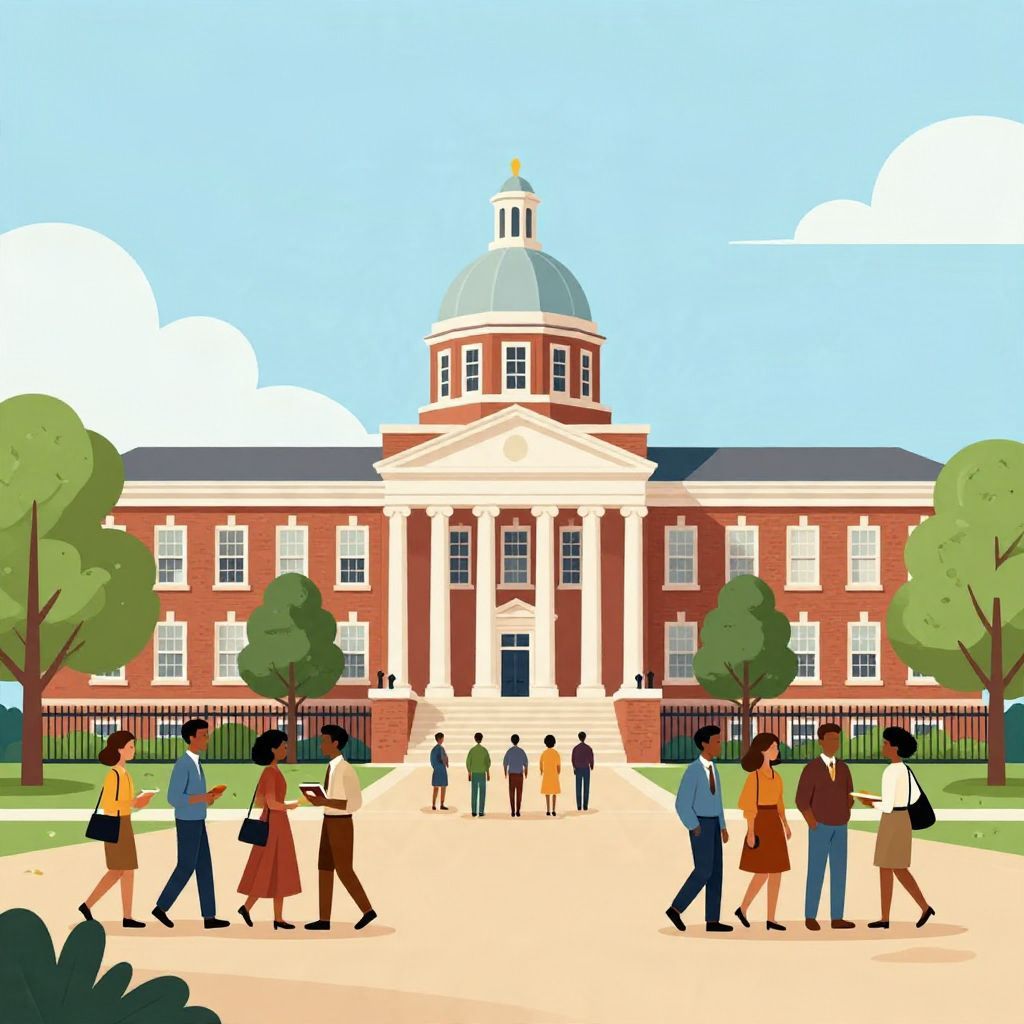
What is HBCU mean? In U.S. history, the acronym stands for Historically Black Colleges and Universities. These are institutions founded before 1964 with the primary mission of educating Black students during eras of legal segregation and exclusion, though today they enroll students of many backgrounds.
HBCUs grew out of slavery, Reconstruction, Jim Crow segregation, and the long struggle for equal access to higher education. Their story is not only about schools, but also about Black self-determination, leadership, and the making of a broader American educational tradition.
What does HBCU mean?
HBCU means Historically Black College or University. The term refers to U.S. colleges and universities established before 1964 whose original purpose was to educate Black Americans, especially when most white institutions barred them from admission. HBCUs remain important because they preserve a distinct educational legacy while serving diverse student bodies today.
Why were HBCUs created?
HBCUs were created because Black Americans were largely denied access to higher education in the 19th and early 20th centuries. Before the Civil War, slavery made advanced schooling for enslaved people illegal or severely restricted in many places. After emancipation, segregation and racial violence continued to block equal access, so Black communities, churches, philanthropists, and reformers built their own institutions.
The post-slavery educational crisis
After 1865, millions of formerly enslaved people sought literacy, vocational training, teacher education, and professional advancement. Public systems in the South were weak or segregated, and many white colleges refused Black applicants. HBCUs emerged to meet urgent needs: training teachers, ministers, doctors, lawyers, and civic leaders for communities that had been systematically deprived of opportunity.
Religion, philanthropy, and Black initiative
Many early HBCUs were founded by religious organizations, especially Protestant missionary groups and Black churches. Some received support from Northern philanthropists and the federal government, particularly through the Freedmen’s Bureau and later land-grant programs. But it is important not to lose sight of Black agency: Black communities themselves pushed for schools, raised money, taught classes, and defended these institutions as essential to freedom.
How did HBCUs begin historically?
The earliest HBCUs appeared in the mid-19th century, with many founded during Reconstruction and the decades that followed. A few examples help show the pattern: Cheyney University in Pennsylvania traces its origins to 1837, and Lincoln University in Pennsylvania was founded in 1854. Many others were established after the Civil War, when the demand for Black education expanded rapidly.
Reconstruction and the first wave of institutions
Reconstruction (1865–1877) was a formative period for HBCUs. The federal government briefly supported Black civil rights, and missionaries, educators, and Black leaders seized the opportunity to create schools. Institutions such as Howard University (founded 1867) and Fisk University (founded 1866) became major centers of Black intellectual life. Their early missions often included preparing teachers, since Black schools needed Black educators.
Land-grant colleges and public support
The Morrill Acts of 1862 and 1890 shaped HBCU development. The first Morrill Act created land-grant colleges, but in the segregated South many Black students were excluded from the original institutions. The second Morrill Act of 1890 required states practicing segregation either to integrate land-grant schools or establish separate Black land-grant colleges. This policy helped expand public HBCUs, especially in the South.
What makes an HBCU historically significant?
HBCUs are significant because they provided education when the larger society denied it, and they became engines of Black advancement. They produced generations of teachers, ministers, scientists, artists, activists, and public officials. Their historical importance lies not only in access, but also in the institutions’ role as centers of leadership, cultural affirmation, and social mobility.
Centers of leadership and activism
HBCUs helped form the leadership class of Black America. Many civil rights figures studied or taught at HBCUs, and campuses often served as organizing spaces for activism. Students and faculty debated politics, challenged segregation, and contributed to the broader freedom struggle. These schools were not isolated from history; they were active participants in it.
Cultural and intellectual influence
HBCUs also nurtured Black cultural expression. They supported literary traditions, musical performance, debate societies, fraternities and sororities, and scholarly communities that valued Black history and identity at a time when mainstream institutions often ignored or demeaned them. In this sense, HBCUs were not only schools but also cultural institutions that helped define Black modernity in the United States.
How did segregation shape HBCU history?
Segregation made HBCUs necessary, but it also limited their resources. For much of the 20th century, state funding for public HBCUs was often far below that of white institutions. Private HBCUs depended heavily on church support, donations, and tuition. Despite these obstacles, they educated large numbers of students and became vital institutions in communities that had few alternatives.
Unequal funding and long struggles
During Jim Crow, many HBCUs operated with overcrowded buildings, limited libraries, underpaid faculty, and inadequate laboratories. These inequalities were not accidental; they reflected broader systems of racial discrimination. Even after legal segregation began to fall, many HBCUs continued to fight for fair funding, facilities, and recognition. Their history therefore includes both achievement and persistent structural inequality.
Desegregation and changing missions
After Brown v. Board of Education in 1954 and the Civil Rights Act of 1964, legally segregated admissions began to disappear. HBCUs did not become obsolete, however. Instead, they adapted to a new era by expanding academic programs, recruiting broader student populations, and continuing to serve students who valued their supportive environments, cultural heritage, and lower costs. The “historically” in HBCU matters because the institutions arose from a specific unequal past, even as they continue to evolve.
What kinds of schools are HBCUs?
HBCUs include public and private colleges, universities, liberal arts colleges, research institutions, and professional schools. Some are small and church-affiliated; others are large public universities with extensive graduate programs. They are not all the same, and the term describes a shared historical origin rather than a single type of institution.
Examples of well-known HBCUs
- Howard University — a major private research university in Washington, D.C.
- Spelman College — a private women’s college in Atlanta, Georgia
- Morehouse College — a private men’s college in Atlanta, Georgia
- Florida A&M University — a public land-grant university
- North Carolina A&T State University — a public HBCU known for engineering and STEM programs
- Tuskegee University — a historically important institution in Alabama with deep ties to vocational and professional education
How many HBCUs are there?
The number of HBCUs is generally given as more than 100 in the United States. The exact count can vary slightly depending on classification changes, mergers, or whether an institution is federally designated as an HBCU. The key point is that they form a national network of schools concentrated especially in the South but present in several regions.
Where are they located?
Most HBCUs are in the southern United States, where segregation was most entrenched and where Black population growth after the Civil War created strong demand for education. But HBCUs also exist outside the South, including in the Mid-Atlantic and Midwest. Their geography reflects both the history of slavery and segregation and the later movement of Black communities across the country.
Why do HBCUs still matter today?
HBCUs still matter because they continue to educate students, preserve historical memory, and provide environments shaped by a long tradition of Black excellence and service. Many students choose HBCUs for academic support, community, affordability, cultural familiarity, and the chance to study in institutions with deep historical roots. Their legacy is both educational and symbolic.
Modern role and broader student body
Although founded for Black education, HBCUs now enroll students of many races and ethnicities. This does not erase their history; rather, it shows how institutions born in exclusion can become broader centers of learning. At the same time, HBCUs remain especially important in discussions about access, representation, and the continuing effects of racial inequality in higher education.
Enduring challenges and achievements
HBCUs have faced financial pressures, deferred maintenance, and competition for students and funding. Yet they continue to produce influential graduates and contribute disproportionately to the education of Black professionals in several fields. Their survival over generations is itself historically significant, showing how communities built institutions that outlasted the systems meant to marginalize them.
Common misconceptions about HBCUs
One common misconception is that HBCUs are only for Black students. In fact, they have always had some non-Black students, and today they are open to all qualified applicants. Another misconception is that HBCUs are relics of the past. In reality, they remain active institutions with contemporary academic, athletic, and cultural importance.
“Historically Black” does not mean exclusively Black
The phrase “Historically Black” refers to origin and mission, not a racial quota. HBCUs were created because Black students were excluded elsewhere, and they became institutions where Black intellectual life could flourish. Their identity is historic and cultural, even as their campuses have become more diverse over time.
What is the historical takeaway?
HBCU means Historically Black College or University, but the term carries much more than a definition. It points to a long history of exclusion, resilience, institution-building, and educational achievement. HBCUs were created because Black Americans were denied equal access to higher education, and they remain lasting monuments to the struggle for freedom, learning, and self-determination. For related cultural history, you may also want to read about cultural divergence and capoeira.