
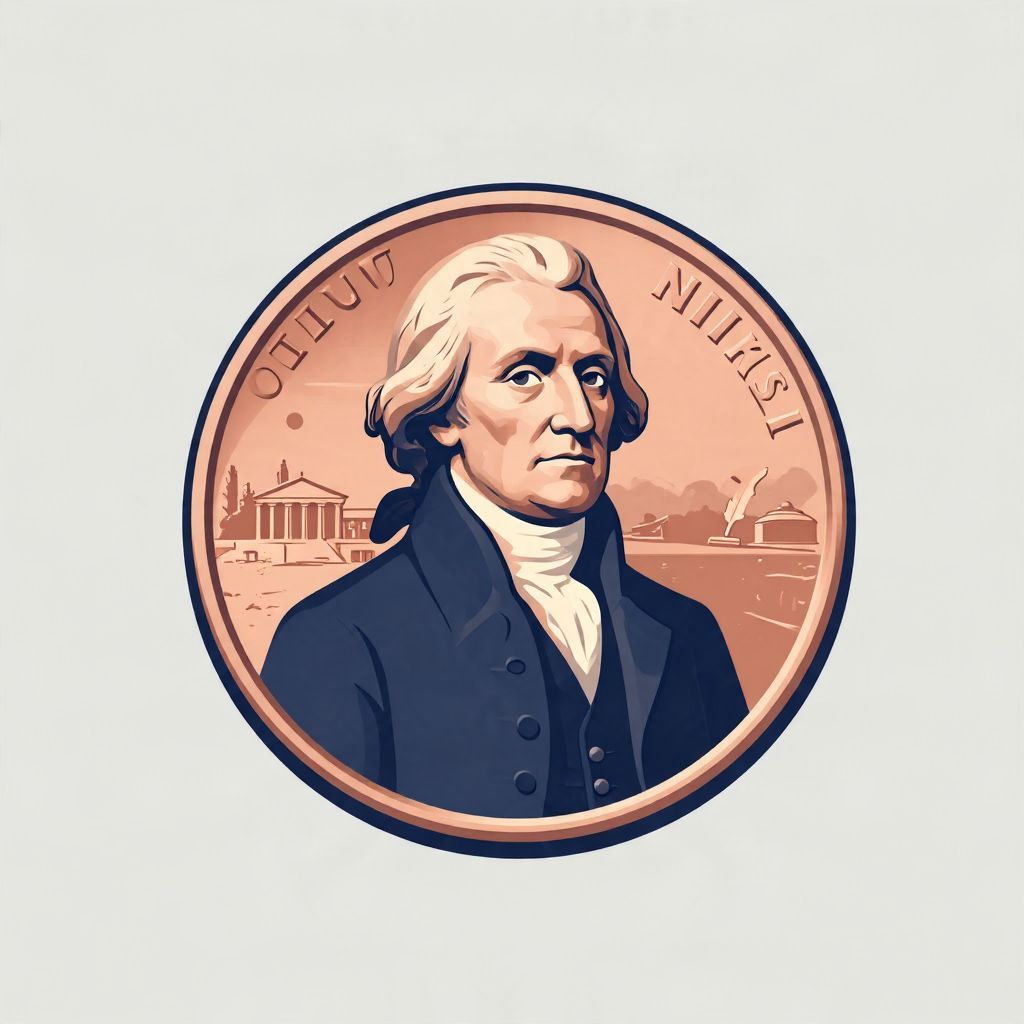
What president is on the nickel? The answer is Thomas Jefferson, the third president of the United States. His portrait has appeared on the five-cent coin since 1938, making the nickel one of the most familiar pieces of American currency.
That simple coin opens a wider story about Jefferson’s political legacy, the history of U.S. coin design, and the changing ways Americans have chosen to honor national leaders.
What president is on the nickel?
Thomas Jefferson is the president on the nickel. His profile appears on the obverse, or front, of the U.S. five-cent coin. Jefferson’s image replaced earlier designs in 1938, and it remains the standard portrait on the modern nickel. The coin also features Monticello, Jefferson’s Virginia home, on the reverse in most current designs.
Who was Thomas Jefferson?
Thomas Jefferson (1743–1826) was one of the most influential figures in early American history. He served as the principal author of the Declaration of Independence, the third president of the United States from 1801 to 1809, and a leading voice for republican government, westward expansion, and limited federal power. At the same time, his legacy is deeply complicated by his lifelong ownership of enslaved people and the contradiction between his ideals and his personal life.
Jefferson’s early life and education
Jefferson was born in colonial Virginia into a wealthy planter family. He studied at the College of William & Mary, trained in law, and quickly entered public life during the revolutionary era. His education, social position, and intellectual curiosity helped shape his reputation as a thinker as well as a politician.
Declaration of Independence and revolutionary politics
In 1776, Jefferson drafted the Declaration of Independence, a document that gave powerful language to the American break with Britain. Its famous phrases about equality and rights became central to later political debates in the United States, even when the country failed to live up to them in practice.
Why is Thomas Jefferson on the nickel?
Jefferson appears on the nickel because the U.S. Mint chose him for the coin’s redesign in 1938. The decision was part of a broader effort to replace older, inconsistent coin designs with standardized images of major American figures. Jefferson was selected in recognition of his importance to the founding of the nation and because his home, Monticello, offered a distinctive reverse design.
The 1938 redesign
Before 1938, the nickel featured the Buffalo nickel design, which had been introduced in 1913. That coin was admired for its artistic quality, but its design was difficult to keep consistent in circulation. The Mint moved to a new portrait of Jefferson and a view of Monticello, creating a more durable and recognizable coin.
How coin design reflects national memory
Putting Jefferson on the nickel was not a random artistic choice. Coins are small public monuments, and their designs often reflect what a nation wants to remember. By the 1930s, Jefferson had become a symbol of the founding era, democratic ideals, and agrarian republicanism, even though historians also recognize the contradictions in his life and politics.
Jefferson’s historical influence
Jefferson’s importance goes far beyond the nickel. His influence shaped American politics, diplomacy, education, architecture, and ideas about liberty. He helped define the early republic, and later generations continued to debate what his legacy meant.
As president
During his presidency, Jefferson oversaw the Louisiana Purchase in 1803, which doubled the size of the United States and transformed the country’s future. He also supported the Lewis and Clark expedition, which helped the young nation learn more about the lands west of the Mississippi River. His administration emphasized simplicity in government, though the realities of governing a growing republic often required flexibility.
As a thinker and writer
Jefferson is often remembered as a champion of individual rights, religious freedom, and public education. He believed that an informed citizenry was essential to republican government. His writings influenced American political culture long after his death, especially ideas about liberty, limited government, and the importance of civic virtue.
The contradiction of slavery
Any honest biography of Jefferson must address slavery. Jefferson enslaved hundreds of people over the course of his life, and his public language about equality stood in stark contrast to that reality. Historians continue to study this contradiction because it reveals one of the central tensions in American history: the gap between the nation’s ideals and its institutions.
The nickel itself: a brief history
The nickel is the five-cent coin of the United States, and its name comes from the metal nickel, which is part of the modern alloy. The coin has gone through several redesigns since the 19th century, but Jefferson has remained its most enduring face. That continuity makes the nickel one of the most stable and recognizable coins in American circulation.
From Liberty to Jefferson
Earlier five-cent pieces featured different symbols and figures, including Liberty-themed designs. The move to Jefferson in 1938 reflected a broader shift in American coinage toward portraits of notable historical figures rather than allegorical images. This change made the coin more personal and historically specific.
Monticello on the reverse
One reason the nickel stands out is that it does not simply show Jefferson’s face. Its reverse has often displayed Monticello, his estate near Charlottesville, Virginia. Monticello symbolizes Jefferson’s architectural interests, his identity as a Virginia planter, and the elite world from which he came. It also serves as a reminder that the nation’s founders lived within a slaveholding society.
How Jefferson’s image changed over time
Jefferson’s presence on the nickel has not been entirely static. Different issues and commemorative versions have altered the coin’s look, but his connection to the five-cent piece has remained central. In 2004 and 2005, for example, the U.S. Mint released special Westward Journey nickels to mark the bicentennial of the Lewis and Clark expedition and the Louisiana Purchase. These designs temporarily replaced the usual Monticello reverse.
Modern commemorative variations
Those special nickels featured different images while keeping Jefferson on the obverse. They showed how coinage can be used to tell a broader national story, linking Jefferson not only to the founding era but also to expansion across the continent. After the commemorative series ended, the coin returned to a Monticello-based design.
Why people still ask this question
“What president is on the nickel?” is a common question because U.S. coins are everyday objects that many people use without thinking about their history. The nickel is especially memorable because its design is tied to a major founding figure. Learning the answer often leads to larger questions about why certain leaders are honored and what their symbols mean.
Coins as public history
Currency is one of the most widely circulated forms of public art and historical memory. Every day, millions of people encounter Jefferson’s image, even if only briefly. In that sense, the nickel functions as a miniature history lesson, preserving a version of the nation’s past in metal.
Thomas Jefferson’s lasting place in American memory
Jefferson remains one of the most studied and debated figures in United States history. He is remembered for independence, expansion, and political philosophy, but also for inconsistency and contradiction. That complexity helps explain why his image endures on the nickel: he represents both the promise and the unfinished work of the American experiment.
So, the answer to “What president is on the nickel?” is Thomas Jefferson, but the coin’s real significance lies in the history behind that portrait. If you want to explore more coin history, you may also enjoy which president is on the nickel and what year nickels are silver.