
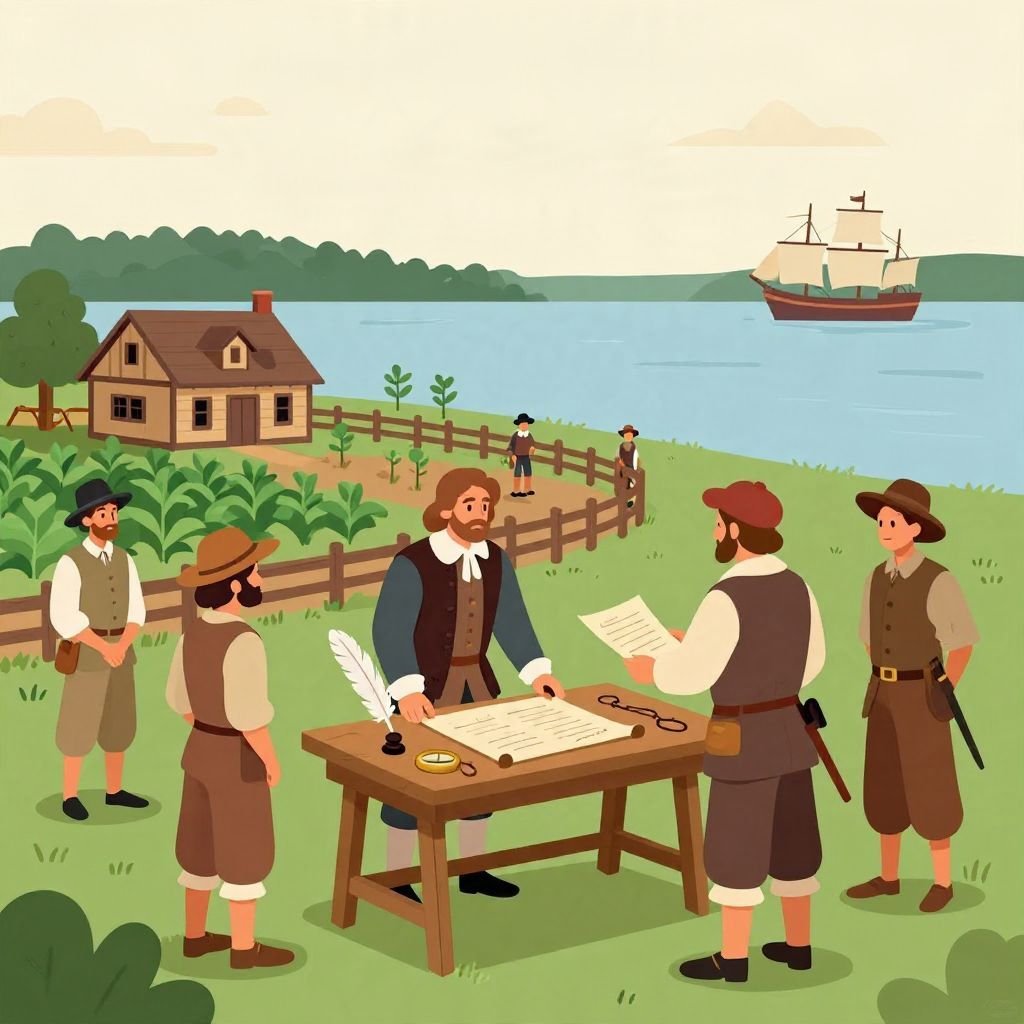
The headright system was a colonial land policy used most famously in Virginia and other English colonies in North America. It granted land to settlers, or to people who paid for the transport of others, in order to encourage migration and labor supply.
In practice, the system helped wealthy planters amass large estates while also drawing thousands of newcomers to the colonies. It became one of the most important ways that land, labor, and power were organized in early British America.
What Was the Headright System?
The headright system was a land-grant policy that awarded acreage to colonists for each “head” of labor they brought to America, usually 50 acres per person. First developed in the early 1600s in Virginia, it was designed to attract settlers and workers, but it also accelerated plantation growth and social inequality.
How the Headright System Worked
The basic idea was simple: a colony would grant land to a person who financed the passage of settlers, servants, or family members across the Atlantic. Each transported person counted as a “headright,” and the sponsor received a set amount of land for each one. The system was especially useful in colonies where land was abundant but labor was scarce.
The usual process
- A colonist paid for someone’s passage to America.
- After arrival, the sponsor claimed land based on the number of people transported.
- The land was then surveyed and recorded by colonial authorities.
- Large landowners could repeat the process many times and expand their holdings.
In theory, the policy rewarded investment and settlement. In reality, it often favored those with money, connections, and political influence. Poor migrants who arrived under indenture usually did not receive land themselves; instead, their labor helped sponsors accumulate property.
Why Was the Headright System Created?
The headright system emerged from the needs of early English colonization. Colonies such as Virginia were expected to become profitable, but they struggled with high mortality, unstable settlement, and a shortage of workers. Colonial leaders and investors wanted a way to increase population quickly and make plantation agriculture viable.
Colonial labor shortages
Early settlements in the Chesapeake region faced severe labor problems. Tobacco cultivation demanded many workers, yet voluntary migration was limited. By offering land in exchange for transported labor, colonial officials hoped to solve two problems at once: populate the colony and create a workforce for export crops.
Encouraging imperial expansion
The English crown and colonial companies also saw land policies as tools of empire. A larger settler population strengthened English claims against rival European powers and Indigenous nations. In this sense, the headright system was not just an economic policy; it was part of a broader strategy of colonial expansion.
Where and When Did It Begin?
The headright system is most closely associated with Virginia in the early 17th century, especially after the colony’s government began using land incentives to promote settlement. It later appeared in modified form in other southern colonies, including Maryland, Georgia, and parts of the Carolinas. Exact rules varied by colony and changed over time.
Because colonial governments adjusted land policies frequently, historians describe the headright system as a family of related practices rather than one single unchanging law. Its most influential decades were the 1600s and early 1700s, when plantation agriculture expanded rapidly in the Chesapeake and the Lower South.
Who Benefited Most from the System?
The biggest winners were usually wealthy planters, merchants, and colonial elites. They had the capital to pay passage costs, the political influence to secure claims, and the resources to develop large estates. Over time, the system helped create a landed aristocracy in parts of the South.
Elite land accumulation
Because one sponsor could claim land for many transported people, the system encouraged large-scale speculation. A planter who paid for dozens of workers could receive hundreds or even thousands of acres. This made it easier for a small number of families to control extensive estates and dominate local politics.
Indentured servants and laborers
For indentured servants, the headright system was usually indirect. Many were brought to America because someone else wanted the land credit, not because the migrants themselves owned property. Some eventually gained freedom and, in some cases, land of their own after completing their contracts. But for most, the system tied migration to exploitative labor arrangements.
How Did the Headright System Affect Slavery?
The headright system played an important role in the transition from indentured servitude to racial slavery in English America. As the demand for labor grew, planters increasingly turned to enslaved Africans rather than relying only on temporary European servants. The land policy itself did not create slavery, but it helped build the plantation economy in which slavery expanded.
Large tobacco and rice plantations required a steady labor force. Over time, enslaved labor became more profitable and more controllable for plantation owners than indentured labor. The headright system therefore contributed to the growth of a society built on land concentration, coerced labor, and racial hierarchy.
What Were the Consequences of the Headright System?
The consequences were far-reaching. It encouraged immigration, expanded colonial settlement, and increased agricultural production. At the same time, it deepened inequality, displaced Indigenous communities, and reinforced elite control over land and labor.
1. Rapid settlement and expansion
The policy helped populate frontier regions and push colonial settlement inland. This expansion often came at the expense of Native peoples, whose lands were claimed, surveyed, and occupied without consent. Land hunger in the colonies frequently led to conflict, pressure, and violence.
2. Growth of plantation agriculture
By rewarding land acquisition, the system favored large estates over small farms in many areas. Tobacco in Virginia and Maryland, and later rice and other cash crops farther south, flourished under this model. The plantation economy became one of the defining features of colonial southern society.
3. Social inequality
The system widened the gap between rich and poor. Those with capital could buy labor and claim land repeatedly, while ordinary settlers often remained landless or dependent. This helped create a colonial elite with disproportionate wealth and political influence.
Was the Headright System Fair?
By modern standards, the headright system was deeply unequal. It offered opportunity to some settlers, but it was structured to benefit those already able to pay for transportation and development. It also rested on colonial dispossession of Indigenous lands and on forms of coerced labor that limited real freedom for many migrants.
Some historians view the system as a pragmatic solution to colonial labor shortages; others emphasize its role in building an exploitative plantation order. Both views can be true. The policy did help colonies grow, but it did so by concentrating power and encouraging systems of exploitation.
How Long Did the Headright System Last?
The headright system did not disappear everywhere at the same time. It persisted in different forms across several colonies and later states, but it gradually lost importance as land became more settled and colonial governments adopted other land policies. By the late 18th century, it was no longer the dominant way land was distributed in most places.
Its decline reflected changing economic conditions, population growth, and new political ideas about land ownership. As settlement expanded, governments increasingly used surveys, sales, and grants tied to military service or other criteria rather than simply to imported labor.
Why Does the Headright System Matter in American History?
The headright system matters because it shaped the early development of English America. It influenced who got land, how labor was organized, and how plantation society took root. It also reveals how colonial governments used land policy to encourage settlement while producing long-term inequality.
Understanding the headright system helps explain several major themes in early American history: westward expansion, the rise of slavery, the concentration of wealth, and the displacement of Native peoples. It is a reminder that land policy was never neutral; it was a powerful tool of empire and social control.
Key Facts About the Headright System
- It was a colonial land-grant policy, not a single universal law.
- It is most closely associated with Virginia in the early 1600s.
- Sponsors typically received about 50 acres per transported person.
- It was designed to attract settlers and solve labor shortages.
- It helped wealthy planters build large estates.
- It contributed to plantation growth and the expansion of slavery.
In short, the headright system was a land policy that helped build colonial America by rewarding the transport of settlers and workers, but it also concentrated land, intensified labor exploitation, and accelerated Indigenous dispossession. For more on American land policy, see the Homestead Act and the Northwest Ordinance.