
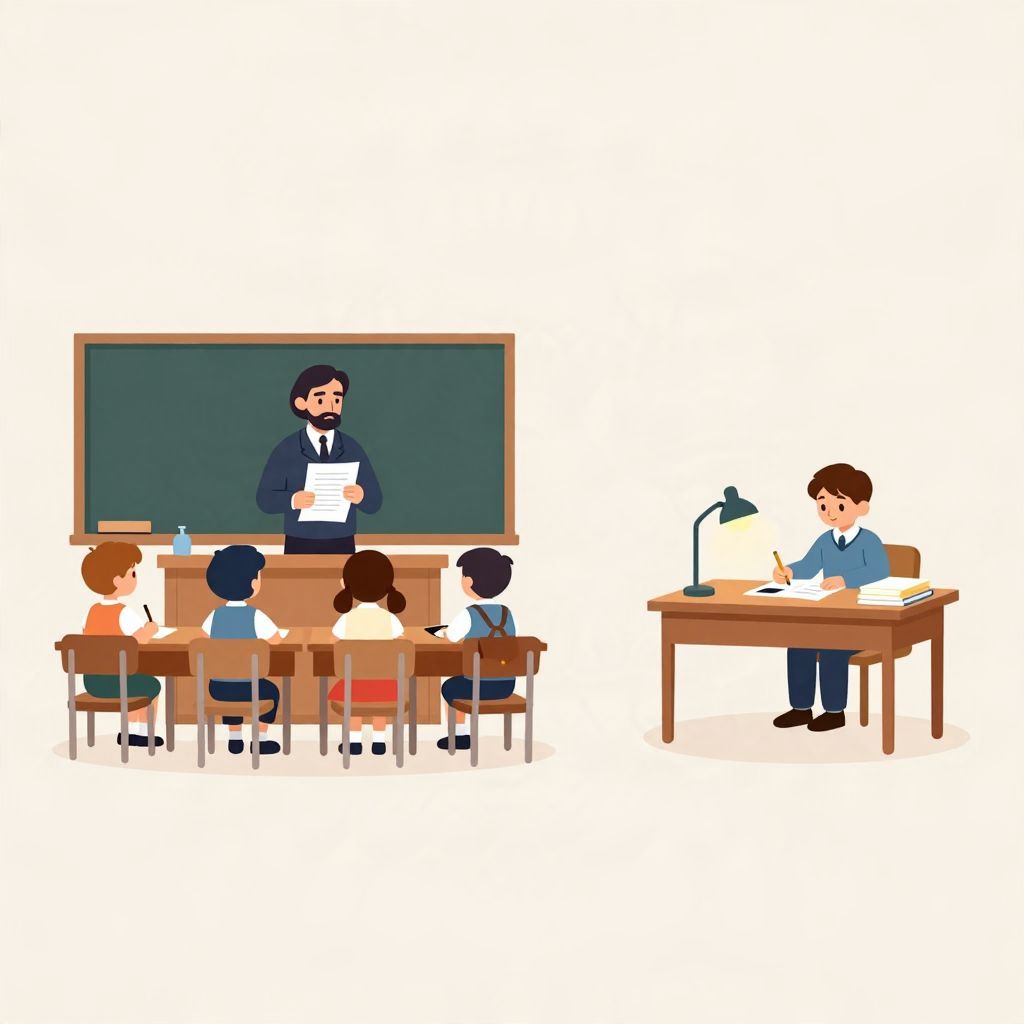
When was homework invented? There is no single inventor or exact birth date, because homework grew out of older educational practices rather than appearing all at once. The modern idea of students doing assigned work outside class took shape in the 19th century, especially in Europe and the United States, as mass schooling expanded.
Still, the story reaches back much further. From ancient tutors to Roman educators and later school systems, teachers have long expected learners to practice on their own. What changed over time was not the basic idea of study, but the scale, purpose, and controversy surrounding it.
When was homework invented?
Homework was not invented on one date. Its modern form emerged gradually in the 19th century, when compulsory schooling became more common and teachers began assigning work to be completed at home. Earlier societies used private study, memorization, and written exercises, but “homework” as a regular school practice is a modern development.
The long prehistory of homework
Learning outside the classroom in the ancient world
Long before modern schools, students were expected to study independently. In ancient Greece and Rome, education often relied on repetition, reading, copying, and memorization. Wealthy families hired tutors, and students practiced lessons between meetings. This was not homework in the modern sense, but it was a clear ancestor of the idea that learning continues beyond direct instruction.
In the classical world, education was usually personal rather than mass-based. Because teachers worked with small numbers of pupils, they could assign reading, recitation, or writing practice that students completed on their own. The key difference is that these tasks were part of elite tutoring or philosophical schooling, not a universal system of school assignments for children.
Medieval and early modern schooling
In medieval Europe, schooling was often tied to the Church. Students in cathedral schools, monasteries, and later universities copied texts, memorized prayers, and repeated lessons. Again, this was not homework in the modern, standardized sense. But it did normalize the idea that learning required work done away from the teacher’s immediate supervision.
By the early modern period, especially after the invention of the printing press, textbooks and printed readers became more common. That made it easier for teachers to assign reading and exercises. Even so, most children did not attend school regularly, and education was still uneven. Homework as a routine expectation needed a broader school system to exist.
Why the 19th century matters most
The strongest answer to when homework was invented is the 19th century, when compulsory education, larger classrooms, and standardized curricula made out-of-class assignments practical and useful. Teachers needed ways to reinforce lessons, manage many students, and extend instruction beyond school hours. Homework became a tool of modern mass education.
Compulsory schooling and larger classrooms
As governments created public school systems, more children attended class for longer periods. Teachers faced crowded rooms, limited time, and a need to keep students progressing at the same pace. Homework helped fill that gap. It allowed students to practice reading, arithmetic, grammar, and writing at home while class time focused on explanation and review.
This shift also reflected new ideas about childhood and discipline. Many educators believed that regular study habits built character, self-control, and diligence. Homework was therefore not only academic practice but also a moral exercise. In the 19th century, school systems increasingly treated time outside school as part of education rather than a break from it.
Germany and the spread of assigned study
Historians often point to German schooling as an important influence on modern homework. In the 18th and 19th centuries, German educational reforms emphasized structured lessons, recitation, and preparation outside class. These methods spread through Europe and the United States as educators borrowed from one another. Homework became especially common where schools aimed to standardize learning and test achievement.
It is important not to overstate a single national “invention.” Germany helped shape modern schooling, but homework developed across many places at once. The broader pattern was the same: as schools became more organized and universal, teachers increasingly assigned work to be completed at home.
Homework in the United States
From elite schooling to public education
In the United States, homework expanded alongside public schooling in the 19th century. Early American education varied widely, but by the mid-1800s many communities were building more regular school systems. Teachers used homework to reinforce reading, spelling, arithmetic, and composition. By the late 19th century, it had become familiar in many classrooms.
At the same time, homework was controversial. Some parents and reformers worried that too much study harmed children’s health or took away needed time for rest and family life. Others argued that homework trained responsibility and improved academic performance. These debates would continue into the 20th century and beyond.
The anti-homework movement of the early 1900s
Homework did not simply rise without resistance. In the early 20th century, some American educators criticized it as excessive and unhealthy, especially for younger children. Progressive education reformers often preferred more play, hands-on learning, and school-based instruction. In some places, homework loads were reduced or restricted for elementary students.
Later, during the Cold War era, attitudes shifted again. After the Soviet launch of Sputnik in 1957, many Americans worried that schools were not demanding enough. Homework gained renewed support as part of academic rigor and national competition. Since then, it has remained a regular, if debated, feature of schooling.
What homework looked like in different eras
Memorization and copying
Early homework often meant copying passages, memorizing facts, or practicing arithmetic. These tasks reflected the teaching methods of the time. Before widespread access to books and digital tools, repetition was one of the main ways to learn. Homework was therefore closely tied to drill-based education.
Reading and written exercises
As literacy rates rose, homework came to include reading assignments, essays, and problem sets. Teachers could now expect students to work through material independently and return with written evidence of learning. This was especially important in secondary schools, where students were preparing for exams, jobs, or higher education.
Homework as a bridge between school and home
Homework also reflected a major change in how society viewed childhood. In earlier periods, children often worked in family labor or apprenticeships. Modern schooling separated learning from work and home life, but homework linked those spaces again. It asked families to support education while keeping the school’s authority over what children should learn.
Was there a single inventor of homework?
No. There is no reliable evidence for one person who invented homework in the modern sense. Because homework developed gradually, it is better understood as a school practice that evolved over centuries. Some popular stories try to credit a single teacher, reformer, or country, but those claims usually simplify a much more complex history.
What can be said confidently is this: the modern homework system emerged when mass schooling made out-of-class assignments practical, and when educators believed that learning should continue beyond the school day. That development was most visible in the 19th century, though its roots are much older.
Why homework became so common
Academic practice
Teachers assigned homework because it helped students remember and apply what they learned in class. Practice matters in subjects like mathematics, languages, and writing. Homework made it possible to extend that practice without lengthening the school day indefinitely.
Discipline and habit
Homework also served a social purpose. Many school systems used it to teach punctuality, responsibility, and persistence. Completing work independently was seen as preparation for adult life, employment, and citizenship. In that sense, homework was never only about school subjects.
Standardization
As education became more standardized, homework helped teachers measure progress. Assignments gave schools a way to compare students, prepare for examinations, and maintain a common pace. That made homework especially attractive in systems designed for large numbers of children rather than a few private pupils.
So, when was homework invented?
If you want the shortest historically accurate answer, homework in its modern school form was invented gradually in the 19th century, not on a single day. Its deeper roots go back to ancient tutoring and premodern study habits, but the familiar practice of assigning work to be done at home belongs to the age of mass education.
That is why the history of homework is really the history of schooling itself: as education became more organized, more public, and more demanding, work at home became part of the lesson. For more on the debate over its origins, see who invented homework and why, and for the wider social world that shaped education, explore what a feudal system was.