
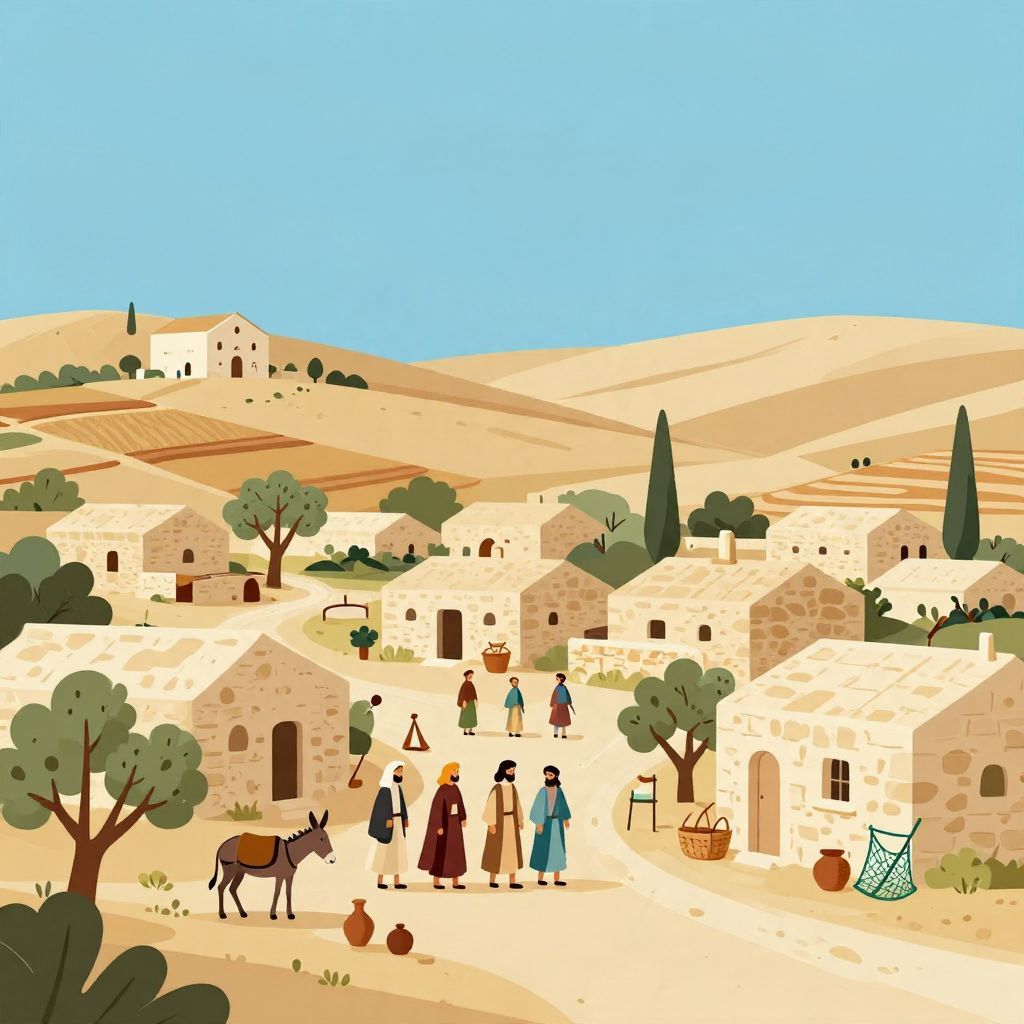
Where did Jesus live? The shortest historical answer is that Jesus of Nazareth lived in Roman Judea and Galilee, in the eastern Mediterranean region that is now part of modern Israel and the Palestinian territories. The Gospels place his early life in Nazareth and his public activity mainly in towns and villages around Galilee, especially near the Sea of Galilee.
Because the surviving evidence comes mostly from religious texts written decades after his death, historians can describe Jesus’s likely places of residence and movement, but not every detail with certainty. The historical setting, however, is clear: a small Jewish world under Roman rule, shaped by local villages, pilgrimage, and political tension.
Where did Jesus live?
Historically, Jesus is understood to have lived in Nazareth in Galilee during his youth and to have spent much of his adult ministry traveling through Galilee, Judea, and nearby regions. He was not a resident of one large city; rather, he appears to have lived as an itinerant teacher in a network of villages, with Nazareth as his home base.
Nazareth: the place most closely associated with Jesus
Nazareth is the town most strongly linked to Jesus in Christian tradition and in the New Testament. It was a small settlement in lower Galilee, not a major urban center. For that reason, historians often emphasize that Jesus likely came from an ordinary rural environment rather than from a powerful city or elite household.
What was Nazareth like in the 1st century?
Nazareth in Jesus’s time was probably a modest Jewish village. Archaeology and regional studies suggest a community of farmers, laborers, and artisans living in a landscape of hills, fields, and nearby market towns. It was close enough to larger centers such as Sepphoris and Capernaum to be influenced by regional trade and administration, yet it remained a small local place.
This matters because Jesus’s background is usually understood through that setting. A person from Nazareth would have grown up in an environment where Jewish customs, synagogue life, agricultural work, and Roman political power all shaped daily existence. The town’s obscurity also helps explain the later saying, “Can anything good come out of Nazareth?” which reflects how unremarkable the village seemed to outsiders.
Galilee and Judea in the time of Jesus
Jesus lived in a region divided between Galilee in the north and Judea in the south, both under Roman influence. Galilee was ruled by Herod Antipas during much of Jesus’s life, while Judea came under direct Roman administration after the removal of Herod Archelaus. These political divisions shaped travel, taxation, and public life.
Why geography mattered
Galilee was more rural and densely populated with villages than Judea, while Judea contained Jerusalem, the Temple, and the center of Jewish pilgrimage. Jesus’s movement from Galilee to Jerusalem, especially for festivals, fits the pattern of a Jewish teacher who participated in the religious life of his people while operating mostly outside the capital.
The geography also helps explain the shape of the Gospel narratives. Much of Jesus’s teaching is set in villages, on roads, by the sea, or in homes, not in palaces or courts. The places associated with him reflect a Galilean teacher moving among ordinary people rather than a permanent resident of Jerusalem.
Did Jesus live in one house or one city?
There is no historical evidence that Jesus lived in a single permanent house as an adult. The sources present him as a traveling preacher and healer who moved with disciples and relied on hospitality. He likely stayed in private homes, villages, and temporary lodgings while teaching in different places.
Home, family, and early life
Jesus’s childhood home is traditionally placed in Nazareth, where he is associated with his family. The Gospels mention Mary, Joseph, and siblings, though the exact meaning of those family references has been debated for centuries within Christian traditions. Historically, what can be said with confidence is that Jesus came from a Jewish family rooted in a small Galilean community.
His occupation is often described as that of a tekton, a Greek term usually translated as carpenter, builder, or craftsman. That suggests a working background rather than an aristocratic one. Such a family would likely have lived in a modest dwelling typical of village life in Roman Palestine.
Where did Jesus live during his public ministry?
During his public ministry, Jesus appears to have lived mainly in Galilee, especially around the northern shore of the Sea of Galilee. Towns such as Capernaum, Bethsaida, Chorazin, and nearby villages are central in the Gospel accounts. These locations formed the practical center of his activity before his final journey to Jerusalem.
Capernaum as a base
Capernaum is often described as a base for Jesus’s ministry. The Gospels place him there frequently, and it is where he is said to have taught, healed, and gathered followers. While historians cannot verify every narrative detail, Capernaum fits the pattern of a small fishing and trading town that would have been strategically placed for movement around the lake.
The Sea of Galilee region was important because it linked fishing, agriculture, and travel routes. A teacher moving through this area could reach diverse audiences: peasants, fishermen, tax collectors, and local synagogue communities. That setting helps explain why Jesus’s message spread through networks of villages rather than through a single urban center.
Did Jesus live in Jerusalem?
Jesus did not appear to live permanently in Jerusalem, but he did spend time there, especially during religious festivals and at the end of his life. Jerusalem was the political and religious center of Judea, and it became the setting for the final events of his ministry, arrest, trial, crucifixion, and, in Christian belief, resurrection.
Jerusalem’s importance
For a first-century Jew, Jerusalem was the city of the Temple and the heart of pilgrimage life. Jesus’s presence there is historically significant because it shows that his ministry was not isolated from the wider Jewish world. His teachings and actions in Jerusalem also placed him in direct contact with religious authorities and Roman power.
That said, the sources do not suggest that Jerusalem was his home in the ordinary sense. It was a destination, not a hometown. The distinction matters when answering where Jesus lived historically: his life was rooted in Galilee, but his death is associated with Jerusalem.
What can historians say with confidence?
Historians work with a limited set of sources, mainly the New Testament Gospels, later Christian writings, and what is known about 1st-century Jewish life under Rome. From that evidence, several points are widely accepted: Jesus came from Nazareth, lived in Galilee, traveled through nearby regions, and visited Jerusalem. The exact details of each stop are harder to prove.
Evidence and uncertainty
- Well supported: Jesus was associated with Nazareth and Galilee.
- Well supported: He moved among villages and towns during his ministry.
- Well supported: He went to Jerusalem near the end of his life.
- Less certain: the exact house, street, or daily address where he lived.
- Less certain: the precise chronology of every journey recorded in the Gospels.
This is why careful historical writing avoids claiming a single exact residence in the modern sense. Ancient people, especially itinerant teachers, often lived in multiple places depending on season, work, family ties, and public activity.
How the historical setting shaped Jesus’s life
Jesus lived in a region marked by Roman occupation, local Jewish identity, economic inequality, and religious expectation. Galilean villages were not isolated from empire: taxes, land pressure, and administrative authority affected everyday life. In that world, a teacher who spoke about God’s kingdom, justice, repentance, and hope could attract attention quickly.
Village life and movement
Travel in the first century was slower and more local than today, but it was still connected. People moved between villages, markets, synagogues, and pilgrimage routes. Jesus’s life reflects that pattern. He was not a cloistered figure removed from society; he seems to have lived among ordinary people and spoken in forms they could understand.
That social setting also helps explain why his message spread after his death. Followers who had encountered him in Galilee and Jerusalem could carry stories about him into other Jewish communities and, eventually, into the wider Roman world.
Popular traditions and later beliefs
Over time, Christian tradition developed many sacred associations with Jesus’s life, including sites in Nazareth, Bethlehem, Capernaum, and Jerusalem. Some of these locations became pilgrimage destinations long after the 1st century. While such traditions are historically important, they should not be confused with direct contemporary evidence.
For example, later devotion often treats particular houses, wells, or streets as exact places where Jesus lived or taught. Historians are more cautious. They may recognize the significance of those traditions without claiming that every later shrine preserves a verifiable first-century location.
The historical answer in one sentence
So, where did Jesus live? Historically, the best-supported answer is that Jesus lived in Nazareth as his hometown, spent much of his adult life in Galilee among its villages and towns, and traveled to Jerusalem near the end of his life.
That answer captures both the evidence and the uncertainty: Jesus was a Galilean Jew from a small village, active in the rural world of Roman Palestine. For more on the wider setting of his world, see where Canaan was and who was emperor when Jesus died.