
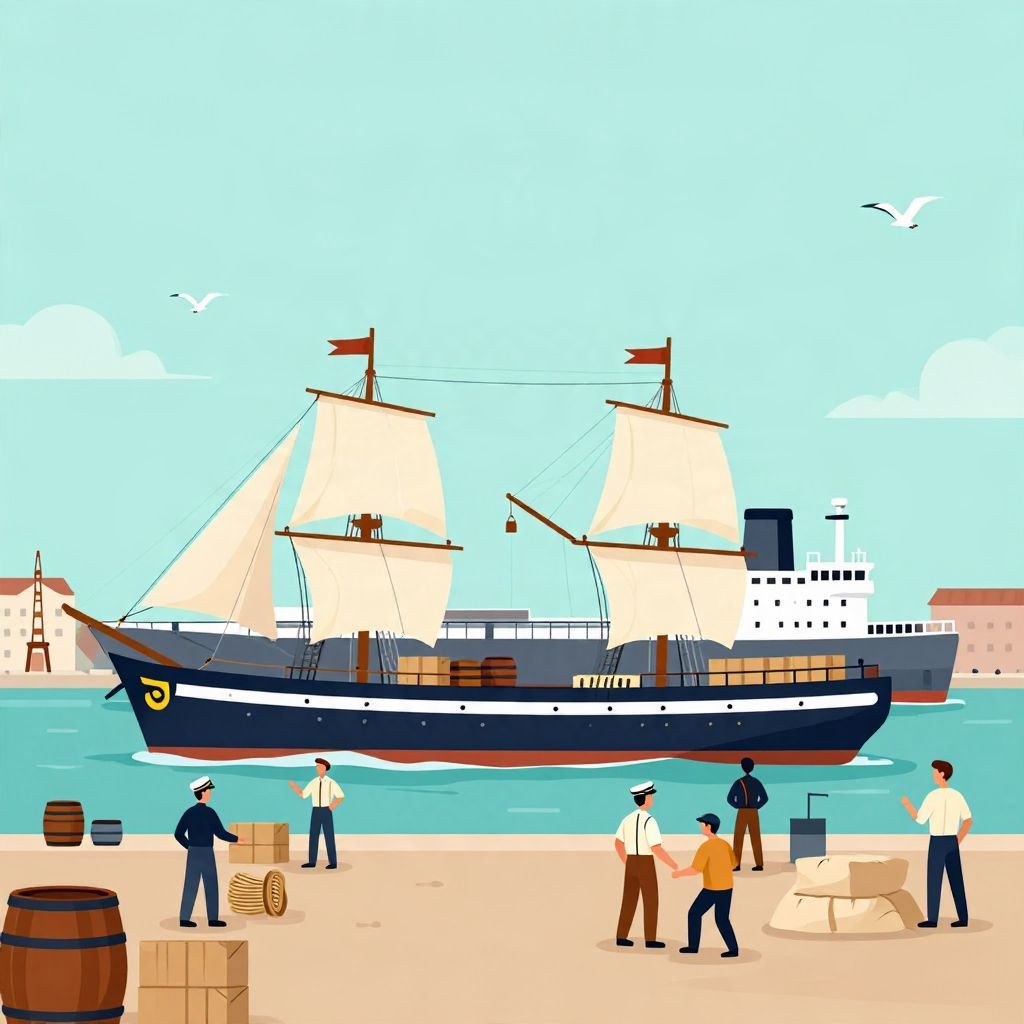
What is a merchant marine? In history, the term refers to a nation’s civilian fleet of merchant ships and the mariners who crew them. These vessels carry goods, passengers, and mail across seas and oceans, forming the commercial backbone of maritime trade.
Though not usually part of a navy, merchant marines have often mattered in war, empire, migration, and global economics. Their ships linked ports, moved raw materials and finished products, and helped shape the modern world.
What Is a Merchant Marine?
A merchant marine is the commercial shipping force of a country: cargo ships, tankers, passenger vessels, and the civilian sailors who operate them. Unlike a navy, which exists for defense and warfare, a merchant marine serves trade and transport, though it can become crucial to military logistics in wartime.
Where Did the Merchant Marine Come From?
Merchant shipping is almost as old as seafaring itself. Long before the modern term existed, ancient societies used privately owned or state-supported ships to move timber, grain, wine, metals, textiles, and luxury goods. What we now call a merchant marine developed gradually as maritime trade expanded and states began to regulate shipping more closely.
Ancient and medieval roots
In the ancient Mediterranean, Phoenician, Greek, Roman, and later Byzantine traders used merchant vessels to connect ports across a wide sea network. Similar patterns existed in the Indian Ocean, where Arab, Indian, and later Chinese merchants carried goods along monsoon routes. These were not “merchant marines” in the modern bureaucratic sense, but they were the historical foundation of commercial sea power.
By the medieval period, maritime trade had become more organized. Italian city-states such as Venice and Genoa built powerful commercial fleets, while the Hanseatic League linked ports around the Baltic and North Seas. In these societies, merchant shipping was not just an occupation; it was a pillar of urban wealth, diplomacy, and political influence.
How Did the Modern Merchant Marine Develop?
The modern merchant marine emerged with early modern expansion, imperial competition, and the growth of global trade from the 15th century onward. European states increasingly protected shipping, issued trading charters, and built legal systems around commerce at sea. Over time, national merchant fleets became essential to overseas empires and industrial economies.
Age of exploration and empire
From the late 1400s, Portuguese and Spanish voyages opened new sea routes between Europe, Africa, Asia, and the Americas. Later, Dutch, English, and French merchant fleets expanded these connections. Merchant ships carried spices, silver, sugar, enslaved people, manufactured goods, and colonial produce. The commercial fleet became inseparable from imperial power.
This period also showed one of the merchant marine’s most important historical roles: it was both an economic engine and a strategic asset. States depended on merchant shipping for customs revenue, colonial supply lines, and wartime transport. Private merchants and governments often worked together, but their interests did not always align.
Industrial era expansion
The 19th century transformed merchant shipping. Steam power, iron and steel hulls, improved navigation, and the opening of canals such as Suez in 1869 made sea transport faster and more reliable. National merchant fleets grew alongside industrial production and global trade. Shipping companies became larger, more specialized, and more tightly connected to banking, insurance, and industrial supply chains.
By this time, “merchant marine” had become a common term in many countries for the civilian shipping sector. Governments began to see it not only as commerce but also as a reserve of trained seafarers and transport capacity that could be mobilized in war.
What Do Merchant Mariners Do?
Merchant mariners are the civilian professionals who operate merchant ships. Their work includes navigation, engineering, cargo handling, maintenance, communications, and safety procedures. On modern vessels, crews may include deck officers, engineers, ratings, stewards, and specialists depending on the ship’s type and function.
Main types of merchant vessels
- Cargo ships – carry manufactured goods, machinery, and packaged freight.
- Bulk carriers – transport loose commodities such as coal, grain, ore, and fertilizer.
- Tankers – move oil, chemicals, and liquefied gas.
- Container ships – carry standardized containers that revolutionized global trade in the mid-20th century.
- Passenger ships and ferries – transport people, including on some historic ocean liner routes.
- Specialized vessels – include refrigerated ships, roll-on/roll-off carriers, research support ships, and offshore supply vessels.
Why Has the Merchant Marine Been So Important in History?
The merchant marine has mattered because sea transport has long been the cheapest way to move large volumes of goods over long distances. Before railways and airplanes, and even after them, oceans were the highways of world commerce. Merchant fleets helped create interconnected economies, sustained empires, and enabled mass migration.
Trade, migration, and everyday life
Merchant shipping moved far more than luxury goods. It carried food, fuel, raw materials, machinery, and people. Millions of migrants crossed oceans on merchant and passenger vessels in the 19th and early 20th centuries, reshaping the populations of the Americas, Australia, southern Africa, and parts of Europe. Everyday life in industrial societies depended on these ships, even when most people never saw them.
Because so much trade moved by sea, disruptions to shipping could have major consequences. Blockades, piracy, war, strikes, storms, and submarine attacks all exposed how vulnerable global commerce could be when merchant shipping was threatened.
What Is the Difference Between a Merchant Marine and a Navy?
The difference is purpose. A navy is a military force designed to defend a state, project power, and fight at sea. A merchant marine is civilian and commercial, focused on transport and trade. The two can interact closely, especially in wartime, but they are not the same institution.
How they overlap in wartime
In major wars, merchant ships often become strategically vital. They carry troops, weapons, fuel, food, and industrial materials. Governments may requisition ships, protect convoys, or arm merchant vessels for defense. Merchant mariners may face danger from mines, submarines, aircraft, and raiders even though they are not combatants in the same sense as naval personnel.
During the two world wars, merchant shipping proved essential to survival and victory. The Battle of the Atlantic in the Second World War, for example, was not only a naval campaign but also a struggle to keep merchant supply lines open across the ocean. Merchant mariners suffered heavy losses while sustaining the Allied war effort.
How Did Governments Support Merchant Marines?
Because merchant fleets were so important, many states encouraged them through subsidies, navigation laws, training systems, and ship registration rules. Some countries used “flag” policies to define ships as part of their national merchant marine, even when ownership, crew, or routes were international.
National policy and maritime law
Historically, governments supported merchant shipping to strengthen trade and maintain a pool of trained sailors. In some eras, laws favored domestic ships or restricted foreign competition. In others, states subsidized shipbuilding, port improvements, or maritime academies. The exact structure varied by country and period, but the goal was often the same: to keep a reliable commercial fleet under national control.
International maritime law also developed to regulate safety, labor, and navigation. As shipping became more global, standards for ship design, crew training, and emergency procedures became increasingly important.
What Changed in the 20th and 21st Centuries?
The merchant marine changed dramatically with containerization, globalization, and the rise of international shipping firms. Container ships, introduced in the mid-20th century, reduced loading times and lowered costs, making global supply chains faster and more efficient. This helped accelerate the movement of manufactured goods across continents.
Modern challenges
Today, merchant mariners still face demanding conditions, though their work is shaped by advanced navigation systems, automation, and international regulation. The industry also faces challenges such as labor disputes, piracy in some regions, environmental concerns, and the pressure to reduce emissions from shipping.
At the same time, the merchant marine remains indispensable. Most global trade by volume still moves by sea. That means the civilian shipping fleet continues to be one of the most important but least visible systems in the modern world economy.
Key Facts About the Merchant Marine
- The term refers to a nation’s civilian commercial shipping fleet and the sailors who crew it.
- Its roots go back to ancient maritime trade, but the modern concept developed with global commerce and state regulation.
- Merchant marines are distinct from navies, though they often support military logistics in wartime.
- Merchant shipping has been central to empire, migration, industrialization, and globalization.
- In the modern era, container ships and large cargo vessels carry the bulk of world trade.
The Historical Significance of Merchant Mariners
Merchant mariners have often worked outside the spotlight, but their labor has shaped history in profound ways. They connected distant economies, sustained empires, enabled migration, and kept wartime supply lines moving. The merchant marine is therefore not just a shipping industry; it is a major historical force in the making of the modern world.
In short, a merchant marine is the civilian sea transport system of a nation, and its history is the history of trade itself. For related maritime history, you may also be interested in the history of the navy and the Age of Exploration.