
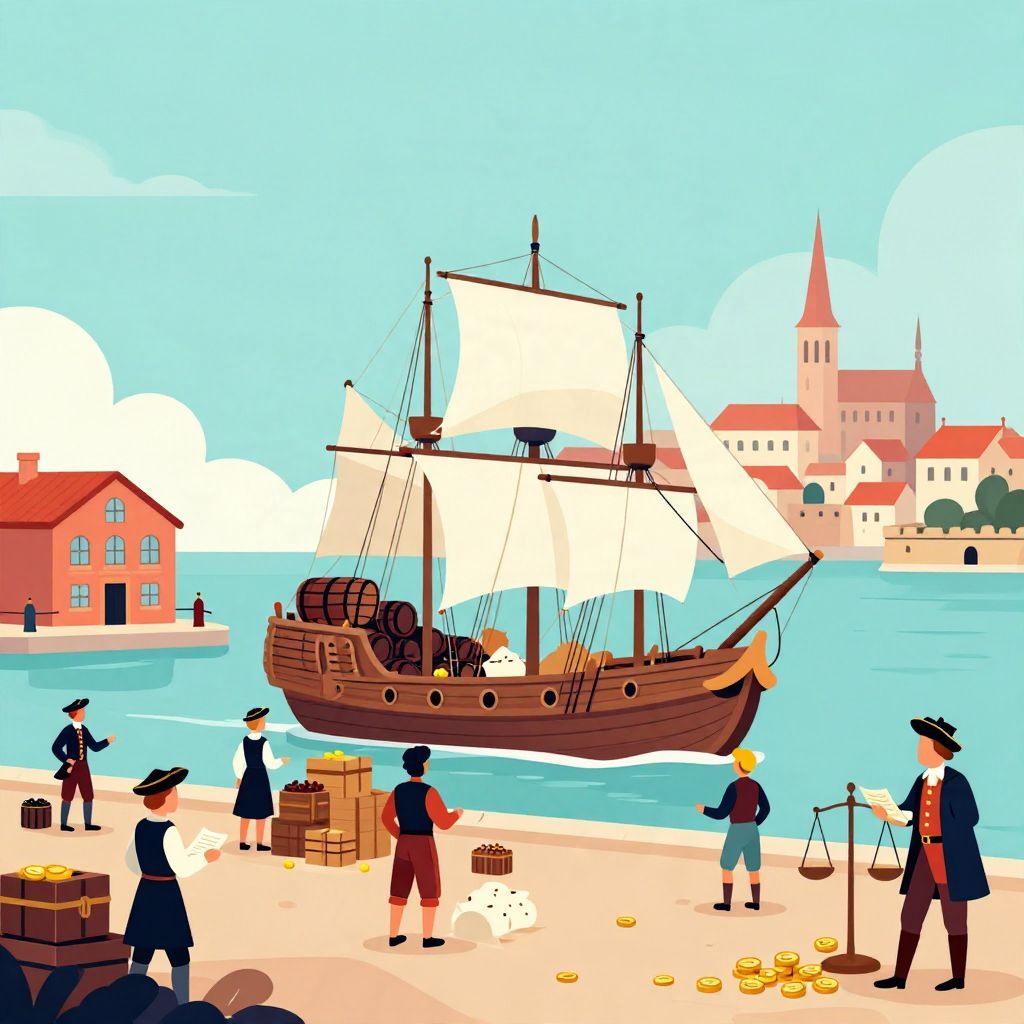
What was mercantilism? It was a broad set of economic ideas and state policies that shaped European empires from roughly the 16th to the 18th century. In simple terms, governments tried to make their countries richer and more powerful by controlling trade, building up exports, limiting imports, and accumulating precious metals.
Mercantilism was never a single, neatly defined doctrine. It was a practical way of thinking about wealth, war, colonies, and state power in an age of expanding overseas empires and intense rivalry.
What Was Mercantilism?
Mercantilism was an early modern economic system in which states sought to increase national wealth and power by regulating trade, encouraging exports, restricting imports, and using colonies to benefit the mother country. It emerged in Europe after the late medieval period and reached its height between the 16th and 18th centuries.
How Mercantilism Worked
Mercantilist governments believed that a nation’s wealth depended on how much valuable bullion, especially gold and silver, it could hold and how favorable its trade balance was. If a country exported more than it imported, money was thought to flow in; if it imported too much, wealth would leave.
This logic led states to intervene heavily in the economy. They granted monopolies, imposed tariffs, regulated shipping, supported chartered companies, and tried to direct colonial production toward the needs of the home country. The goal was not free competition, but national advantage.
Common Mercantilist Policies
- Tariffs on imported goods to protect domestic producers
- Navigation laws that reserved trade for national ships
- Colonial restrictions requiring colonies to trade mainly with the mother country
- State subsidies for industries such as textiles, shipbuilding, and armaments
- Monopolies and chartered companies to organize overseas trade
Where Did Mercantilism Come From?
Mercantilism developed gradually in Europe during the transition from medieval to early modern life. Its roots lay in the growth of centralized monarchies, expanding Atlantic trade, the rise of overseas empires, and the fiscal demands of frequent warfare. As states became stronger, rulers increasingly saw the economy as a tool of power.
There was no single inventor of mercantilism. The term itself was coined later by critics and historians, not by the people who practiced the policy. Early modern writers and officials used different labels and arguments, but many shared a common concern: how to make the state richer, stronger, and more self-sufficient.
Intellectual Background
Mercantilist ideas drew on older assumptions that wealth was limited and that one nation’s gain could be another’s loss. They also reflected practical experience. Rulers saw that trade revenues, customs duties, and access to bullion helped finance armies, navies, and administration. In that context, economic control seemed inseparable from state security.
Why Did Mercantilism Become So Important?
Mercantilism mattered because early modern Europe was highly competitive. Monarchies such as Spain, France, England, and the Dutch Republic fought repeated wars and competed for colonies, trade routes, and naval dominance. Economic policy was therefore tied directly to military and imperial rivalry.
War was expensive. Governments needed reliable revenue, and trade offered a way to obtain it. Customs duties, colonial monopolies, and protected industries could all help fund the state. Mercantilism was attractive because it linked commerce to national strength in a period when the two were difficult to separate.
State Power and Empire
Mercantilism also fit the logic of empire. Colonies were expected to supply raw materials, provide markets for manufactured goods, and strengthen the mother country’s strategic position. This system helped European powers justify imperial expansion, even when it imposed heavy costs on colonial populations and local economies.
Mercantilism in Practice: England, France, Spain, and Others
Different states applied mercantilist ideas in different ways. England is often associated with mercantilism through the Navigation Acts, especially from the mid-17th century onward. These laws aimed to channel trade through English ships and ports, strengthening maritime power and limiting Dutch competition.
In France, ministers such as Jean-Baptiste Colbert under Louis XIV promoted state-directed industry, infrastructure, and trade regulation. “Colbertism” became a famous form of mercantilist policy, though it was shaped by French political conditions and should not be treated as identical to every other mercantilist system.
Spain and Portugal relied heavily on colonial bullion and imperial trade networks, especially in the Americas. Their systems differed from English and French models, but they shared the assumption that imperial possessions should enrich the home state rather than develop independently.
Chartered Companies and Global Trade
Mercantilist states often used chartered companies to manage long-distance commerce. These firms received special privileges in exchange for helping the state expand trade and influence. Examples include the English East India Company and the Dutch East India Company, both of which became powerful commercial and political actors.
These companies were not simply businesses. They were tools of empire, diplomacy, and sometimes warfare. Their activities show how closely commerce and state power were linked in the mercantilist age.
Mercantilism and the Colonies
Colonies were central to mercantilist thinking. European powers wanted colonies to provide raw materials such as sugar, tobacco, timber, and metals, while also serving as captive markets for finished goods. Colonial trade was often tightly regulated to ensure that profits flowed back to the imperial center.
This system benefited some merchants, shipowners, manufacturers, and state officials, but it also created resentment and conflict. Colonists often objected to trade restrictions, taxes, and the denial of local economic autonomy. In many places, mercantilism helped lay the groundwork for later political tensions, including resistance to imperial rule.
Effects on Indigenous Peoples and Enslaved Labor
Mercantilist expansion was deeply connected to colonization, dispossession, and slavery. The demand for plantation goods such as sugar and tobacco increased the use of enslaved labor in the Atlantic world. Indigenous communities were displaced, coerced, or drawn into imperial trade networks that often undermined older social and economic systems.
So while mercantilism is sometimes described in abstract economic terms, it had very real human consequences. It helped finance empires, but it also intensified exploitation and violence across the Atlantic and beyond.
What Did Mercantilists Believe About Wealth?
Mercantilists generally believed that wealth was finite and that the state should actively manage economic life to secure its share. Many thought that a strong manufacturing sector, a favorable trade balance, and a large stock of bullion were signs of national strength. They also believed that population growth and labor discipline could increase productivity.
However, mercantilism was not a single theory with one set of rules. Some writers emphasized bullion, others trade surpluses, and others manufacturing or shipping. In practice, mercantilism was a flexible collection of policies adapted to local conditions and political goals.
Important Misconception
Mercantilism is sometimes described as if early modern rulers simply “believed in gold.” That is too simplistic. Bullion mattered, but so did customs revenue, naval power, colonial control, and industrial capacity. The real aim was to strengthen the state in a competitive international system.
When Did Mercantilism Decline?
Mercantilism began to lose influence in the late 18th and early 19th centuries, though it did not disappear all at once. Critics increasingly argued that trade could be mutually beneficial rather than zero-sum. The rise of classical economics, especially the work of Adam Smith, challenged the idea that heavy state control was the best way to create wealth.
Smith’s The Wealth of Nations in 1776 became famous for criticizing mercantilist restrictions and monopoly privileges. Later, industrial capitalism and freer trade policies in some countries further weakened older mercantilist assumptions. Still, many states continued to protect industries and manage trade in ways that echoed mercantilist thinking.
Did Mercantilism End Completely?
No. It faded gradually rather than ending on a single date. Some mercantilist institutions survived into the 19th century, and governments have continued to use tariffs, subsidies, and trade controls in various forms ever since. The difference is that these policies were no longer justified by the same older theory of bullion-centered national wealth.
Why Mercantilism Matters Today
Mercantilism is important because it helps explain how modern states, empires, and global trade systems developed. It shows that economic policy was once closely tied to warfare, colonial expansion, and political centralization. It also helps historians understand why trade debates have so often been about power, not just prices.
Even today, discussions about tariffs, trade deficits, strategic industries, and economic nationalism can echo mercantilist concerns. The historical context is different, but the underlying question remains familiar: how should states balance commerce, security, and prosperity?
Key Facts About Mercantilism
- Time period: roughly the 16th to 18th centuries
- Main goal: strengthen the state by controlling trade and increasing national wealth
- Core belief: wealth and power were closely linked
- Typical tools: tariffs, monopolies, navigation laws, colonial trade controls
- Major critics: later classical economists such as Adam Smith
- Historical impact: helped shape European empires, colonial economies, and modern state power
Mercantilism was not a single blueprint but a powerful early modern approach to economics and empire. It grew out of rivalry, war, and expanding global trade, and it left a lasting mark on the history of capitalism and colonialism. For a closer look at the broader economic setting, see what mercantilism is and the Commercial Revolution.