
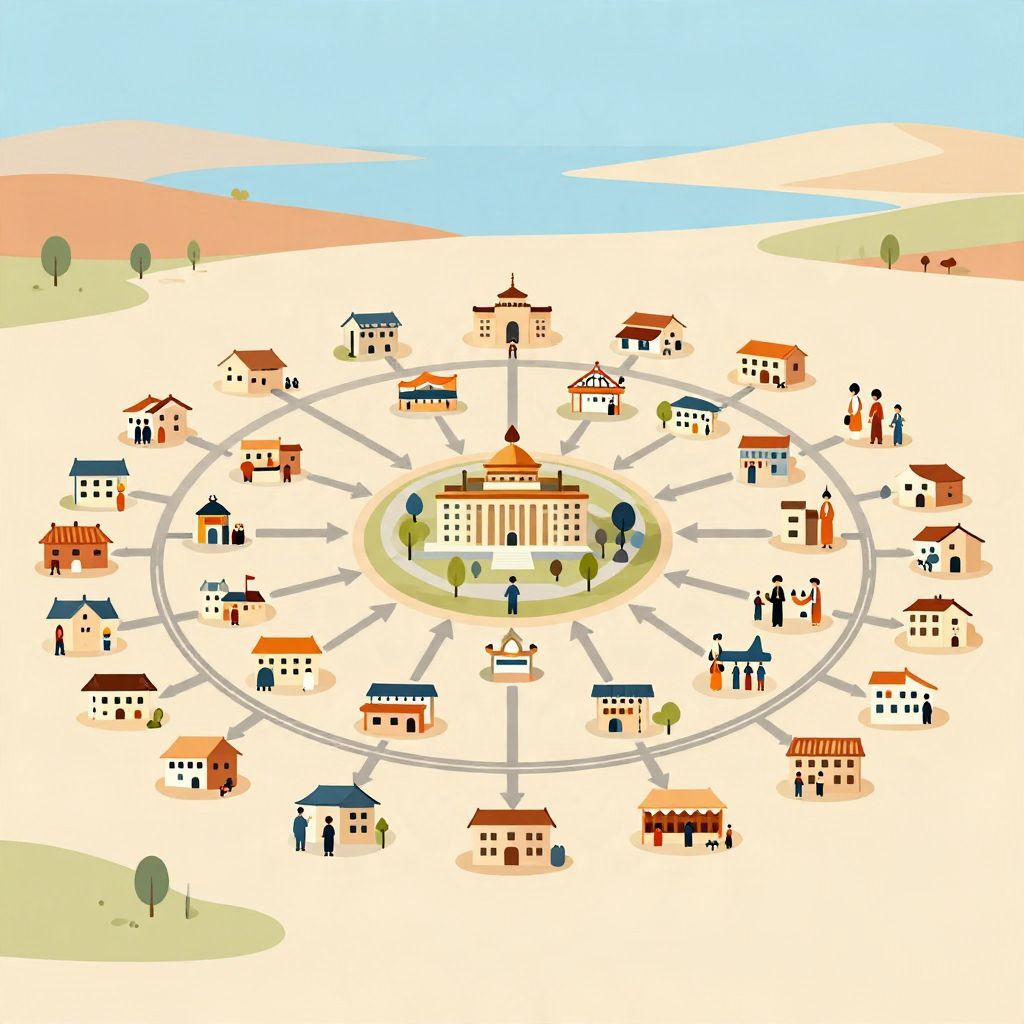
What is hierarchical diffusion? In historical geography and cultural history, it is the spread of an idea, style, belief, technology, or practice from people or places of higher status to lower status, often jumping over nearby areas. It helps explain why some trends move first through elites, major cities, or powerful institutions before reaching the wider population.
The concept is especially useful for understanding how influence traveled in premodern and modern societies alike, from royal courts and capitals to provincial towns and ordinary communities. It is not a single event in history, but a pattern of diffusion that historians and geographers use to interpret change.
What Is Hierarchical Diffusion?
Hierarchical diffusion is the spread of a cultural trait through levels of rank or importance, rather than evenly across space. A new fashion, political idea, religion, or innovation often appears first among elites, large cities, or influential centers, then passes downward or outward to smaller places and broader social groups.
How Hierarchical Diffusion Works
Hierarchical diffusion usually begins in a place or group with power, prestige, or visibility. Because people often imitate those they admire or depend on, ideas can move quickly from a center of authority to other connected centers. This creates a pattern of spread that may skip intermediate locations.
Key features of the pattern
- Starts with high-status groups: rulers, clergy, merchants, intellectuals, celebrities, or major institutions.
- Moves through important centers: capitals, ports, universities, or large cities.
- Can bypass nearby places: a small town may adopt a trend after a distant metropolis does.
- Depends on prestige and communication: people copy what seems authoritative, modern, or successful.
This pattern is different from simple physical proximity. A village next to another village may not be the first to adopt a new custom if the real influence comes from a capital city, a court, a church hierarchy, or a media network.
Why Historians and Geographers Use the Term
The term is widely used in cultural geography, social history, and the history of ideas because it captures a recurring historical process. Human societies rarely adopt change in a perfectly even way. Status, power, transport routes, literacy, and institutions shape who hears about something first and who treats it as worth copying.
Hierarchical diffusion helps explain why the same idea can appear first in a few prominent places and only later in smaller communities. It also shows that influence is often social as well as geographic. In other words, people do not just copy what is near them; they often copy what is prestigious.
Historical Examples of Hierarchical Diffusion
Hierarchical diffusion can be seen across many periods of history. The exact examples vary, but the underlying pattern remains recognizable. Below are some of the clearest historical settings where it appears.
Religion and belief systems
Religions often spread through hierarchical channels. A faith may first gain support among rulers, urban elites, or educated clergy before reaching rural populations. In many historical cases, conversion at the top of society encouraged wider adoption below.
For example, when a ruler or ruling class adopted a religion, that choice could influence administration, law, education, and public ritual. The spread of Christianity in the Roman Empire, or later the adoption of state religions in various kingdoms, often followed this top-down pattern, though local practice was usually more complex than a simple chain of command.
Fashion, language, and court culture
Courts have long been engines of hierarchical diffusion. Styles of dress, speech, etiquette, and architecture often began among aristocratic circles before reaching merchants and, eventually, broader society. A royal court could make a particular garment, hairstyle, or decorative style fashionable across a kingdom.
This was especially true in early modern Europe, where court culture had strong symbolic power. What appeared at court could become a model for nobility, then for urban elites, and later for the middle classes. The same pattern appears in many societies, not just Europe.
Political ideas and reforms
Political change often spreads hierarchically too. New administrative systems, legal reforms, and ideologies may first be discussed among intellectuals, officials, or urban leaders. From there, they can move into wider public debate and eventually reshape institutions.
The spread of constitutional ideas, nationalism, socialism, liberalism, and other modern political movements often followed this pattern. Newspapers, universities, salons, and legislatures played major roles in carrying ideas from influential centers to broader audiences.
Technology and consumer goods
Technological adoption can also be hierarchical. A new device may first appear in large cities, wealthy households, government offices, or specialized industries. Only later does it become common in smaller towns or rural areas.
Historically, this happened with many forms of transport, communication, and household technology. Prestige and cost mattered: early adopters were often those with money, access, or a desire to signal modernity. Once the innovation proved useful or fashionable, adoption widened.
How It Differs from Other Types of Diffusion
Hierarchical diffusion is one of several ways cultural change spreads. Understanding the difference between them makes the concept much clearer.
Hierarchical diffusion vs. contagious diffusion
Contagious diffusion spreads outward from person to person or place to place in a more even, wave-like pattern. It is often compared to the spread of an infectious disease. Hierarchical diffusion, by contrast, jumps through ranks or centers of power first.
Hierarchical diffusion vs. relocation diffusion
Relocation diffusion happens when people move and carry their culture, beliefs, or practices with them. Hierarchical diffusion does not require migration. It can occur through imitation, communication networks, institutions, or media, even when people stay where they are.
Hierarchical diffusion vs. stimulus diffusion
Stimulus diffusion occurs when the underlying idea spreads, but the original form changes as it is adapted locally. Hierarchical diffusion may include adaptation, but its defining feature is the rank-based path of spread, not the transformation of the idea itself.
Why Hierarchy Matters in History
Hierarchy has always shaped access to information. In many historical societies, elites controlled literacy, education, trade, or religious authority. That meant they often learned about new ideas first and had the power to spread them. Even when ordinary people were not passive, they usually encountered change through institutions already above them.
This is why hierarchical diffusion is so useful for historians. It reminds us that culture does not spread only through geography. It also spreads through inequality, prestige, and institutional power. A capital city, for example, may influence a whole region far beyond what its size alone would suggest.
Origins of the Concept in Modern Scholarship
The term is a modern analytical tool rather than an ancient historical practice with a single origin date. Scholars in geography and related fields developed diffusion models in the twentieth century to explain how innovations and cultural traits spread across space and society. Hierarchical diffusion became one of the standard categories used in that analysis.
Its value lies in description rather than invention. Historians had long observed that courts, capitals, churches, and major cities often led cultural change, but the formal term gave researchers a way to compare cases across time and place. It helped turn a familiar historical observation into a clearer analytical framework.
Common Historical Settings Where It Appears
Hierarchical diffusion is especially visible in societies with strong central institutions or sharp social stratification. Some of the most common settings include:
- Imperial capitals that set administrative and cultural standards for a wide territory.
- Royal courts that influenced fashion, etiquette, patronage, and taste.
- Religious hierarchies that transmitted doctrine and ritual from leaders to local communities.
- Universities and learned societies that spread intellectual trends.
- Modern media centers that shape national and international culture.
In each case, influence tends to flow from a place or group with greater authority to one with less. That does not mean the lower levels simply copy everything. Local communities often adapt, resist, or reinterpret what they receive.
Limits and Criticisms of the Idea
Like any model, hierarchical diffusion simplifies reality. Not every innovation spreads neatly from top to bottom, and not every elite idea succeeds. Some trends fail because they are too expensive, unpopular, or disconnected from local needs. Others spread from ordinary people upward instead of downward.
Historians also caution that diffusion models can understate conflict. People do not always adopt ideas because they admire elites; sometimes they do so because of coercion, law, colonial power, or economic dependence. In many cases, hierarchical diffusion overlaps with force, persuasion, and resistance.
So the concept is best used as a guide, not a rigid rule. It explains a pattern of spread, but it does not replace the need to study specific historical contexts.
Why the Concept Still Matters Today
Hierarchical diffusion remains relevant because modern societies still have centers of influence. National governments, global media, universities, corporations, and digital platforms can all help new ideas move rapidly from prestigious circles to wider audiences. The pattern is old, but the speed of spread has changed.
Understanding hierarchical diffusion also helps explain why some innovations become mainstream while others remain niche. Prestige, visibility, and institutional support still matter. Whether the subject is political language, fashion, technology, or social behavior, influence often travels through networks of rank and reputation.
Takeaway
Hierarchical diffusion is the spread of ideas and cultural traits through layers of status and power, usually starting with influential people or places before reaching broader society. It is a key concept for understanding how religion, fashion, politics, and technology have spread throughout history. For related concepts, see relocation diffusion and sequent occupance.