
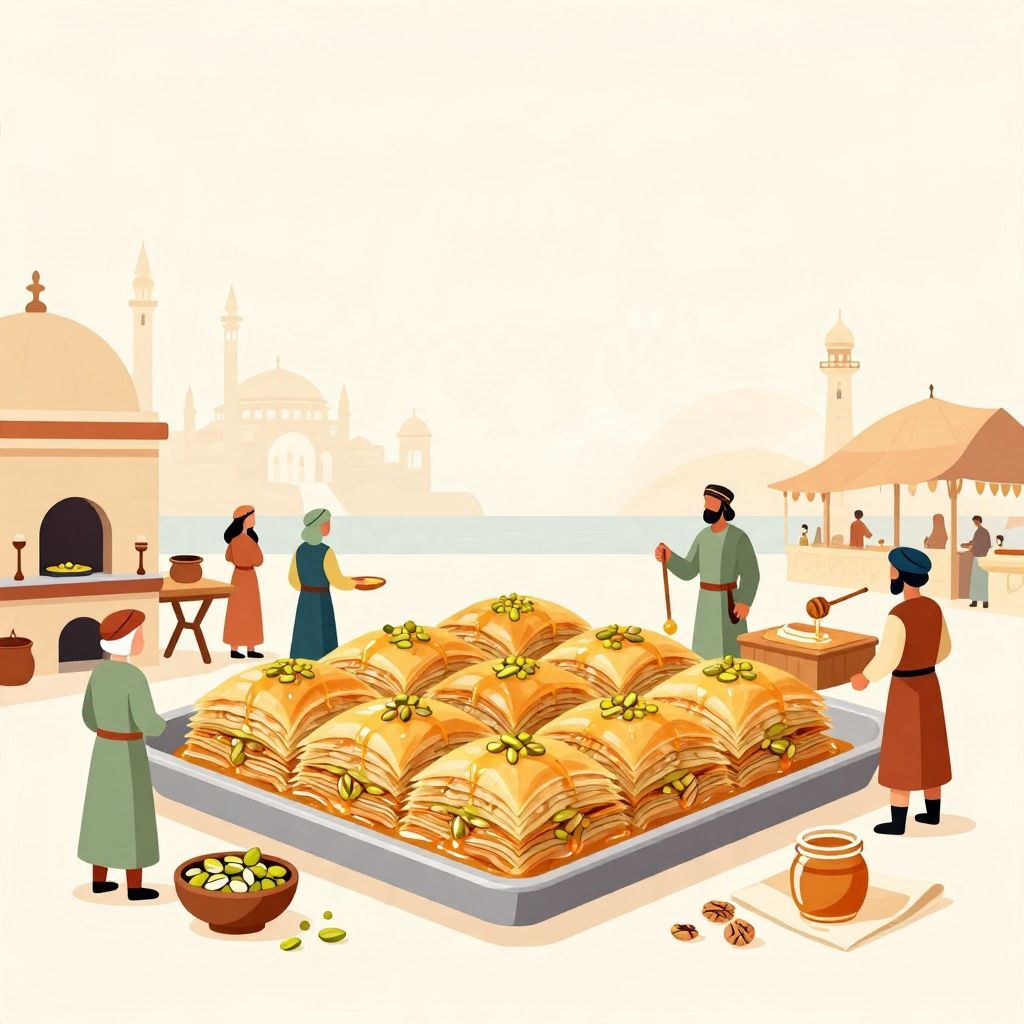
Baklava is one of the best-known sweets in the eastern Mediterranean and Middle East, but its exact birthplace is not easy to pin down. The short answer is that baklava most likely emerged in the kitchens of the Ottoman Empire, especially in and around Istanbul, while drawing on much older layered pastry traditions from Central Asia, the Byzantine world, and the broader Near East.
So when people ask where baklava originated, the most careful historical answer is not a single city or nation, but a long culinary evolution shaped by empires, migration, and courtly cooking.
Where Did Baklava Originate?
Baklava is most strongly associated with the Ottoman court in Istanbul, where it took recognizable form by the late medieval and early modern period. However, its deeper roots lie in earlier layered dough desserts from the eastern Mediterranean and Central Asia, making baklava a product of shared regional history rather than one isolated invention.
The Historical Background of Baklava
Layered pastries existed long before baklava
The idea behind baklava—thin sheets of dough, butter or fat, nuts, and sweet syrup or honey—did not appear suddenly. Ancient and medieval cooks across West and Central Asia made many kinds of filled or layered pastries. These earlier foods were not baklava in the modern sense, but they created the techniques and tastes that later made baklava possible.
In the Byzantine and Near Eastern worlds, cooks used thin doughs, nuts, honey, and aromatic spices in desserts and festive dishes. In Central Asia, nomadic and semi-nomadic food traditions also valued portable dough-based foods, which later influenced the pastry culture of the Islamic empires. Over time, these traditions blended.
Why the Ottoman Empire matters
The strongest historical case for baklava’s recognizable origin points to the Ottoman Empire, where the dessert became a refined court specialty. Istanbul, as the imperial capital, was a place where ingredients, techniques, and cooks from many regions met. The Ottoman palace kitchens helped standardize and elevate baklava into a prestigious dessert associated with celebration and status.
By the 15th and 16th centuries, Ottoman culinary culture had become highly sophisticated. Court records and later food histories suggest that layered pastries were being prepared in elite settings, and baklava became especially important in ceremonial and festive contexts. This does not mean the Ottomans “invented” the basic concept of sweet layered pastry, but they were crucial in shaping the version most people recognize today.
Baklava’s Deeper Roots: Central Asia, Byzantium, and the Middle East
Central Asian influences
Some scholars trace part of baklava’s ancestry to Central Asian pastry traditions brought westward by Turkic-speaking peoples. These groups carried foodways across vast distances as they moved into the Middle East and Anatolia. Thin doughs, rich fillings, and sweetened desserts fit well into the culinary exchange that followed these migrations.
This is one reason baklava is often discussed in the context of Turkic and Ottoman history. The pastry’s development was not a simple borrowing from one place to another, but a long process of adaptation as people, ingredients, and techniques moved across empires.
Byzantine and eastern Mediterranean connections
Another important layer of baklava’s history comes from the Byzantine and Greek-speaking eastern Mediterranean. The region already had a strong tradition of honeyed sweets, nut-filled pastries, and thin dough preparations. These practices likely influenced the pastry culture that later developed under Ottoman rule.
Because the eastern Mediterranean was a zone of constant contact—between Greeks, Armenians, Arabs, Persians, Turks, and others—culinary traditions overlapped. That is why baklava cannot be assigned cleanly to one modern nation without oversimplifying the past.
Middle Eastern pastry traditions
Baklava also belongs to a wider family of sweets found across the Middle East. Similar desserts using nuts, syrup, and delicate pastry appear in many regional cuisines. Some may have developed independently; others likely influenced one another through trade, conquest, and shared urban food culture.
In this sense, baklava’s origin is best understood as regional and imperial rather than national. It emerged from a culinary environment where sweet pastries were already popular, and where elite kitchens competed to produce more elaborate versions.
How Baklava Became Associated with Istanbul
The Ottoman palace kitchens
One of the clearest reasons baklava is linked to Istanbul is the role of the Topkapı Palace kitchens. Ottoman court cuisine was highly organized, with specialized cooks preparing food for the sultan, officials, and ceremonial occasions. Baklava became one of the signature sweets of this environment.
Its association with the palace gave baklava prestige. A dessert served at court did not remain a local specialty for long; it spread through urban markets, provincial elites, and household cooking. As the empire expanded, baklava traveled with it.
The baklava procession
A famous Ottoman custom helped cement baklava’s status: the baklava procession, in which trays of baklava were carried from the palace to elite military units during Ramadan. This ceremonial distribution linked the pastry to imperial generosity, hierarchy, and celebration. It also shows that baklava was not merely a dessert, but part of political and social ritual.
This tradition illustrates a broader historical pattern: foods often gain meaning when they become tied to power. Baklava’s reputation spread not only because it tasted good, but because it was associated with the Ottoman center of authority.
What the Evidence Can and Cannot Prove
What is well supported
Historians can say with confidence that baklava in its recognizable form was developed and popularized in the Ottoman world, especially in Istanbul. The pastry became a refined court dessert and spread widely across the empire’s territories. Its modern identity is therefore closely tied to Ottoman culinary culture.
What remains uncertain
What historians cannot prove is a single, neat “first baklava” moment. There is no universally accepted document or archaeological find that identifies one inventor or one exact birthplace. Claims that baklava was first made in a specific modern country are usually shaped by later national identities, not by the medieval evidence itself.
That uncertainty matters. Food history often gets pulled into modern debates about ownership and authenticity. In the case of baklava, the evidence points to a shared regional tradition that was refined under Ottoman rule, rather than a single isolated invention.
Baklava in Different Countries Today
A shared dessert with local variations
Today, baklava is made in Greece, Turkey, the Balkans, the Levant, the Caucasus, and beyond. Each region has its own style: different nuts, syrups, spices, and shapes. Some versions use walnuts, others pistachios or almonds. Syrup may be flavored with lemon, rosewater, or orange blossom depending on local taste.
These variations are not proof of separate origins so much as evidence of a long shared history. As baklava spread across the Ottoman world and beyond, local cooks adapted it to available ingredients and regional preferences.
Why modern national claims are complicated
Modern countries often claim baklava as part of their national heritage, and those claims are understandable. But the pastry predates modern national borders. It developed in a world of empires, religious communities, and trade networks, not in the framework of today’s nation-states.
That is why the question “Where did baklava originate?” has a better historical answer than a nationalist one. It originated in a multicultural culinary zone, with its best-documented rise in the Ottoman Empire.
A Simple Timeline of Baklava’s Development
- Ancient and late antique periods: layered and honeyed pastries appear across the eastern Mediterranean and Near East.
- Medieval period: Turkic, Byzantine, Persian, and Arab food traditions continue to influence one another through migration and trade.
- Late medieval to early modern Ottoman period: baklava takes recognizable form and becomes a courtly specialty in Istanbul.
- Ottoman imperial era: the dessert spreads widely across the empire and becomes part of festive and ceremonial life.
- Modern period: baklava becomes a beloved regional dessert claimed and adapted by many cuisines.
Why Baklava’s Origin Story Still Matters
Baklava’s history shows how food travels with people, empires, and ideas. It is not just a dessert; it is evidence of centuries of cultural exchange. Its layered structure is a fitting symbol of that history, with each layer reflecting a different influence, from Central Asian techniques to Ottoman refinement and eastern Mediterranean tastes.
So, where did baklava originate? Most accurately, it originated through a long process of culinary blending, with its most recognizable form emerging in the Ottoman Empire, especially Istanbul, while drawing on much older traditions from the wider region. If you enjoy tracing the history of foods and their journeys across cultures, you may also like reading about where gin came from and where coffee originally came from.