
What happened to Judas after he betrayed Jesus is one of the most debated episodes in the New Testament. The short answer is that the Gospel traditions agree Judas did not simply disappear: he was overcome by remorse, the betrayal money was returned or rejected, and he died soon afterward. Beyond that core, the details differ sharply between sources.
Because the accounts are brief and not fully consistent, historians and theologians often distinguish between what the texts say and later tradition. The result is a story shaped by scripture, interpretation, and centuries of Christian reflection.
What happened to Judas after betraying Jesus?
According to the New Testament, Judas Iscariot felt remorse after Jesus was condemned, tried to return the silver he had received, and then died soon afterward. Matthew says he hanged himself; Acts says he fell and died in a gruesome accident. The exact sequence is uncertain, but both accounts present his death as a consequence of betrayal.
The betrayal and its immediate aftermath
Judas Iscariot is remembered as the disciple who identified Jesus to authorities in exchange for money. In the Gospel of Matthew, the betrayal is tied to thirty pieces of silver, a detail that became central to later Christian memory. The arrest of Jesus in Jerusalem set in motion the events that led to his trial and crucifixion.
After Jesus was condemned, Judas is described as being seized by remorse. This is an important distinction: the texts do not present him as indifferent after the arrest. Instead, they portray a man who realized the moral and spiritual weight of what he had done. That remorse, however, did not restore the situation or prevent his death.
Matthew’s account: remorse, returned silver, and suicide
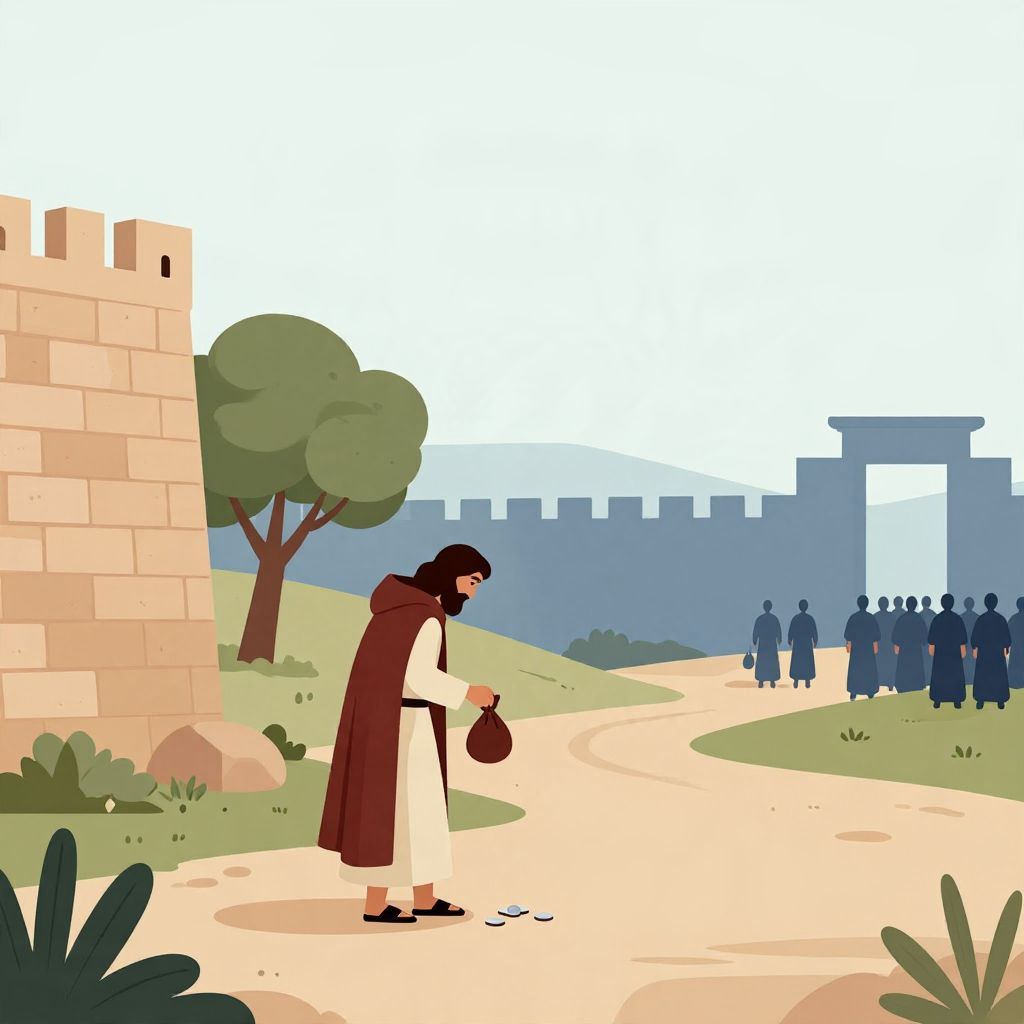
The Gospel of Matthew gives the clearest narrative of Judas’s immediate end. Judas brings back the silver to the chief priests and elders, saying that he has sinned by betraying “innocent blood.” When they refuse to accept the money for the temple treasury, he throws it into the sanctuary and leaves. Matthew then says Judas went away and hanged himself.
This account emphasizes guilt, rejection, and final despair. It also links Judas’s death to the betrayal money, which later Christian readers interpreted as a sign that the act itself was spiritually corrupt and self-destructive. Matthew’s version is the one most people know today, especially the image of Judas taking his own life.
Acts’ account: a different and more graphic death
The Acts of the Apostles offers another version. There, Judas is said to have acquired a field with the reward of his wickedness and then suffered a violent death: he fell headlong, burst open, and his intestines spilled out. The field was afterward called the Field of Blood.
This account differs from Matthew in both method and emphasis. In Acts, Judas’s end is not suicide by hanging but a gruesome fall that serves as a public sign of divine judgment. Because the two narratives are not identical, scholars generally treat them as separate theological traditions rather than as a single harmonized report.
Why do the Gospel accounts differ?
The differences between Matthew and Acts have long attracted attention. Historians usually approach them as evidence that early Christian communities preserved more than one way of explaining Judas’s fate. The writers were not composing modern biographies; they were making theological arguments about betrayal, guilt, judgment, and the meaning of Jesus’s death.
Different purposes, different emphases
Matthew’s version focuses on personal remorse and the tragic consequences of betrayal. Acts, by contrast, uses Judas as a warning example in a speech about replacing him among the apostles. Its description is vivid and judgmental, fitting the book’s broader interest in the vindication of the early Christian movement.
Some later interpreters have tried to reconcile the two accounts by suggesting that Judas hanged himself and later his body fell and burst open. That is possible as a harmonization, but it is not stated explicitly in either text. Historically, the safest conclusion is that the sources preserve distinct traditions about a death associated with shame and divine punishment.
What can be said with confidence?
- Judas betrayed Jesus and received money for it.
- He later experienced remorse.
- He died soon after the betrayal.
- The New Testament preserves two different descriptions of how he died.
What happened to the betrayal money and the “Field of Blood”?
Matthew says the returned silver could not be put into the temple treasury because it was considered blood money. The priests therefore used it to buy a potter’s field as a burial place for foreigners. This field became linked with Judas’s death and was remembered as the Field of Blood.
Acts also mentions a field associated with Judas, though in a different way. The name may reflect the money’s origin, the violent death connected to Judas, or both. In ancient religious language, “blood” could signal guilt, death, or ritual impurity. The exact historical location of the field is uncertain, and the story functions more as a moral and symbolic tradition than a verifiable land transaction in the modern sense.
How early Christians understood Judas’s fate
For early Christians, Judas was not simply a failed disciple. He became a symbol of betrayal from within the community. His story raised difficult questions: Was he acting freely? Was his betrayal foreknown? Could remorse undo treachery? Different Christian writers and traditions answered these questions in different ways.
Judas as a warning figure
In the New Testament, Judas’s end serves a larger purpose than biography. It warns against greed, disloyalty, and despair. The betrayal is presented as part of the Passion story, but Judas remains morally responsible for his choice. His death reinforces the seriousness of that responsibility.
At the same time, the texts do not offer a simple psychological portrait. They leave open whether Judas was motivated by greed, disappointment, political expectation, spiritual corruption, or some combination of these factors. Later Christian tradition often filled in those gaps, sometimes portraying him as uniquely evil, sometimes as tragic, and sometimes as a figure whose role was mysterious within divine providence.
Was Judas condemned forever?
That question belongs more to theology than to recoverable history. The New Testament does not provide a final statement about Judas’s eternal destiny. Some Christian traditions have assumed damnation because of his betrayal and death; others have been more cautious, noting that judgment belongs to God. Historically, however, the dominant liturgical and artistic tradition has treated Judas as the archetypal betrayer.
What historians can and cannot know
From a historical standpoint, Judas is known primarily through the Christian texts that preserved memory of Jesus’s death. There is no independent contemporary biography of Judas, and no external source confirms the exact details of his end. That means historians must separate the likely historical core from later interpretation.
The most cautious reconstruction is that Judas was one of Jesus’s followers, that he played a role in Jesus’s arrest, and that he died not long afterward. The manner of death is uncertain. The suicide tradition in Matthew may preserve one memory, while Acts preserves another. Both, however, agree that his end was tragic and tied directly to the betrayal.
Why the story mattered so much
Judas’s fate mattered because it helped early Christians explain the scandal of betrayal from within the circle of disciples. If Jesus was the Messiah, why did one of his own followers hand him over? The answer was not merely historical but theological: betrayal happened, remorse followed, and the community had to make sense of it in light of resurrection faith.
This is why Judas became such a powerful figure in Christian culture. He represents the danger of misplaced loyalty, the cost of betrayal, and the possibility of self-destruction after moral collapse. Over time, his name became shorthand for treachery in many languages.
Timeline of Judas’s final days
- During the arrest of Jesus: Judas identifies Jesus to the authorities.
- After Jesus is condemned: Judas feels remorse.
- He returns the silver: In Matthew, he tries to give the money back to the priests.
- The money is rejected or redirected: The priests use it for the potter’s field in Matthew.
- Judas dies: Matthew says he hangs himself; Acts describes a violent fall and death.
- His memory becomes symbolic: Later Christian tradition remembers him as the betrayer of Jesus.
The lasting aftermath of Judas’s story
Judas’s death did not end his influence on history. His name entered Christian preaching, art, literature, and popular speech as a symbol of betrayal. The story also shaped how Christians thought about repentance: remorse alone was not enough to repair the damage caused by treachery.
At the same time, the story has continued to invite debate. Some readers focus on Judas’s guilt; others emphasize the tragedy of despair; still others explore how the Gospels use his figure to interpret the Passion. What remains clear is that the New Testament presents his end as part of the moral drama surrounding Jesus’s death.
So, what happened to Judas after betraying Jesus? In the earliest Christian sources, he was overwhelmed by remorse and died soon afterward, with Matthew and Acts preserving different accounts of how that death occurred. The historical details are uncertain, but the aftermath is unmistakable: Judas became the enduring symbol of betrayal. For related background, see what happened to Judas after he betrayed Jesus and what Judas means in history and culture.