
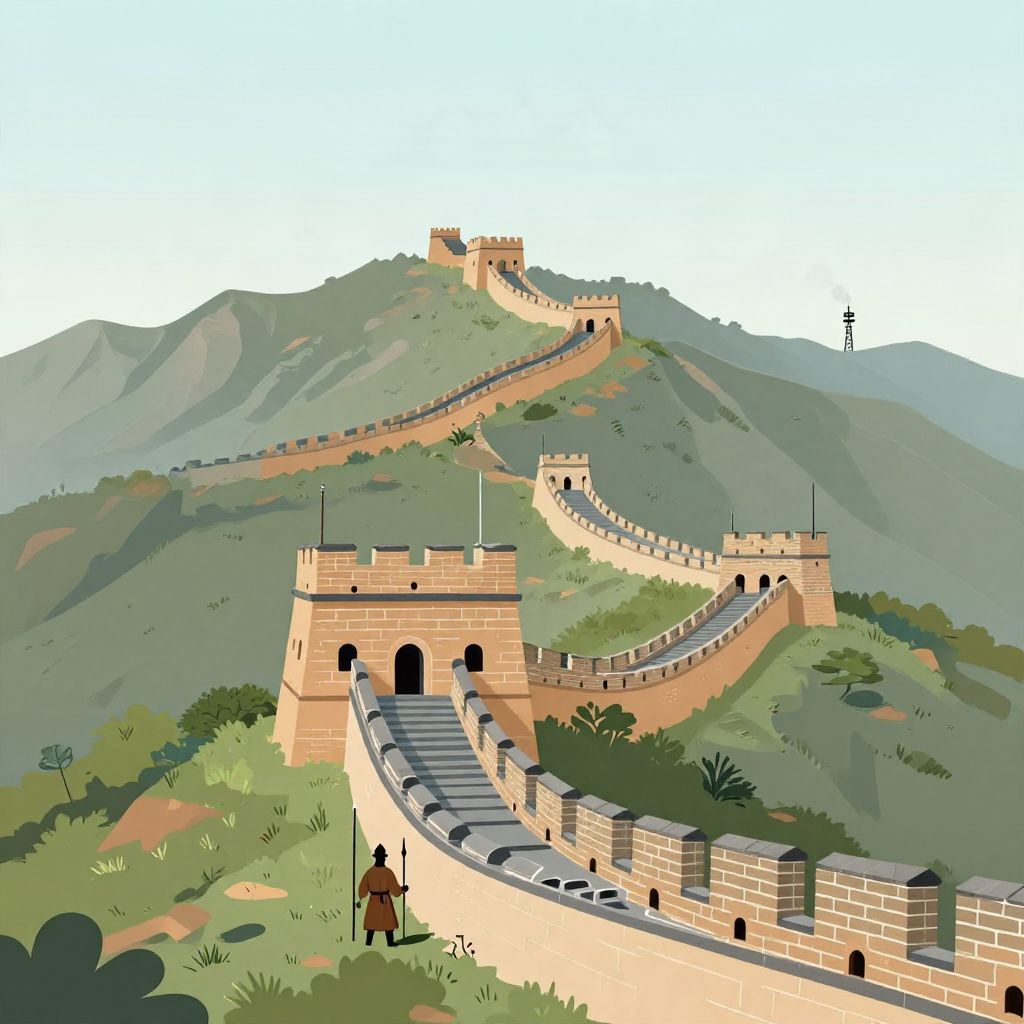
What was the purpose of the Great Wall of China? In the simplest terms, it was built to protect Chinese states and later the Chinese empire from raids, invasions, and border instability. But the wall was never one single project with one single purpose; it was built, rebuilt, and extended over many centuries for military defense, frontier control, and political authority.
Its meaning changed over time. Some sections were meant to slow cavalry attacks, others to mark borders, control movement, or support garrisons and signal systems. The Great Wall was as much a symbol of state power as a barrier of stone and earth.
What Was the Purpose Of The Great Wall Of China?
The Great Wall of China was designed primarily as a defensive frontier system. Its main purposes were to deter raids, delay enemy advances, protect farming communities, and help rulers monitor and control the northern borderlands. It also served administrative and symbolic roles, showing the reach and authority of Chinese states and dynasties.
Why Was the Great Wall Built in the First Place?
The wall emerged from a long history of conflict between settled agricultural states in northern China and mobile pastoral peoples on the steppe. Early Chinese rulers faced frequent raids, horse-borne attacks, and shifting alliances across the frontier. Walls were one response among several, alongside forts, troops, diplomacy, and tribute arrangements.
Defending against northern threats
For many rulers, the biggest concern was not a single massive invasion but repeated border pressure. Raiding groups could steal livestock, disrupt trade, and threaten villages. A wall could not stop every attack, but it could force attackers to slow down, funnel them toward guarded passes, and give defenders time to respond.
Protecting farmland and settlements
Much of northern China depended on agriculture. When frontier security weakened, farming communities were vulnerable to plunder and displacement. The wall helped create a more stable zone where soldiers, watchtowers, and garrisons could support civilian life. In that sense, it was intended to protect both people and production.
The Great Wall Was Not Built All at Once
One reason the wall’s purpose can seem confusing is that it was not a single construction project. Different dynasties built different walls for different strategic needs. The famous continuous structure associated with the Great Wall is largely the result of later Ming dynasty rebuilding, not one ancient master plan.
Early walls in the Warring States period
Before China was unified, rival states built their own frontier walls during the Warring States period, roughly the 5th to 3rd centuries BCE. These were local defenses meant to protect territory from neighboring states and nomadic incursions. They were practical military works, not yet the grand imperial wall known today.
Qin unification and frontier defense
After Qin Shi Huang unified China in 221 BCE, some earlier walls were linked together and extended in the north. The Qin effort aimed to strengthen control over newly unified territory and defend against steppe peoples. Later writers often exaggerated this into a single “first Great Wall,” but the reality was more fragmented.
Han, Northern dynasties, and later rebuilds
Successive dynasties, especially the Han, expanded frontier defenses to support military campaigns and secure trade routes such as those connected to the Silk Road. Other regimes in northern China also built or repaired walls. The wall’s form and function changed with each period’s military needs and political geography.
What Did the Wall Actually Do?
The Great Wall was not just a barrier. It was a system of defense. Towers, passes, beacon fires, patrol routes, and stationed troops made it possible to detect movement and communicate quickly across long distances. Its effectiveness depended on organization, manpower, and supply lines as much as on the wall itself.
Slowing armies and raiders
Even when attackers could cross it, the wall made movement harder. High walls, watchtowers, and fortified gates were designed to delay enemy advances and channel them into controlled points. That delay mattered because it gave defenders time to muster troops and send warnings.
Signaling and surveillance
Beacon towers were a crucial part of the system. Smoke by day and fire by night could relay warnings across the frontier. This made the wall part of an early communication network. In a military emergency, speed of information could be as important as physical strength.
Border administration and movement control
The wall also helped rulers regulate who moved across the frontier. Officials could monitor trade, levy taxes, and restrict unauthorized travel. In this sense, the wall was a tool of governance as well as defense. It helped define where imperial authority was strongest and where it needed reinforcement.
Was the Great Wall Meant to Keep Everyone Out?
Not exactly. A common modern image treats the wall as an impenetrable barrier, but that was never realistic. Large armies could breach or bypass sections, and many border peoples interacted with Chinese states through trade, diplomacy, intermarriage, and service. The wall was meant to manage frontier pressure, not erase frontier contact.
Defense, not total isolation
Chinese dynasties often depended on exchange with northern neighbors. Horses, livestock, tribute, and trade all crossed the frontier. The wall helped regulate these interactions rather than eliminate them. It marked a boundary, but the boundary was porous and politically negotiated.
A tool of statecraft
Rulers used the wall to project strength. Building and maintaining it signaled that the state could organize labor, move supplies, and defend territory. For that reason, the wall was also a political statement: it showed that the dynasty claimed responsibility for the frontier and intended to govern it.
The Ming Dynasty and the Wall Most People Know Today
The best-known surviving sections of the Great Wall were built during the Ming dynasty (1368–1644). After the Ming overthrew Mongol rule, they invested heavily in northern defense. Their wall-building program was more systematic than earlier efforts and used brick and stone in many areas, especially near strategic passes.
Why the Ming strengthened the wall
The Ming faced strong pressure from Mongol powers to the north. Rather than rely only on field armies, they built a fortified frontier to protect the capital region and key agricultural zones. The Ming wall was part of a broader military strategy, combining fortifications with garrisons and logistics.
Why the Ming wall looks so impressive
Many visitors today see the Ming-era wall because it survives better than earlier earthworks. Brick, stone, and carefully built passes endured more effectively than rammed-earth walls in remote areas. This has shaped popular understanding, making the Ming wall appear to be the whole Great Wall, even though it was only the latest major phase.
What the Great Wall Was Not
To understand its purpose clearly, it helps to clear up a few myths. The Great Wall was not built by one emperor alone, not intended as a single continuous line from sea to desert in every era, and not an absolute shield that stopped all invasions. It was a long-term frontier system with changing goals.
- Not one wall: it was many walls, built in different periods.
- Not only military: it also supported administration and border control.
- Not impenetrable: it delayed and redirected threats rather than guaranteeing safety.
- Not static: it was rebuilt, abandoned, and repurposed over centuries.
Why Did Rulers Keep Building It?
Even when walls were expensive and labor-intensive, rulers kept returning to them because they solved several problems at once. They offered visible defense, helped organize frontier troops, and gave governments a practical way to manage uncertain borderlands. In times of insecurity, a wall was a durable answer to a recurring strategic challenge.
Cost, labor, and political control
Building the wall required enormous labor, often from soldiers, peasants, or conscripted workers. That cost is one reason historians see the wall not only as a military project but also as a sign of state power. The ability to mobilize labor showed the reach of the dynasty, even when the work itself was harsh and burdensome.
Frontier psychology
Walls also mattered psychologically. They reassured interior populations and warned potential attackers that the state was prepared. In a world of shifting alliances and unpredictable raids, visible fortifications could have a stabilizing effect even when they were not perfect militarily.
Lasting Significance of the Great Wall
The Great Wall’s purpose changed over time, but its historical importance remained constant. It reflects centuries of Chinese state formation, frontier conflict, and military adaptation. It also shows that borders in history were often managed through a combination of walls, diplomacy, trade, and force rather than through a single solution.
Today, the Great Wall is remembered as a symbol of endurance and national identity, but historically it was first and foremost a practical frontier defense system. Its builders aimed to protect territory, control movement, and strengthen rule along a vulnerable border. That is why the wall mattered then—and why it still fascinates historians now. For related reading, see how long the Great Wall of China is and how many people died building the Great Wall of China.