
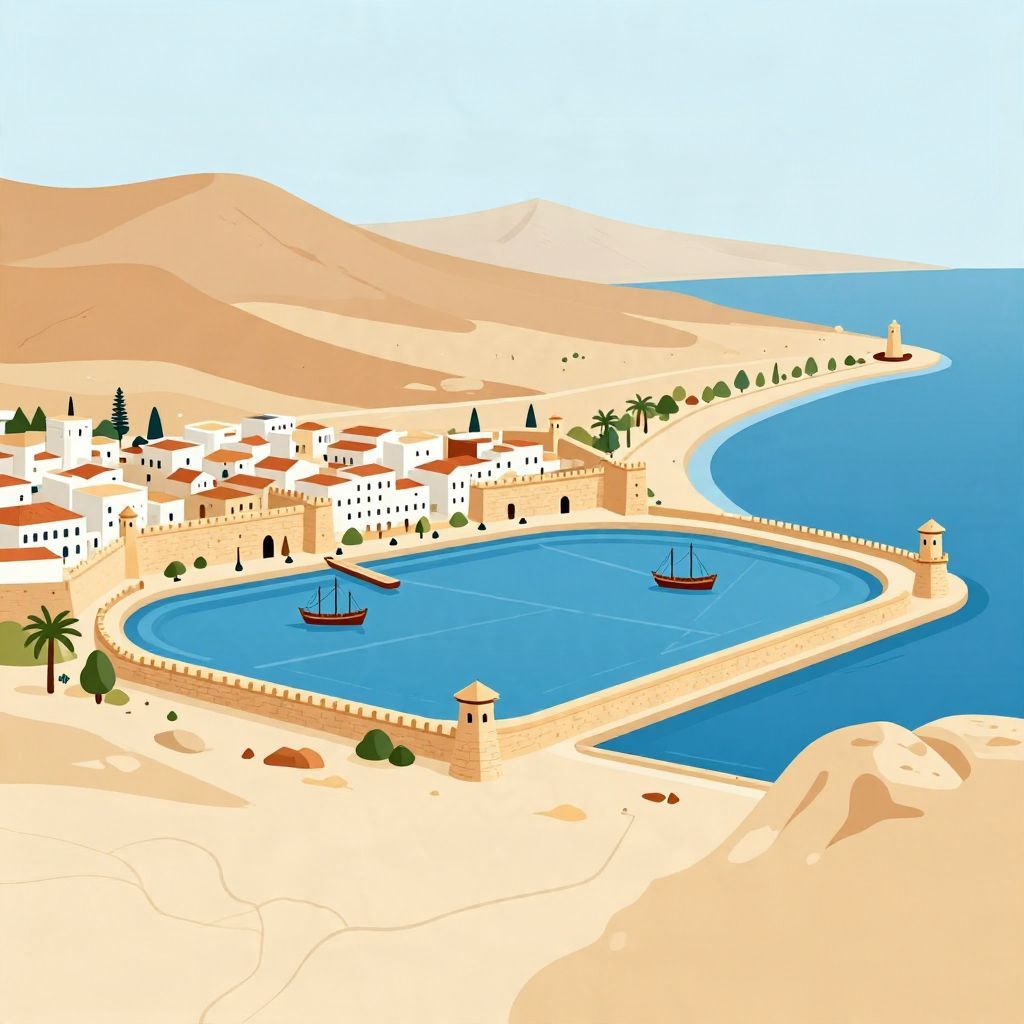
Where was Carthage located? The ancient city of Carthage stood on the North African coast, in what is now Tunisia, just northeast of modern Tunis. Founded by Phoenician settlers, it grew into one of the Mediterranean’s greatest trading powers and Rome’s most famous rival.
Its location gave Carthage access to sea routes, fertile hinterlands, and strategic control of the central Mediterranean. That geography helped shape its rise, its wealth, and eventually its long struggle with Rome.
Where Was Carthage Located?
Carthage was located on the coast of North Africa in present-day Tunisia, overlooking the Gulf of Tunis near the Mediterranean Sea. The city sat on a promontory with natural harbors that made it ideal for trade, naval power, and defense. Its ruins lie near modern Tunis, the capital of Tunisia.
The Geographic Setting of Ancient Carthage
Carthage occupied a highly strategic position in the western Mediterranean. It was close enough to the sea to dominate shipping lanes, yet near fertile land that supported agriculture and population growth. This combination of maritime access and productive countryside helped the city become a major commercial center.
Why the site mattered
The original settlement was placed where ships could anchor safely and be repaired, supplied, and protected. The nearby coast also connected Carthage to trade networks stretching across North Africa, Sicily, Sardinia, Spain, and beyond. In antiquity, location often determined power, and Carthage’s position was one of its greatest advantages.
The city’s harbor system became especially famous. Ancient accounts describe specialized harbors for commerce and war, reflecting Carthage’s dual identity as both a mercantile city and a naval state. Even allowing for some uncertainty in the ancient descriptions, archaeology confirms that Carthage was built for sea power.
Who Founded Carthage and When?
Carthage was traditionally founded by Phoenician settlers from Tyre, a city in the eastern Mediterranean, around the late 9th century BCE, often dated to about 814 BCE. That exact date comes from later tradition and should be treated cautiously, but the broader historical picture is clear: Carthage began as a Phoenician colony and later developed into an independent power.
From colony to empire
The founders brought language, religion, commercial habits, and maritime skills from the Phoenician world. Over time, however, Carthage became something more than a colony. As Phoenician influence in the eastern Mediterranean weakened, Carthage emerged as the leading Phoenician-speaking city in the west and built its own sphere of influence.
By the first millennium BCE, Carthage was no longer just a settlement on the Tunisian coast. It was the center of a network of cities, ports, outposts, and alliances that extended across much of the western Mediterranean.
How Carthage Used Its Location to Build Power
Carthage’s location made it easier to control trade between the eastern and western Mediterranean and to connect North Africa with islands and coastal regions farther west. The city benefited from exchange in metals, grain, olive oil, cloth, salt, and luxury goods. Its merchants and sailors helped make Carthage wealthy and influential.
Trade, agriculture, and naval strength
The city did not rely on trade alone. The surrounding region supported farming, and Carthaginian elites invested in agricultural estates. This gave the city a broader economic base than commerce by itself. With wealth came the ability to build fleets, hire soldiers, and maintain overseas interests.
Carthage’s position also made it a natural crossroads for interaction with indigenous North African populations. The city was not isolated; it was part of a wider regional world that included Phoenician settlers, local communities, and later Greek and Roman rivals. That mixture shaped Carthaginian society and politics.
Carthage and the Wider Mediterranean World
Because of its location, Carthage became deeply involved in Mediterranean competition. It sought influence in Sicily, Sardinia, southern Iberia, and other coastal zones. These regions mattered because they supported trade routes, provided resources, and served as naval stepping-stones.
Conflict with Greece and Rome
Carthage’s expansion brought it into competition with Greek city-states and, later, Rome. The struggle with Rome is the best-known part of its history, especially the Punic Wars fought between the third and second centuries BCE. These wars were not simply about military rivalry; they were also about control of strategic geography, shipping routes, and regional markets.
Rome ultimately defeated Carthage in the Third Punic War, and the city was destroyed in 146 BCE. But the location itself remained important. The site was later reused under Roman rule, showing that Carthage’s geographic advantages had not disappeared even after its political fall.
What Happened to Carthage After Its Destruction?
After 146 BCE, the original Punic city was largely destroyed, though the area did not remain empty for long. The Romans later founded a new city there, and Roman Carthage became one of the major urban centers of North Africa. In this sense, the site of Carthage continued to matter long after the Phoenician city was gone.
Roman and later Carthage
Under Rome, Carthage became an important provincial center. Its favorable location still supported agriculture, trade, and administration. Centuries later, the area remained significant under Byzantine and Islamic rule, and the modern city of Tunis developed nearby. The ancient ruins today are a reminder that cities often outlive the states that first built them.
Where Are the Ruins of Carthage Today?
The archaeological remains of Carthage are found in modern Tunisia, near the city of Tunis and along the Gulf of Tunis. Visitors can see ruins from Phoenician, Punic, Roman, and later periods, because the site was occupied and rebuilt many times over the centuries.
Archaeology and the ancient landscape
Modern archaeology has helped reconstruct the ancient city’s layout, though much of Carthage has been altered by later building and long-term occupation. The surviving evidence includes harbor remains, domestic areas, cemeteries, and monumental Roman structures built after the Punic city’s destruction. This layered landscape makes Carthage one of the most historically complex sites in North Africa.
Because the city was rebuilt and reused, scholars must distinguish between Punic Carthage and later Roman Carthage. That distinction matters when discussing the city’s original location, since the ancient Phoenician settlement and the later Roman urban center occupied the same broad site but belonged to different historical periods.
Why Carthage’s Location Still Matters
Carthage is remembered not only because it was powerful, but because its geography helps explain that power. Its coastal position, access to harbors, and proximity to productive land made it one of the most strategically placed cities in the ancient world. Its location shaped its economy, its military, and its rivalry with Rome.
In historical terms, Carthage shows how geography can influence the rise of cities and empires. A favorable site can encourage trade, attract settlers, support fleets, and create opportunities for expansion. It can also make a city a target. Carthage’s location gave it greatness—and made it central to one of antiquity’s most famous conflicts.
For readers interested in the broader ancient world, it can also help to compare Carthage’s setting with other historical regions such as Canaan and the later empires of Persia, both of which were shaped by geography in similarly powerful ways.
Takeaway: Carthage was located on the North African coast in present-day Tunisia, near modern Tunis. Its commanding position on the Mediterranean helped it grow from a Phoenician settlement into a major trading and naval power, and that same location made it central to its long struggle with Rome.